

Setting The Record Straight
In a recent report, the Center for Economic and Policy Research explain “7 things you need to know about the national debt, deficits, and the dollar.” One of the seven issues considered in the paper is how the trade deficit resulting from a high dollar policy drives the budget deficit.
A large trade deficit requires that we either have a very large budget deficit or extremely low private savings or some combination. This is an accounting identity. If we are borrowers internationally then we must have very low domestic savings. And we are borrowers internationally because we have an over-valued dollar. In other words, the high dollar requires us to either have large budget deficits or to have low private savings.
Scandinavian Not-So-Nice
All Things Considered reports on the fight between IKEA, the international Swedish furniture store, and the International Association of Machinists and Aerospace Workers over organizing the company’s plant in Danville, Virginia.
Click here to listen to the 12-minute report.
Around The Dial – June 27, 2011
Economic policy reports, blog postings, and media stories of interest:
- Naked Capitalism considers the importance of the Greek protests.
- Alan Binder points out the flaws in the “myth of ‘job-killing’ spending.”
- Paul Krugman explains why Keynes still matters.
- Economix takes another look at historical tax levels.
- Dean Baker asks if austerity really will work for the Greek economy.
- Politico wonders if the Democrats have an economic agenda.
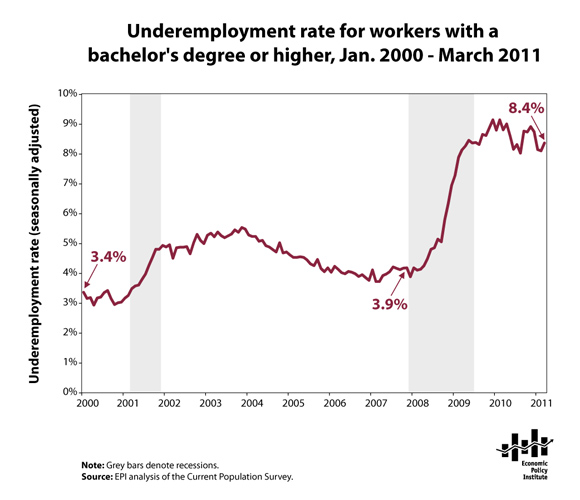
So Much For The Skills Mismatch
The Economic Policy Institute points out that the underemployment rate among workers with at least a four-year college degree now stands at 8.4 percent. Since 2000, the underemployment rate among this population has more than doubled.
Improving Corporate Taxes
The N.C. Budget and Tax Center argues for the adoption of “combined reporting” as a way of improving the state’s corporate tax code.
Large corporations are able to take advantage of tax shelters because most are structured as parent corporations that each own many separate subsidiary corporations in states across the country. Without combined reporting, multi‐state corporations are able to shift income earned in one state to related corporate subsidiary in a state without a corporate income tax or with special corporate tax exemptions.
…
What combined reporting does is require parent corporations and their subsidiaries to “combine” for state tax purposes to file a joint tax return. The profits of the combined corporation are then apportioned by formula to each state in which the corporation does business according the share of total business activity located in each state.
…
As economist Charles McClure, senior fellow at the conservative Hoover Institution and former Deputy Assistant Secretary of the Treasury under President Reagan puts it, “failure to require unitary combination [i.e. combined reporting] is an open invitation to tax avoidance.” And when multi‐state corporations are able to avoid paying taxes, locally‐owned businesses and residents must make up the difference to pay for the public investments that benefit all businesses and residents in North Carolina.
 Email Sign-Up
 RSS Feed