

NC Budget: Economic Impact Edition
The N.C. Budget & Tax Center estimates that the recently enacted state budget will result in the statewide loss of 30,000 jobs over a two year period. From the analysis …
Taken together, the net effects of the tax cut package and budget cuts demonstrate that the proposed budget in its entirety will negatively impact the North Carolina economy. By FY 2012‐13, this budget will cost the state a cumulative 29,782 jobs, $1.2 billion in lower wages, and $2.3 billion in lost industry output.
Around The Dial – June 22, 2011
Economic policy reports, blog postings, and media stories of interest:
- Martin Wolf contrasts the British and American labor markets.
- Simon Tilford explains the “competitiveness trap.”
- Naked Capitalism debunks myths about “the foreclosure system.”
- The American Constitution Society explains the Boeing case before the NLRB.
- Mark Everson explains the role lawyers and accountants played in the crisis.
- Felix Salmon wonders how much money international banks have at risk in Greece.
Jobs, Jobs, Jobs
Economist’s View argues that, regardless of the cause, “jobs, jobs, jobs is part of the answer.”
…The longer people are unemployed, the higher the chance of them dropping out of the labor market permanently. Workers close to retirement will find a way to hang on for a few years by living with family, doing odd jobs, etc., and their experience and skills will go to waste. Younger workers tend to drop out, or work in the underground job market, e.g. doing construction outside of the formal job market. Or they take whatever job they can get and then buy a car, a house, have a kid, etc. and get stuck in a job that does not make full use of their capabilities. They are part of the long-term under-employed. We are all worse off when this happens. The point is that long-term unemployment causes the labor force to erode in both numbers and skill, and that is costly to society. Simply keeping workers connected to the labor market with a job of any type — doing things the community needs for example — avoids the erosion of the workforce and the negative consequences (lower economic growth rate) that come with it.
…
Thus, contrary to what you sometimes hear, we can help the structurally unemployed through job creation. Those who insist, contrary to the evidence, that the problem we face right now is mostly structural cannot use this to argue against a job creation program. In fact, since increasing demand is unlikely to work in the case of structural unemployment in the way it will for a cyclical problem, there is a sense in which the argument for job creation to bridge the long adjustment gap is even more compelling when the problem is structural.
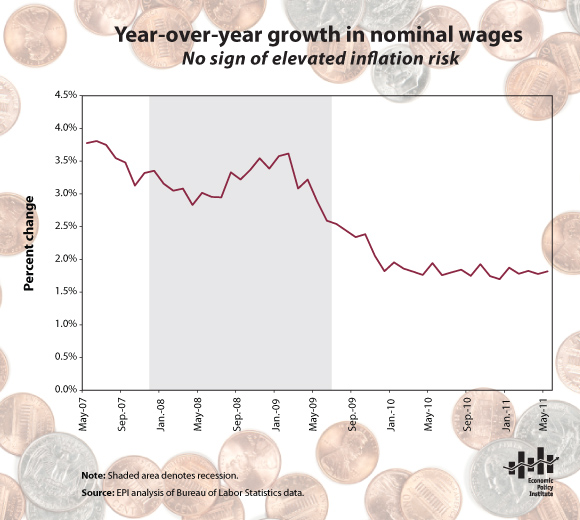
Still Not Rising
The Economic Policy Institute points out that hourly wages are not rising, meaning that the risk of inflation is subdued. In fact, nominal wages are lower now than they were in May 2007.
Around The Dial – June 21, 2011
Economic policy reports, blog postings, and media stories of interest:
- Katrina vanden Heuvel speaks out “for good jobs.”
- Jared Bernstein explains the “misleading Medicare mantra.”
- FedWatch describes a “Fed on the sidelines.”
- Economix discusses “the economics of enough.”
- Naked Capitalism diagnoses “financial schizophrenia.”
 Email Sign-Up
 RSS Feed