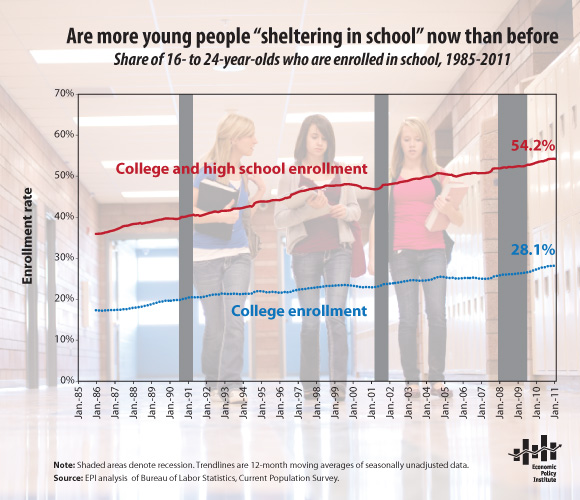
Not Much Shelter From The Storm
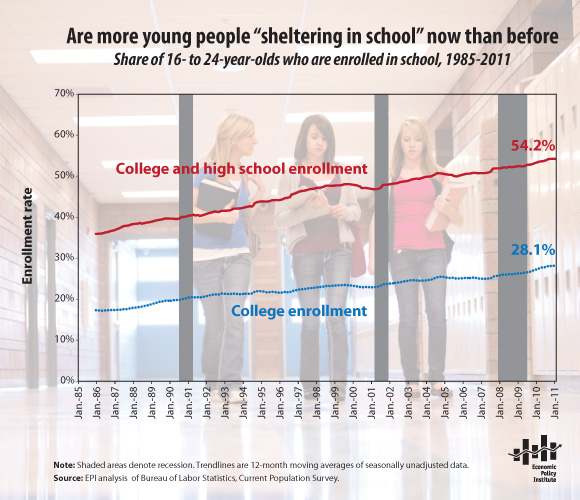
The Economic Policy Institute finds that young adults (ages 16-24) are not using higher education as a safe harbor to ride out the storm of the recession.
Around The Dial – 4/20/11
Economic policy reports, blog postings, and media stories of interest:
- The News & Observer reports on workers cut off from unemployment benefits.
- Jonathan Cohn debunks another false policy equivalence.
- TaxVox revisits the debate over marriage tax penalties or bonuses.
- Ezra Klein points out that budget history didn’t start in 2010.
No Real Bargain In The Works
Elizabeth Drew of The New York Review of Books doesn’t see a “Grand Bargain” as realistic outcome to the budget debate.
But the fact that such a huge fight occurred over spending for a mere twelve percent of the federal budget for just the remaining six months of this fiscal year was absurd. It was a situation made for political drama (and hoked-up television), since if an agreement hadn’t been reached by midnight, the federal government would have had to shut down. The fight over this spending bill was the budgetary Spanish Civil War: both sides were testing their skills and their weapons—and each other.
—
This relatively minor skirmish, in comparison to the ones that were to come, was nevertheless revealing about how Obama handles his role in shaping domestic policy with a divided Congress, one chamber dominated by conservative true believers. Tea Party members and other freshmen elected with its strong backing, were originally written off (and laughed at) as political amateurs, but, with the help of senior colleagues who joined up with them out of shared beliefs or opportunism, they ended up dominating the new Congress’s agenda, partly by default on Obama’s part. The Tea Party turned out to be a formidable political force because they are amateurs, inflexible and uncompromising.
Ideology vs. Principles
Writing in The New Yorker, George Packer differentiates between ideology and principles.
A decade and a half after Clinton and Gingrich, Republicans are once again trying to privatize Medicare, gut Medicaid (by turning it into block grants), cut education spending and regulations that protect the environment, and give yet another round of tax cuts to the rich. They continue to insist—despite years of evidence to the contrary—that market forces will lower health-care costs and that tax cuts will create economic growth and lift all incomes. “Ideology makes it unnecessary for people to confront individual issues on their individual merits,” the late Daniel Bell wrote. “One simply turns to the ideological vending machine, and out comes the prepared formulae.” Ideology knows the answer before the question has been asked.
…
Principles are something different: a set of values that have to be adapted to circumstances but not compromised away. Last week, the President remembered that he was a Democrat and gave a speech at George Washington University articulating his and his party’s vision of the positive role of government: “a belief that we’re all connected, and that there are some things we can only do together, as a nation.” He praised social-insurance programs, saying, “We’re a better country because of these commitments. I’ll go further. We would not be a great country without those commitments.” For once, he seemed eager to join a fight and draw clear lines.
Around The Dial – 4/19/11
Economic policy reports, blog postings, and media stories of interest:
- Mother Jones rounds up some nifty tax charts.
- E.J. Dionne thinks America’s elite have lost their way.
- Paul Krugman isn’t much for being civil.
- Economist’s View rounds up reactions to the S&P outlook.
- David Weigel traces the history of a talking point.
- Jonathan Chait sees crazy people everywhere.
 Email Sign-Up
 RSS Feed