

ARRA and Low-Income Families
A recent policy brief from the Center for Law and Social Policy reviews the impacts that selected provisions of the American Recovery and Reinvestment Act have had on low-income workers and families. Below are summaries of two provisions of interest to readers of Policy Points.
The Workforce Investment Act
The Recovery Act provided $2.95 billion for the Workforce Investment Act (WIA) Adult, Youth and Dislocated Worker employment and training programs, including $500 million for Adults, $1.25 billion for Dislocated Workers and $1.2 billion for summer jobs and youth activities. The legislation boosted the level of training and services to those affected by the recession and set new policy priorities.
…
Effects for Adults: More than 8 million adults and dislocated workers received a range of employment and training services in 2009-2010.1 More than two-thirds (69.6 percent) of adults and more than three-2quarters (75.6 percent) of dislocated workers who entered education and training landed jobs, despite a difficult labor market.
Unemployment Insurance
The Recovery Act expanded and extended unemployment insurance benefits for individuals who lost jobs through no fault of their own during a deep economic recession. Individuals who exhausted regular state benefits (typically after 26 weeks) were eligible for a federally funded extension of benefits. In addition, a $25 weekly benefit was made available to all individuals receiving regular state benefits. As a result of the Recovery Act enhancements, 1.3 million Americans did not fall below the poverty line during 2009.
…
The Recovery Act also provided up to $7 billion in incentive payments for state adoption of laws expanding access to benefits for low-wage workers, part-time workers and workers who leave jobs for compelling family reasons, such as domestic violence. More than 200,000 additional unemployed workers are likely to have access to the unemployment insurance system as a result of the Recovery Act provisions.
Around The Dial – March 11
Economic policy reports, blog postings, and media stories of interest:
- E.J. Dionne mulls the political lessons from Wisconsin.
- The Washington Post reports on the number of “failing” schools.
- The Baseline Scenario ponders the state of big European banks.
- Off the Charts projects state budget shortfalls.
- Paul Krugman is tired of “dumbing deficits down.”
Tax Sense
James Galbraith of the University of Texas testifies before Congress about “sensible tax reform.”
Tax law serves two broad goals: the regulation of effective demand and the pursuit of public purpose. The Tax Reform Act of 1986 was gave us an income tax structure that is viable for the long run. But its purposes are not ours. We face four pressing priorities: to create jobs, to change how we produce and use energy, to restructure our financial sector, and to curtail the pernicious power of a small number of wealthy persons – our new American oligarchs – who have taken undue advantage of past tax reforms. A shift of the tax burden away from labor, onto energy, and onto accumulated wealth – with the philanthropic escape clause – would help give us back a healthier, more egalitarian, and more democratic society in future years.
Unbalanced Job Growth
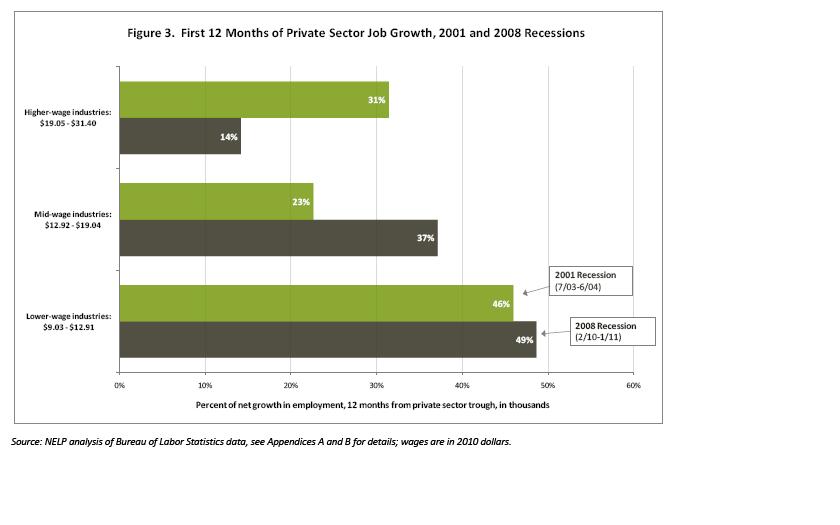
A policy brief from the National Employment Law Project find that the job losses that occurred during the “Great Recession” were skewed towards high- and mid-wage industries, while recent job growth has occurred primarily in low-wage industries. In fact, 49 percent of recent job growth has occurred in industries that pay less than $12.91 per hour.
The figure below compares the distribution of private-sector job growth by industry during the first 12 months following the two most recent recessions.
Around The Dial – March 10
Economic policy reports, blog postings, and media stories of interest:
- Robert Reich notes that Wall Street’s good fortune isn’t spreading.
- TaxVox revisits “the battle over Internet sales taxes.“
- Rortybomb breaks down issues in the interchange fee debate.
- David Leonhardt weighs the conflicting pressures on the economy.
- Harold Meyerson asks where the economic recovery is.
 Email Sign-Up
 RSS Feed