

Financial Aid For Community College Students
A new research report from the N.C. Budget and Tax Center lays out options for improving the quality and quantity of financial aid available to working adults enrolled in community college programs. From the report …
While tuition at community colleges in North Carolina remains low relative to other states, it increased by 17.6 percent from 2004-2005 to 2009-2010. Over that same period the total investment in the grant and scholarship programs for community college students remained steady from 05-06 at $14 million. However, the N.C. Community College Grant saw a 65 percent increase in the inflation-adjusted dollars awarded. And due to the increase in the number of eligible recipients for that program, the inflation-adjusted average grant from this program actually declined over the same period.
…
North Carolina distributed more than$414.9 million in state-based financial aid including grants, scholarships and loans in 2008-2009, 15 percent of which went to community college students.
Around The Dial – Feb. 11
Economic policy reports, blog postings, and media stories of interest:
- Rortybomb explains why the current economy is good for big business.
- Off the Charts explains how to fix unemployment insurance financing.
- EPI warns against “throwing more workers overboard.”
- The PBS NewsHour discusses how Katrina changed New Orleans.
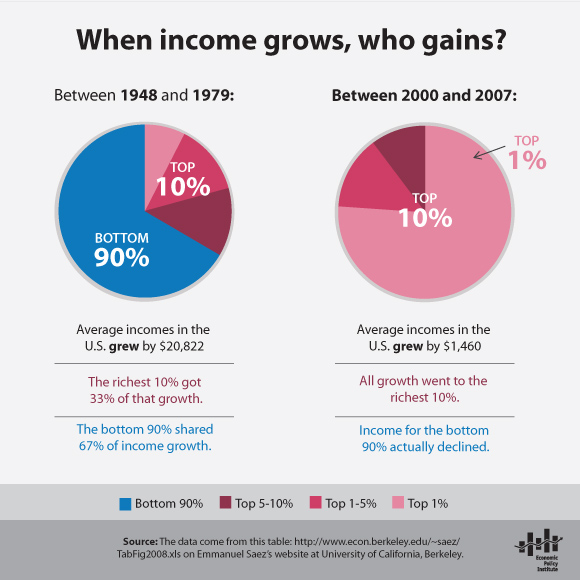
Who Gains From Income Growth?
The Economic Policy compares the distribution of income growth between two periods: 1948-1979 and 2000-2007. Over time, the distribution of income growth has become extremely lopsided.
Is Higher Eduction Being Oversold?
Writing in The American Prospect, Lawrence Mishel of the Economic Policy Institute argues that a better-educated workforce is not a cure-all for economic problems.
The huge increase in wage and income inequality over the last 30 years was not caused by a skills deficit. Rather, workers face a “wage deficit.” The key challenge is to provide good jobs and re-establish the basis for wages and compensation to grow in tandem with productivity, as they did before 1979.
…
We do need more investment in education at all levels, so that the children of the working class have a better opportunity to compete for good jobs. We also need what Europeans call an active labor-market policy, so that the money we invest in training is directly connected to re-employment at good wages, rather than operating in a vacuum.
…
The nation’s productivity increased by 80 percent from 1979 to 2009, and good productivity growth can be expected in the future. It is not education gaps that have caused nearly all of those gains to be captured by the top but rather economic policies that redistributed economic and political power.
Around The Dial – Feb. 10
Economic policy reports, blog postings, and media stories of interest:
- Mark Schmitt argues that the South needs Democrats.
- Robert Reich thinks the attack “on ‘job-killing’ regulations is dumb.”
- Economix shows the inflation debate in one picture.
- TaxVox wonders what to do with its payroll tax cut.
- Random Samplings looks at the fast growth of black-owned businesses.
 Email Sign-Up
 RSS Feed