

Manufacturing In The South Atlantic: Jan.
From the Federal Reserve Bank of Richmond’s latest survey of manufacturing activity in the South Atlantic (District of Columbia, Maryland, North Carolina, South Carolina, Virginia and West Virginia):
Manufacturing activity in the central Atlantic region expanded for the fourth straight month, according to the Richmond Fed’s latest survey. Looking at the main components of the overall index, shipments and new orders grew more slowly, while employment growth held steady. Other indicators varied but suggested continued solid activity. Manufacturers reported that backlogs grew at a slightly slower pace and that increases in capacity utilization and delivery times eased somewhat, while finished goods inventories grew at a somewhat slower rate.
…
Looking forward, manufacturers’ optimism remained in place in January. Survey contacts at more firms looked for steady growth in shipments, new orders, backlog of orders, and capacity utilization in the next six months.
Around The Dial – Jan. 28
Economic policy reports, blog postings, and media stories of interest:
- Brad DeLong seeks “intelligent economic decline.”
- Tapped explains why you should “love the postal service.”
- Economix shows who “wins and loses” under the corporate tax code.
- Off the Charts looks at the state budget picture.
- Economist’s View runs down the weekly unemployment claims data.
4th Quarter GDP: Up, But Not Up Enough
Free Exchange offers an initial overview of the advance GDP report for the 4th Quarter of 2010.
… Well, given the size of the output gap—for now, about $800 billion separates actual and potential real output—the economy should be growing faster. For 2010 as a whole, output expanded by 2.9%. That’s the fastest growth since 2005, but at this point in the early 1990s business cycle annual growth was up (despite a smaller output gap) at a 3.4% pace, and at this point in the early 1980s cycle annual growth was roaring ahead at 4.5%. Current growth is consistent with a painfully slow reduction in the unemployment rate. Forecasters anticipate a further acceleration in 2011, perhaps to an annual rate near 4%. The jobless can only hope such predictions come true.
Reducing American Poverty
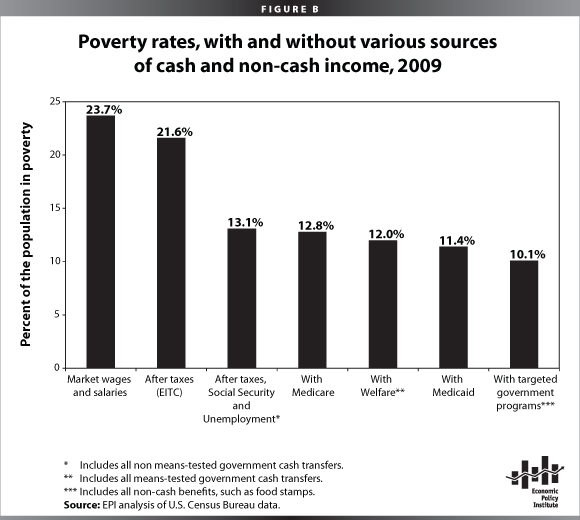
A brief from the Economic Policy Institute compared the share of the Americans living in poverty in 2009 to what the share would be if the benefits provided by various programs were included. As the graph below shows, Social Security is the nation’s most important anti-poverty program.
Around The Dial – Jan. 27
Economic policy reports, blog postings, and media stories of interest:
- Economix asks “where the union members are.”
- Calculated Risk runs down the latest FOMC statement.
- Free Exchange finds “winning the future” to be an empty phrase.
- Rortybomb wonders how we “forgot full employment.”
 Email Sign-Up
 RSS Feed