Modest Progress on The Jobs Front
CHAPEL HILL (January 7, 2010) – The national employment situation improved somewhat in December, as employers added 103,000 more payroll positions than they eliminated. While that gain contributed to a fall in unemployment, a troubling drop in the size of the labor force accounted for almost half of the decline.
“The December employment report was a somewhat positive one,” said John Quinterno, a principal with South by North Strategies, Ltd., a research firm specializing in economic and social policy. “While total payroll employment rose due to some private-sector hiring in a few industries, the gain was far short of the level needed at this point in the recovery.”
In December, the nation’s employers added 103,000 more payroll positions than they cut. Gains occurred exclusively in the private sector (+113,000), while government payrolls fell by 10,000 positions due chiefly to cuts at the local level (-20,000). Additionally, the payroll employment numbers for October and November were revised upwards; with the revisions, the economy gained 281,000 jobs over those two months rather than the 211,000 positions previously reported.
Private-sector gains in December occurred almost entirely in leisure and hospitality services (+47,000, mainly in the food services sub-industry) and education and health services (+44,000). Private-sector losses occurred in construction (-16,000) with all other private-industry groups experiencing few or no changes in December.
“The December employment report offered little evidence that a robust jobs recovery is taking hold across the county,” noted Quinterno. “The current pace of growth, while positive, will not produce the jobs needed to accommodate all those Americans who want work.”
Weak conditions were reflected in the December household survey. Last month, 14.5 million Americans (9.4 percent of the labor force) were jobless and seeking work. While the number of unemployed Americans and the unemployed rate fell last month ( -556,000 positions and -0.4 percentage points, respectively), the share of the population participating in the labor force (64.3 percent) reached the lowest level recorded since the early 1980s. In December, some 260,000 Americans simply left the labor market.
Last month, proportionally more adult male workers were unemployed than female ones (9.4 percent vs. 8.1 percent). Similarly, unemployment rates were higher among Black (15.8 percent) and Hispanic workers (13.0 percent) than among White ones (8.5 percent). The unemployment rate among teenagers was 25.4 percent. With the exception of teenagers, unemployment rates for every major demographic group were lower in December than in November.
Furthermore, 8.3 percent of all veterans were unemployed in December; the rate among recent veterans (served after September 2001) was 11.7 percent.
“The job market ended 2010 on a mixed note,” added Quinterno. “While net job growth was positive and was boosted by upward revisions to previous months’ estimates, reductions in public sector payrolls are weighing on the job market. Especially worrying is the fact that a smaller share of the civilian population is participating in the labor force, as many Americans unable to find positions have abandoned the job market altogether. That was an important reason why the unemployment rate fell in December.”
Jobs remained difficult to find in December. Last month, the underemployment rate equaled 16.7 percent. Among unemployed workers, 44.3 percent had been jobless for at least six months with the average spell of unemployment lasting for 34.2 weeks.
“The December employment report offers much proof that the labor market is not healing itself,” observed Quinterno. “The modest pace of growth is too sluggish to reverse the problem of joblessness, especially long-term joblessness. Unless more attention is paid to the problem and more aggressive action taken, millions of Americans run the risk of being pushed permanently out of the job market.”
The State of America’s Low-Income Working Families
Earlier this week, the CSPAN program Washington Journal discussed the findings of a new report on the state of America’s low-income working families prepared by The Working Poor Families Project. The show highlighted many of the diverse and controversial views regarding work and opportunity possessed by Americans.
Around The Dial – Jan. 6
Economic policy reports, blog postings, and media stories of interest:
- Economix puts governmental pay in perspective.
- Free Exchange visits “Richistan.”
- Slate wonders if economists are jerks.
- Politico reports on rising Medicaid caseloads.
- The Baseline Scenario asks why taxpayers subsidize Facebook.
NC Unemployment Claims: Week of 12/18
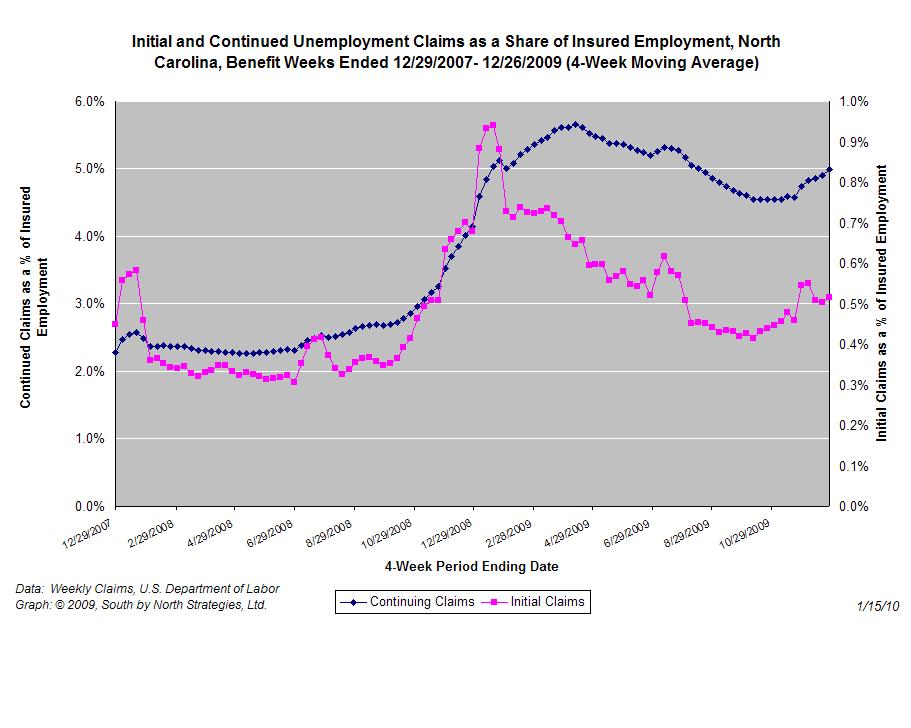
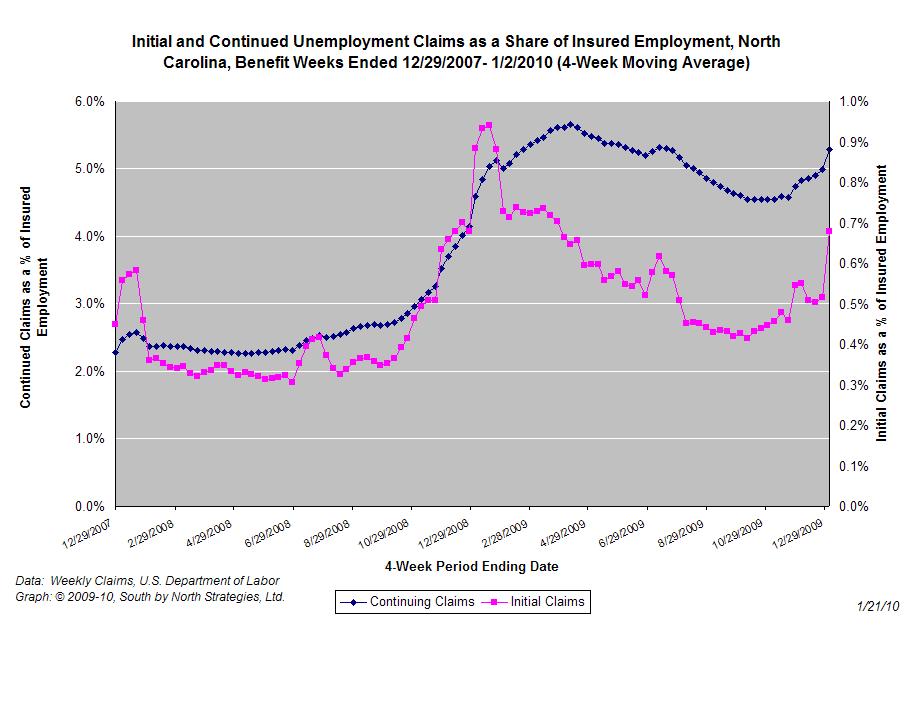
For the benefit week ending on December 18th, 18,503 North Carolinians filed initial claims for state unemployment insurance benefits, and 129,937 individuals applied for state-funded continuing benefits. Compared to the prior week, there were more initial and continuing claims. These figures come from data released by the U.S. Department of Labor.
Averaging new and continuing claims over a four-week period — a process that helps adjust for seasonal fluctuations and better illustrates trends — shows that an average of 18,738 initial claims were filed over the previous four weeks, along with an average of 129,498 continuing claims. Compared to the previous four-week period, there were more initial and continuing claims.
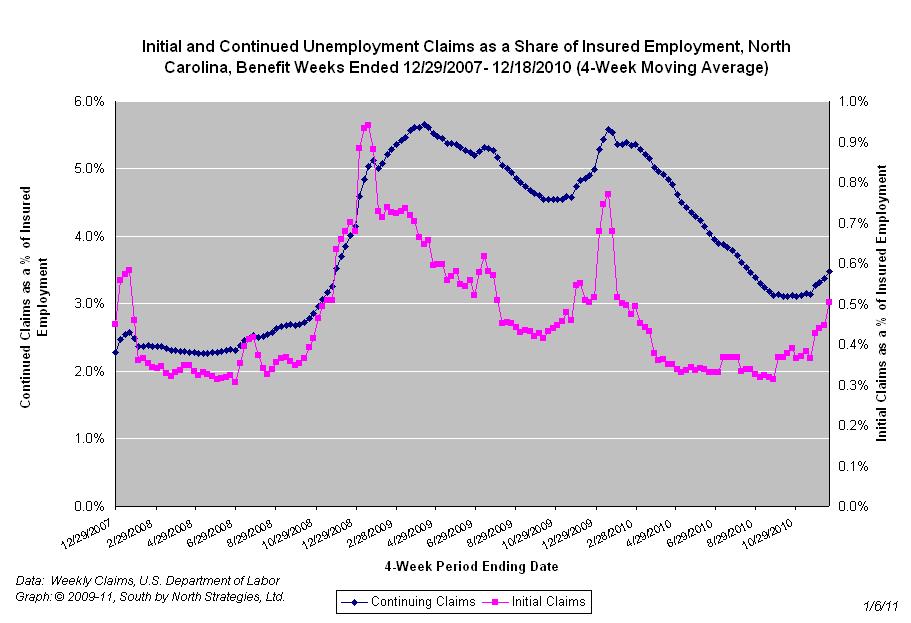 One year ago, the four-week average for initial claims stood at 19,954 and the four-week average of continuing claims equaled 193,955.
While the number of claims has dropped over the past year, so has covered employment. Last week, covered employment totaled 3.7 million, down from 4 million a year ago.
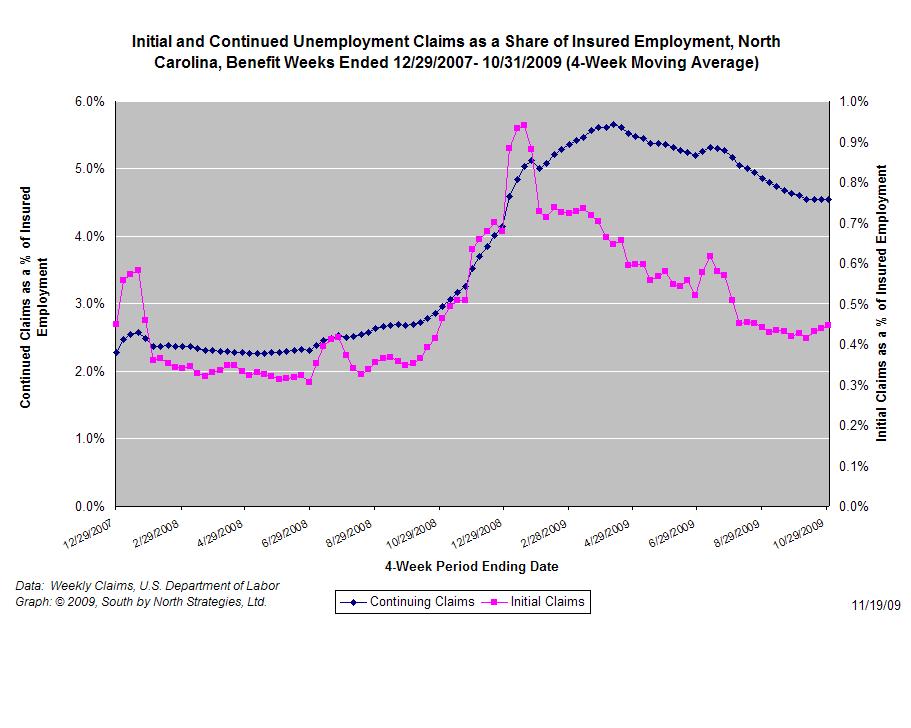
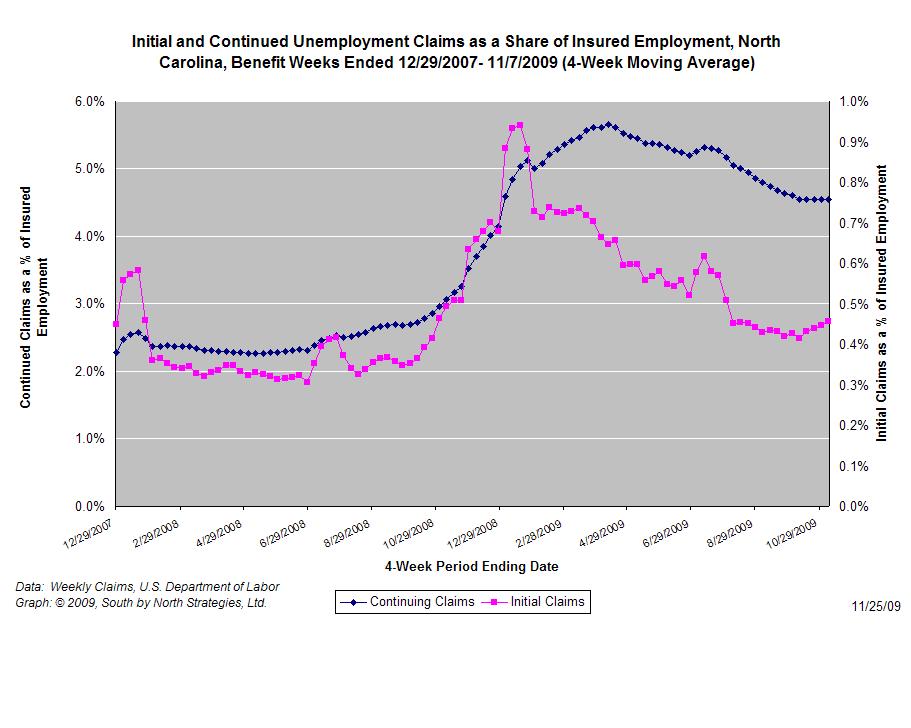
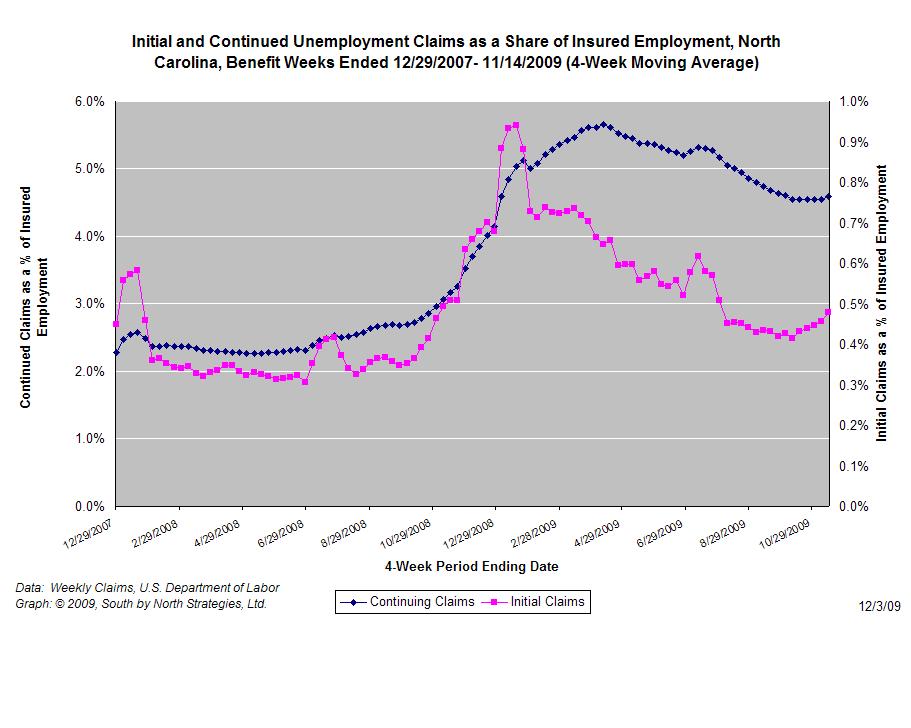
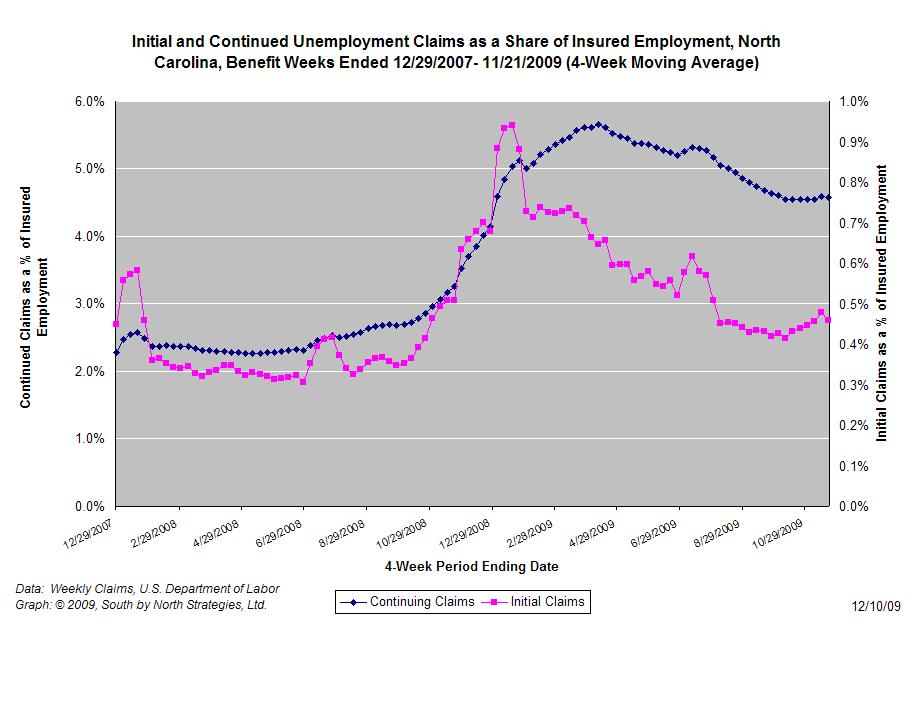
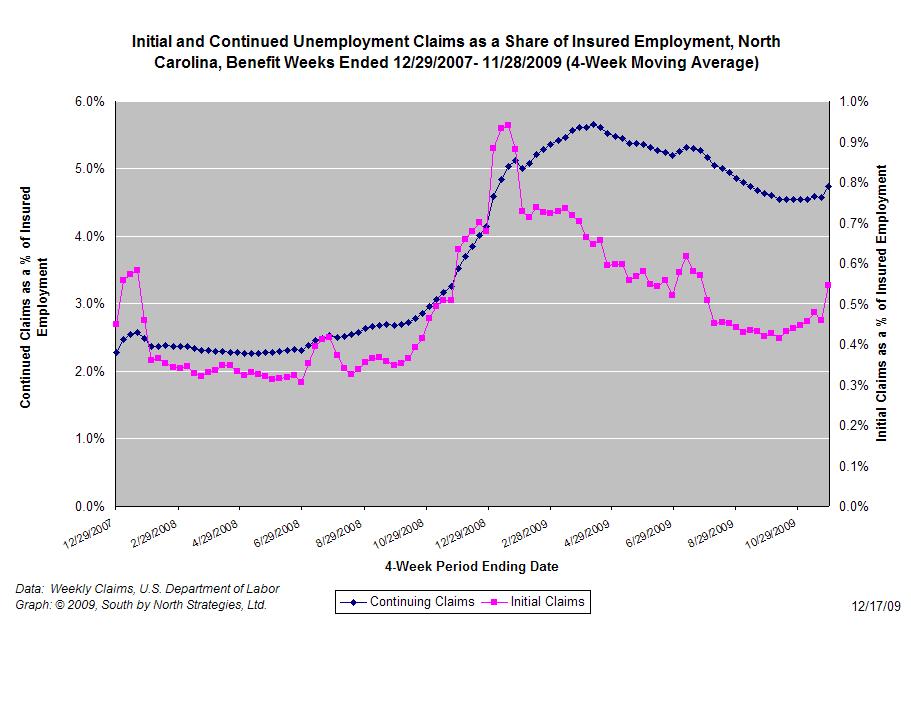
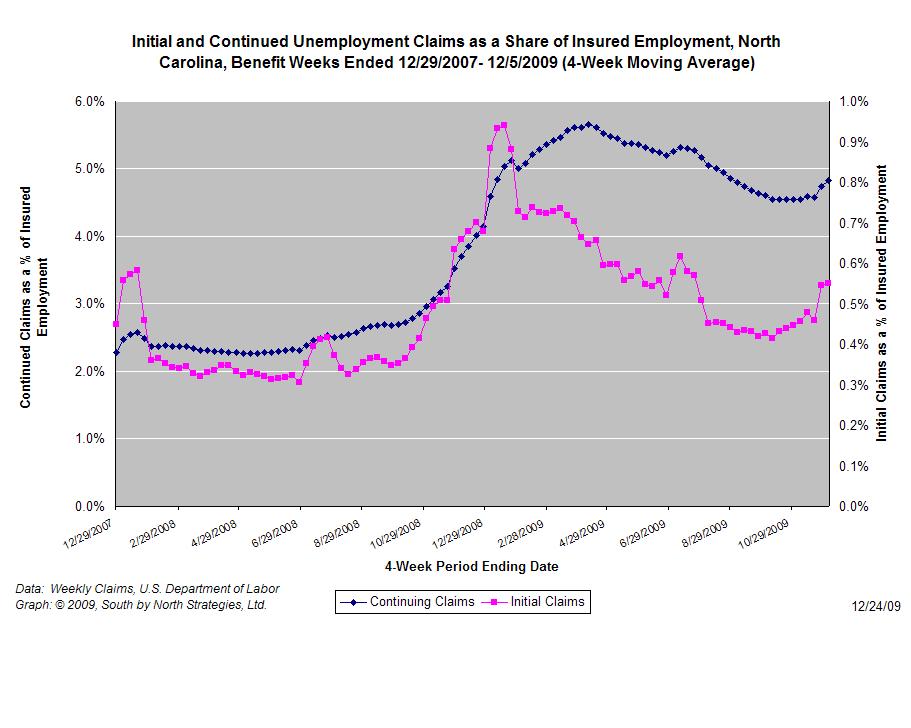
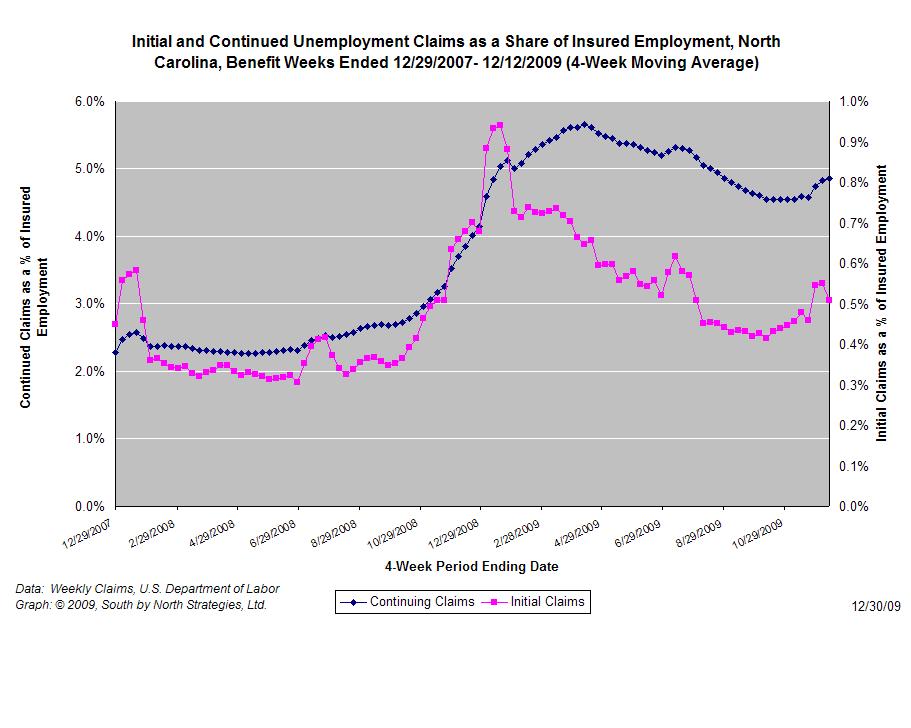
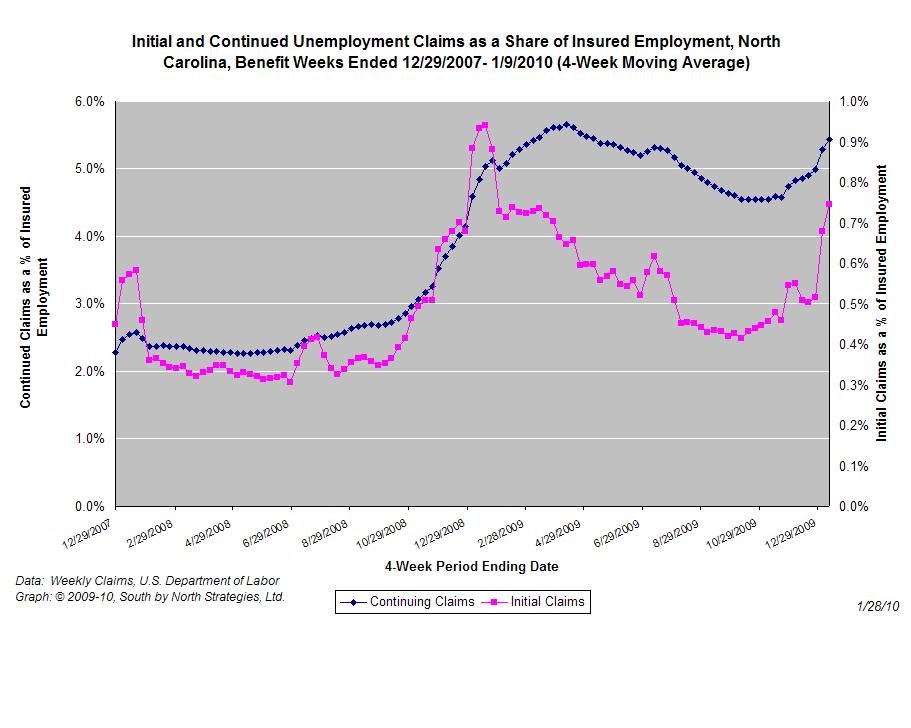
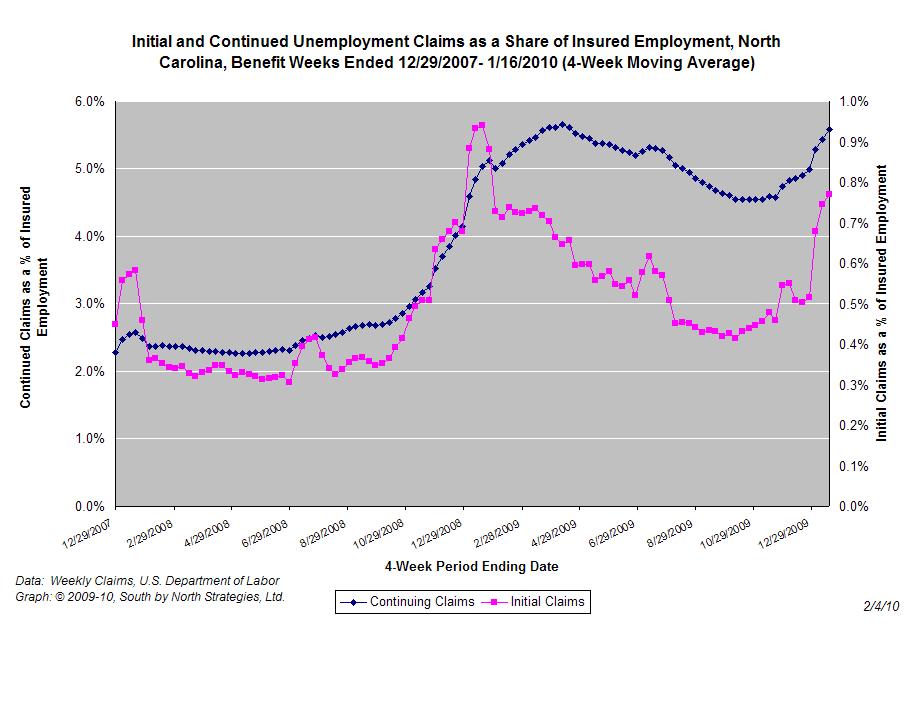
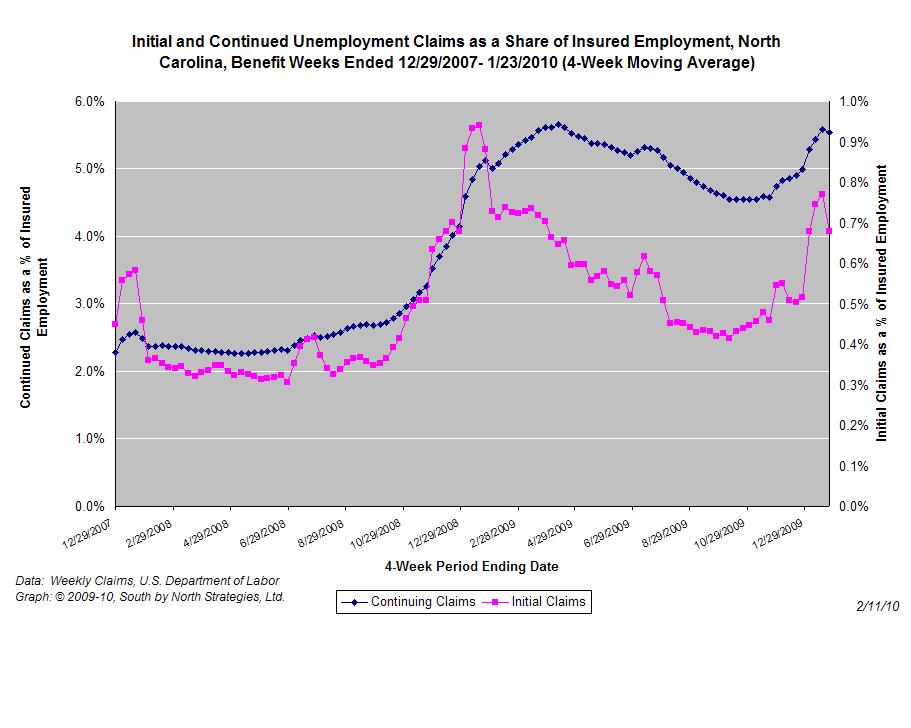
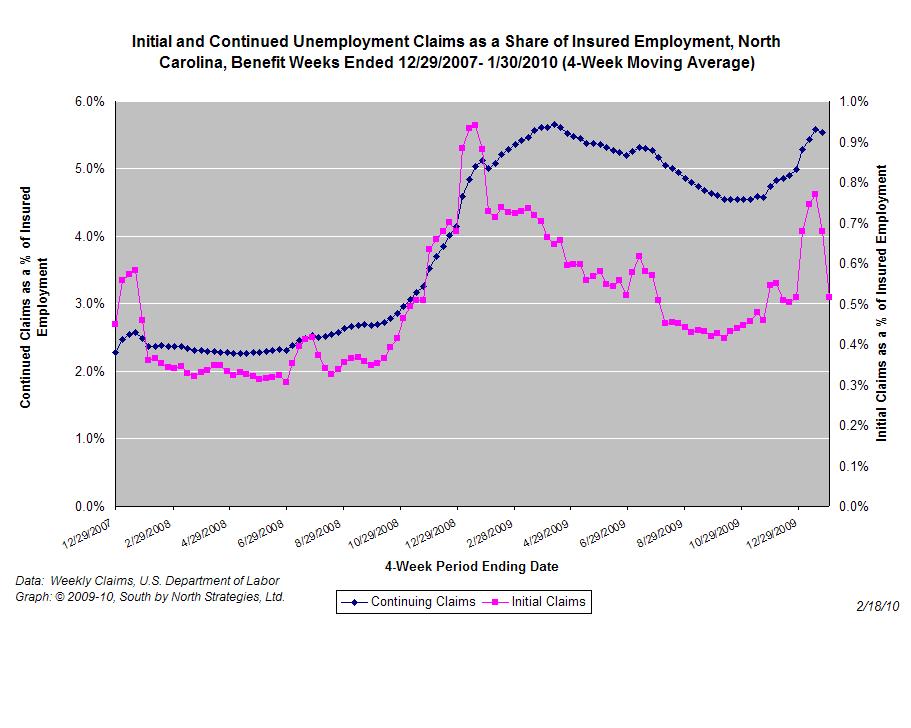
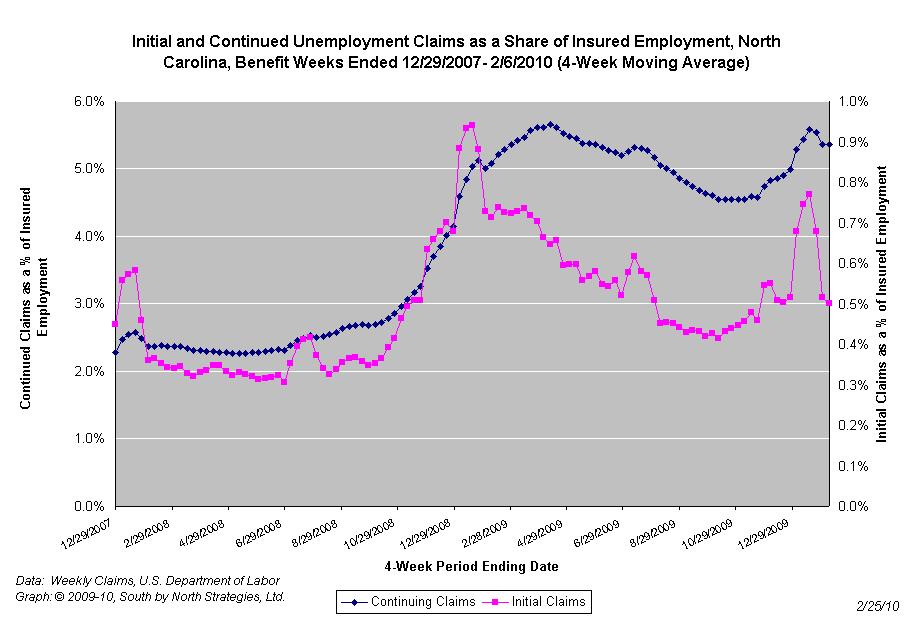
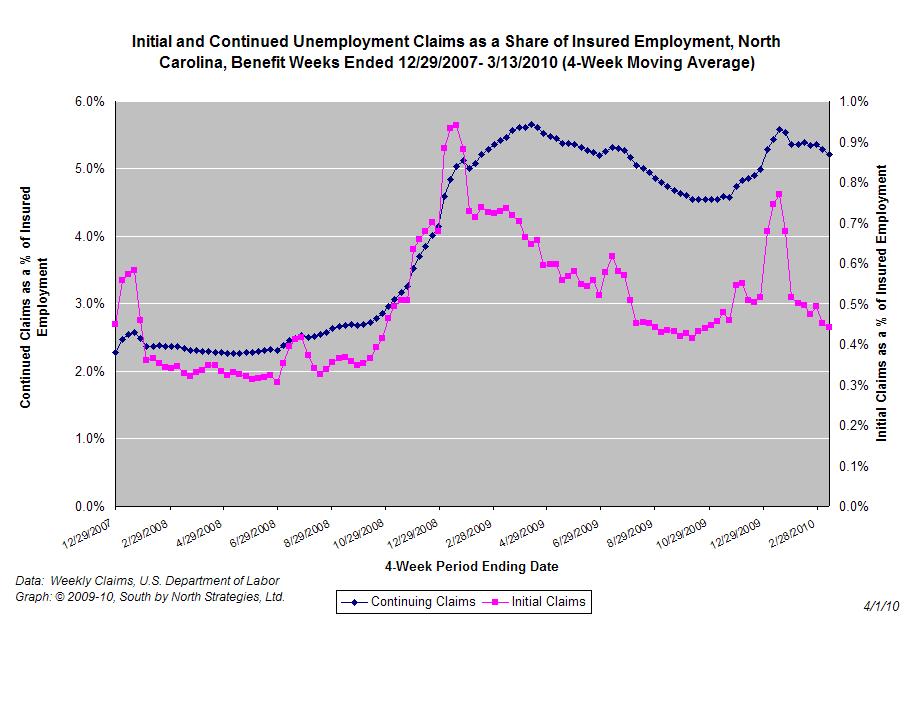
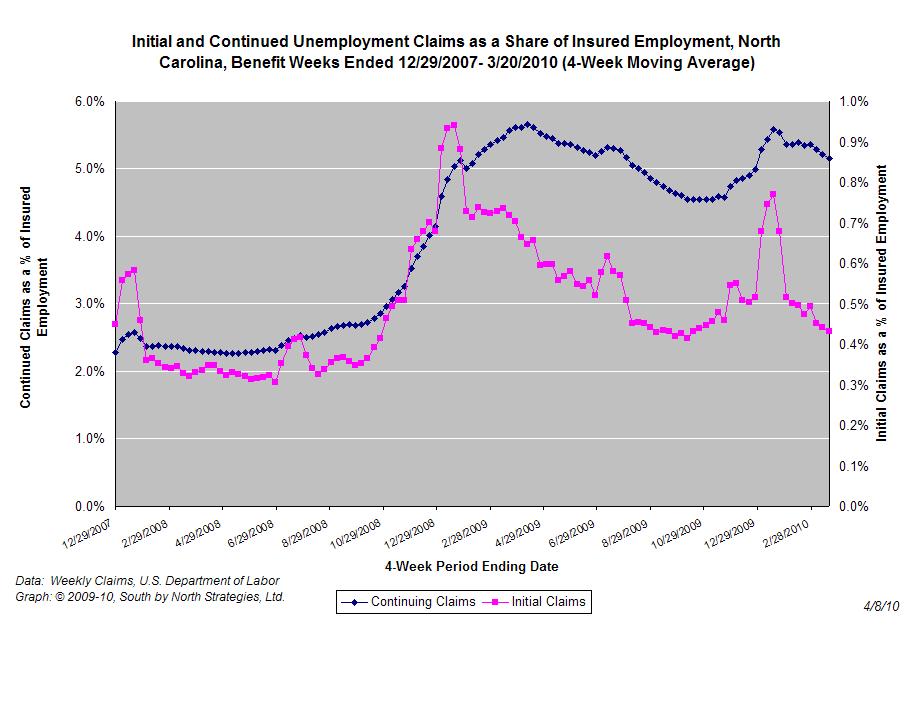
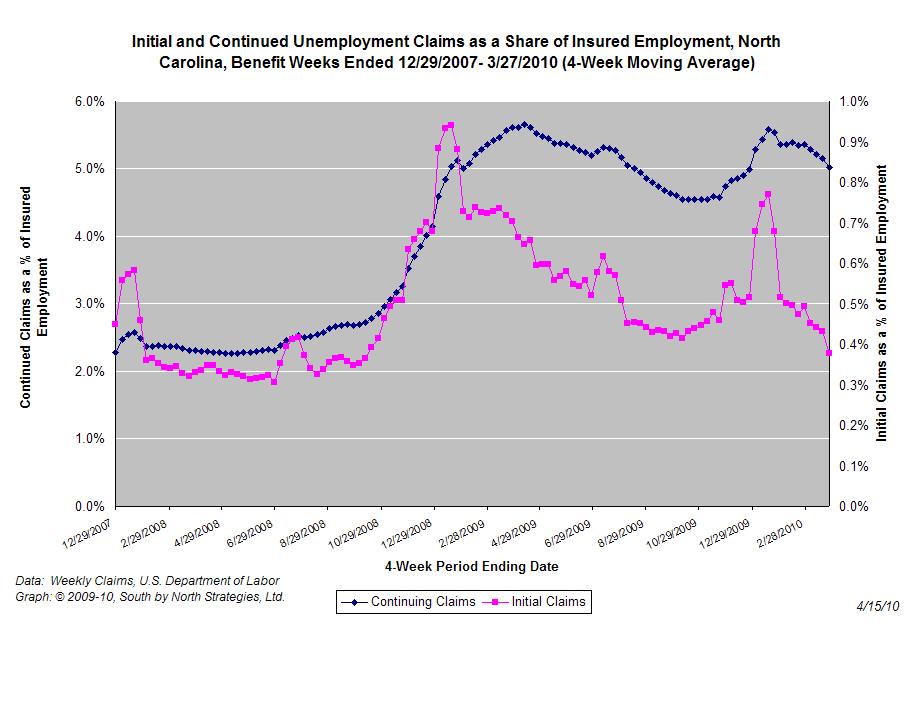
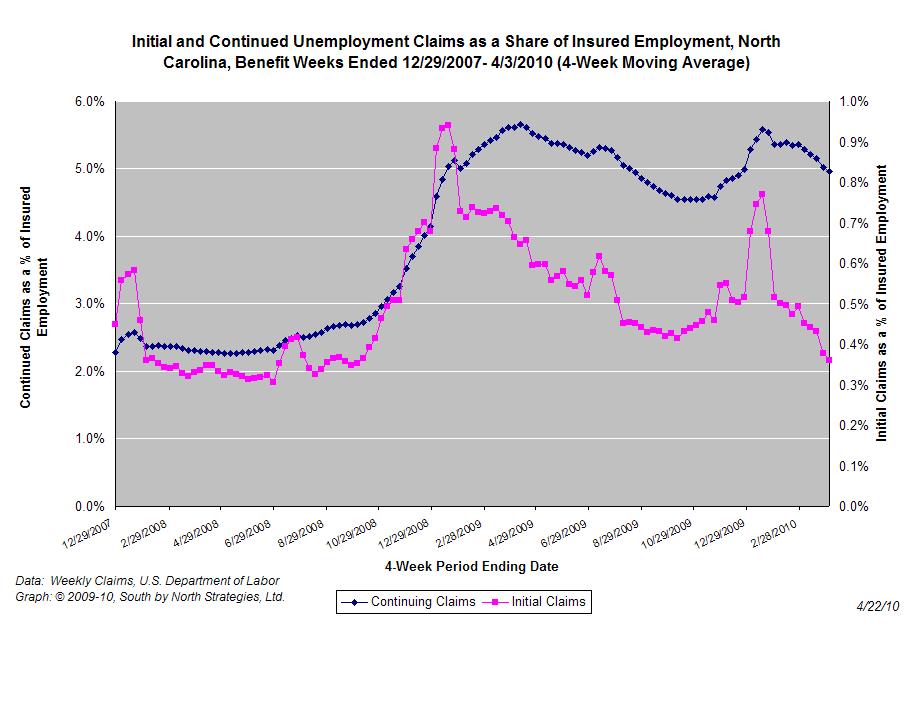
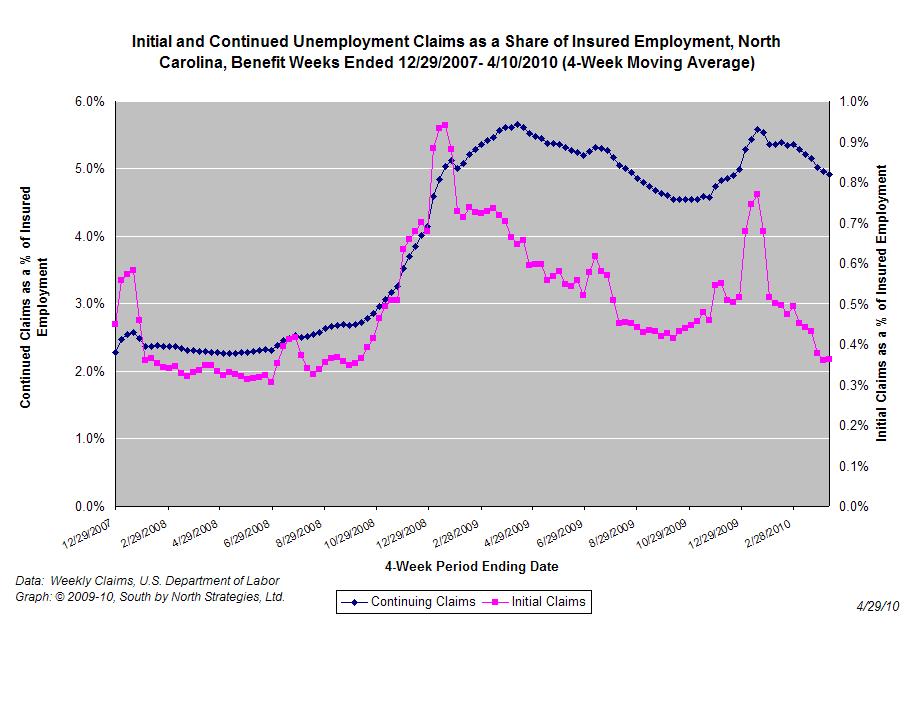
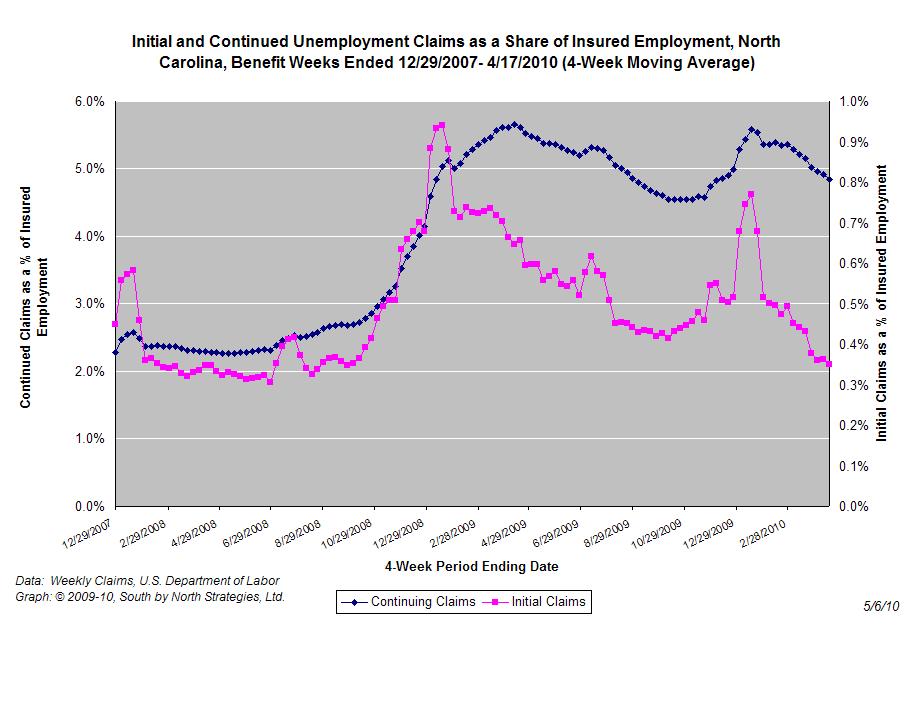
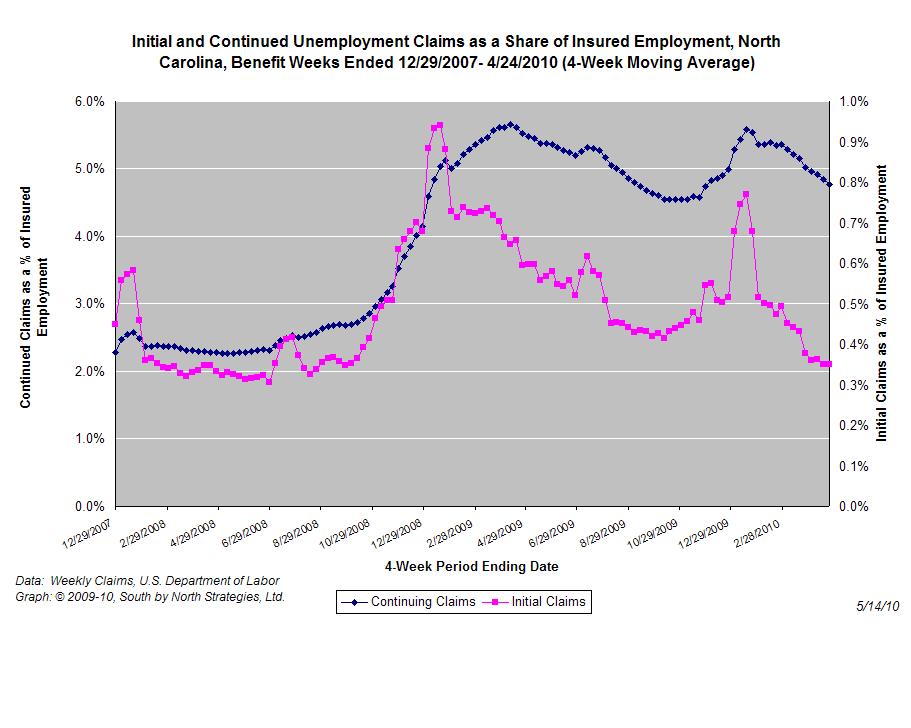
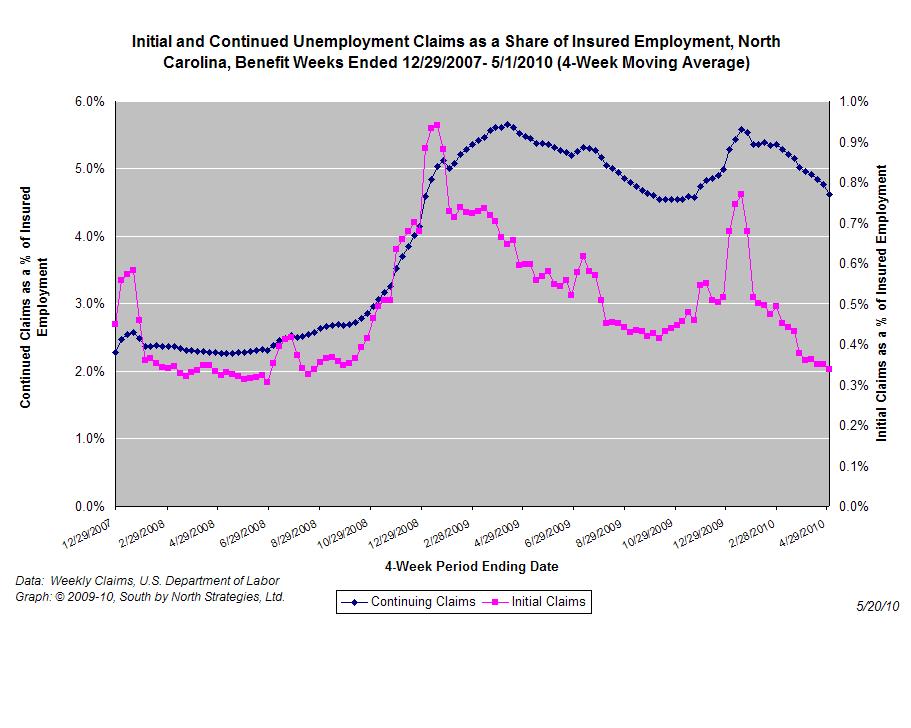
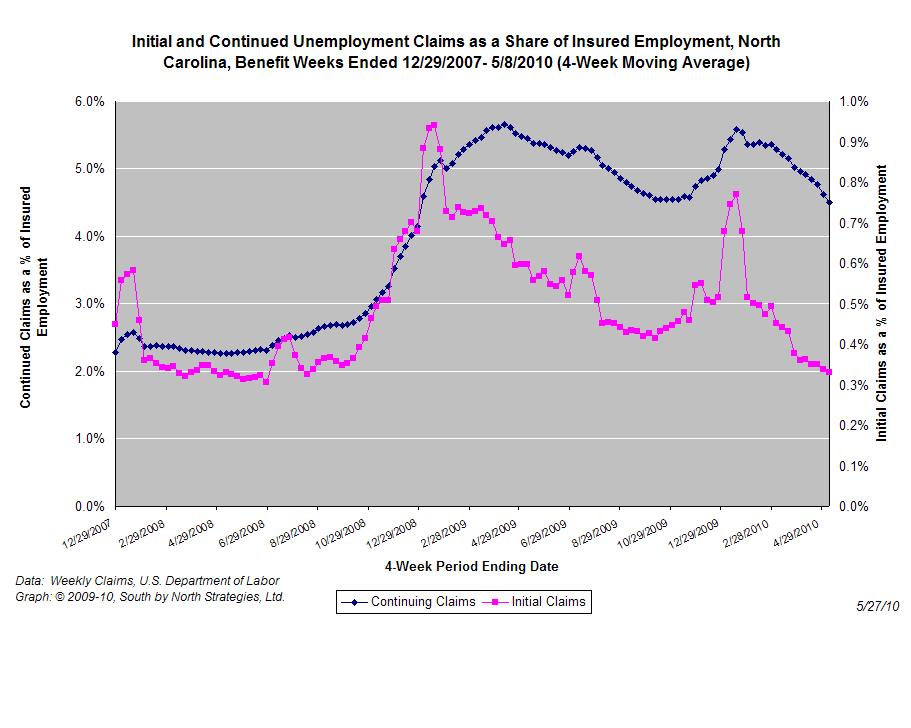
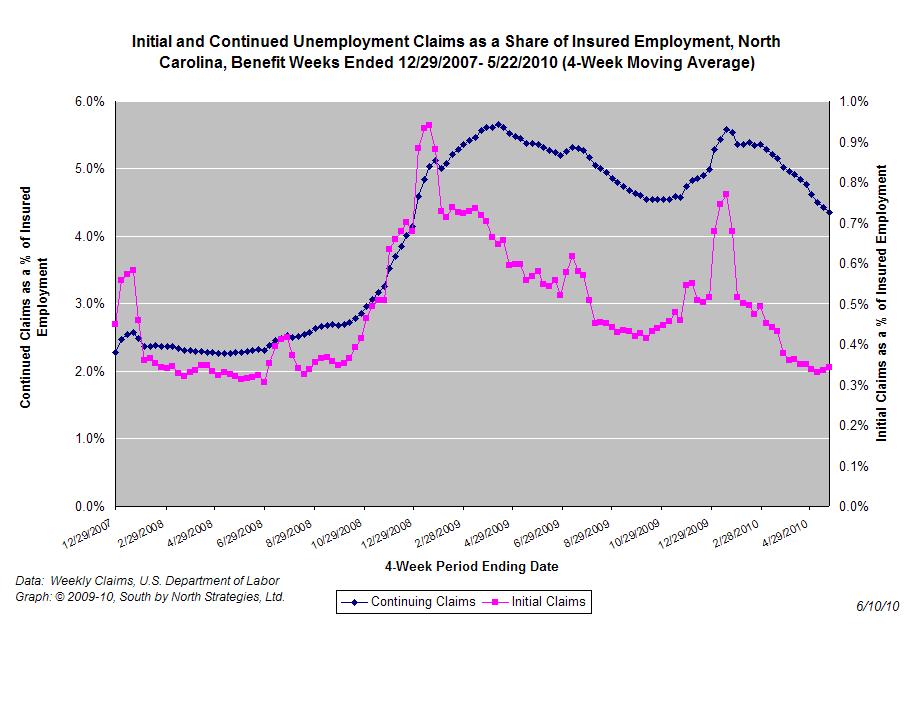
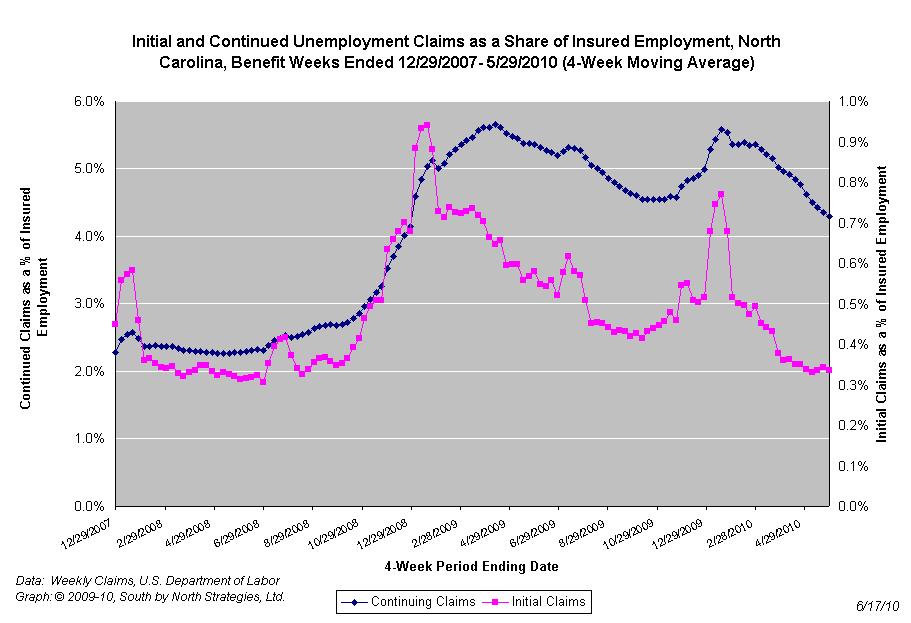
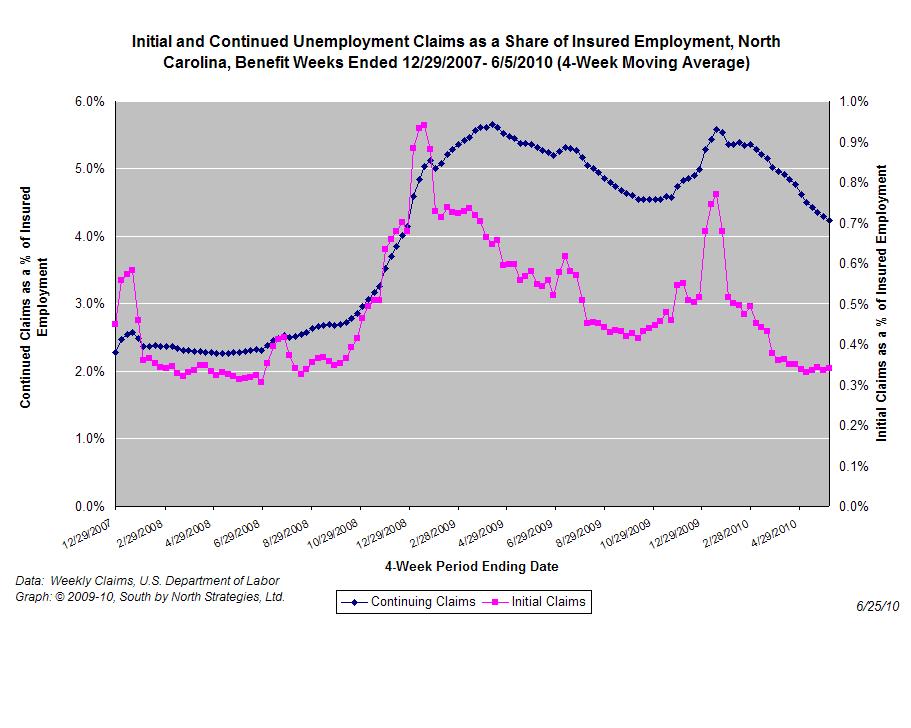
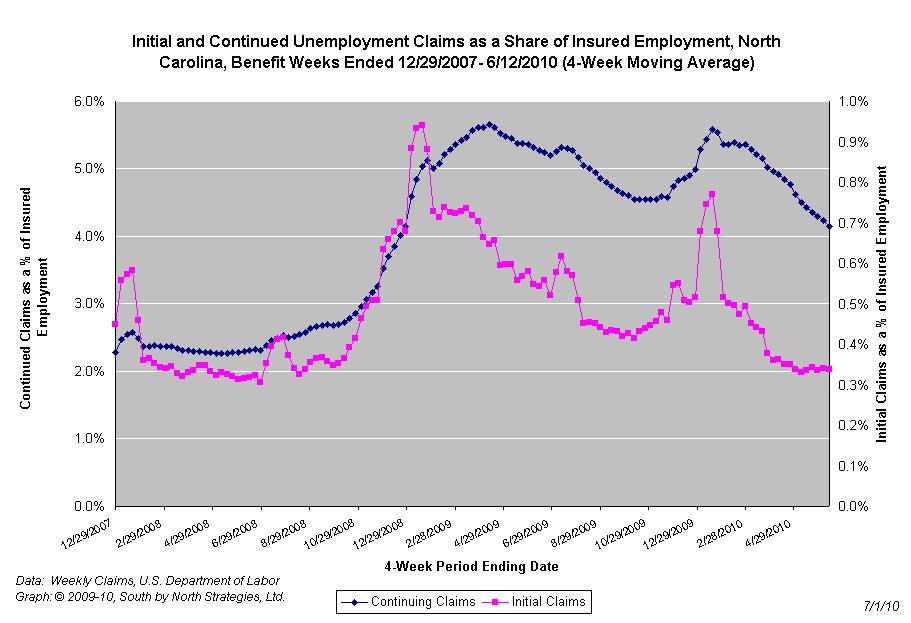
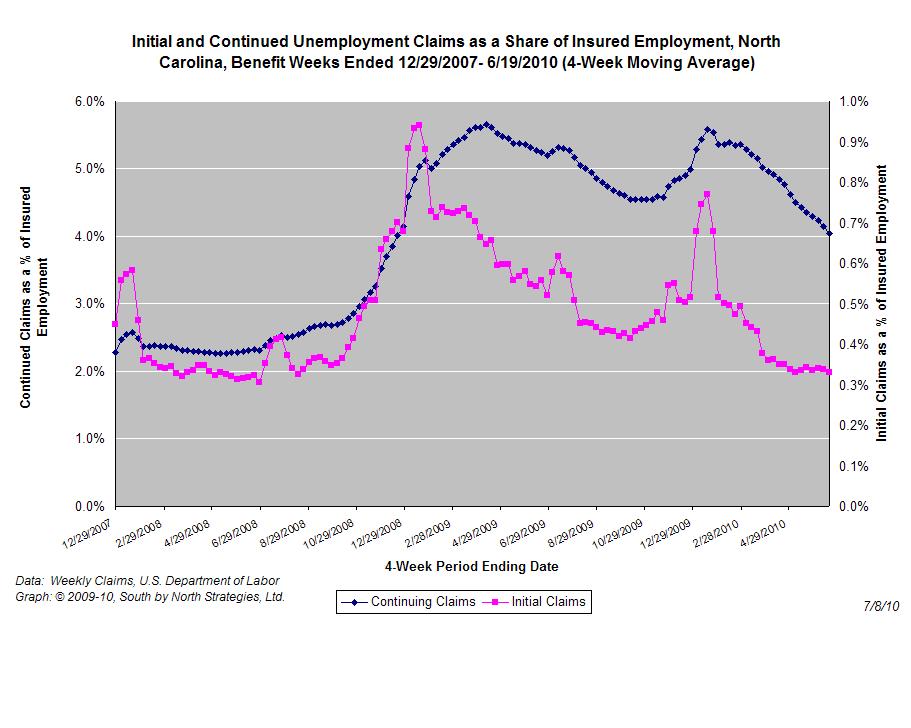
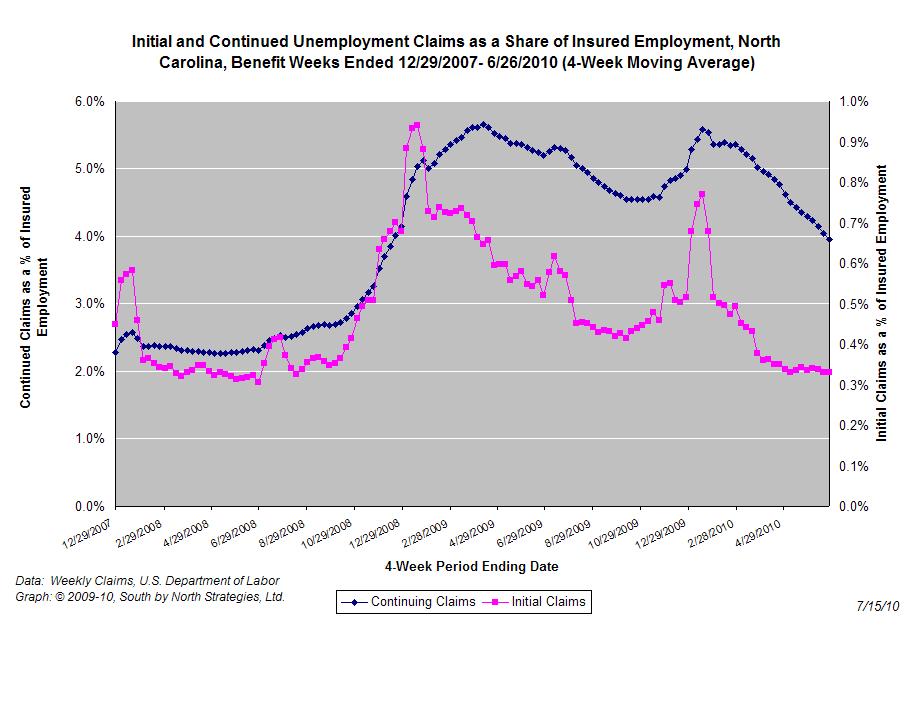
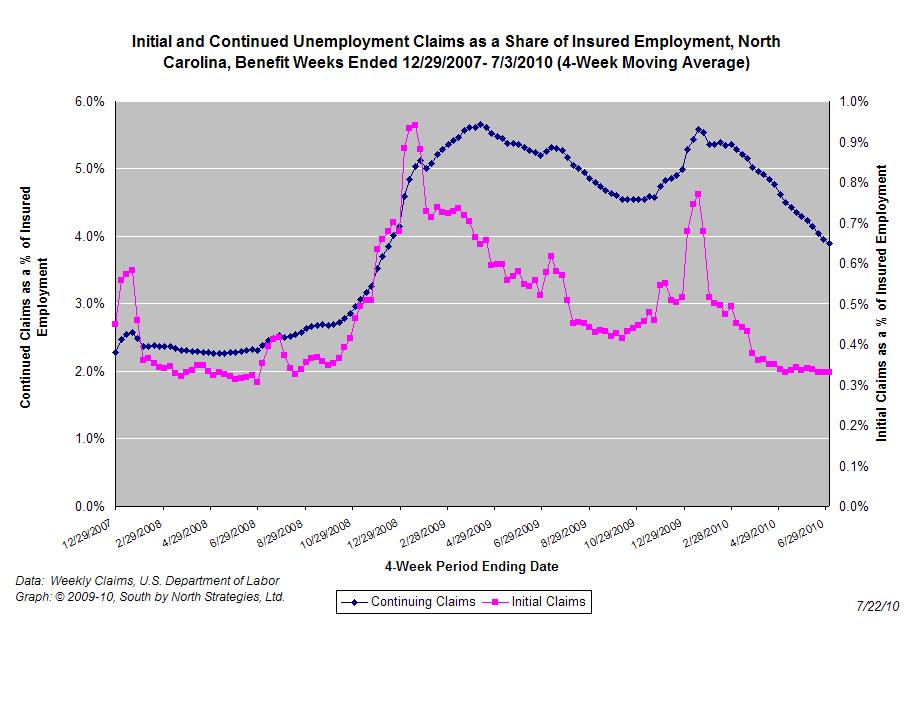
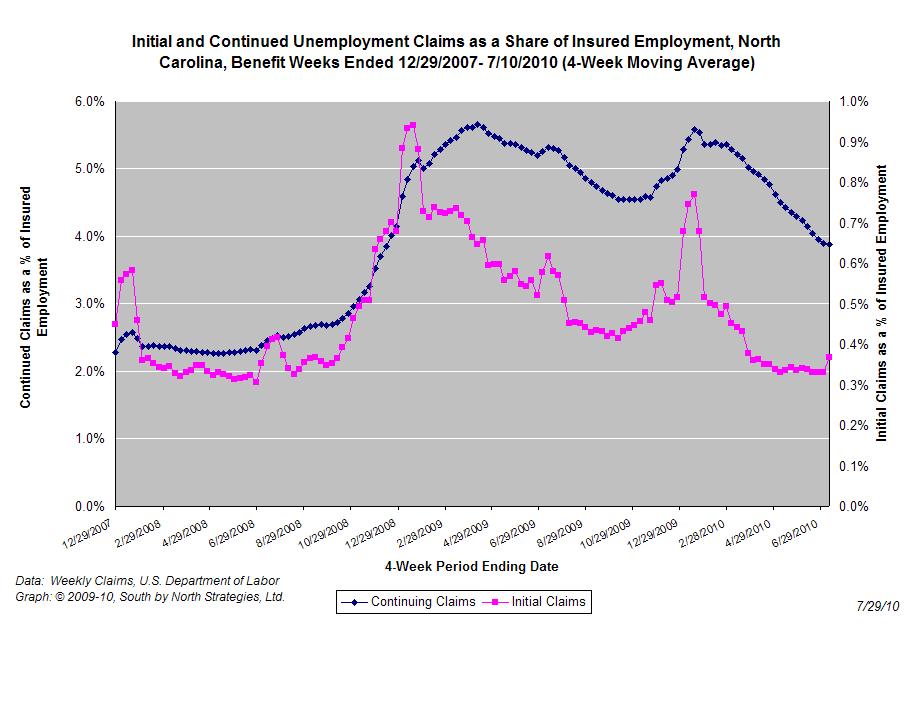
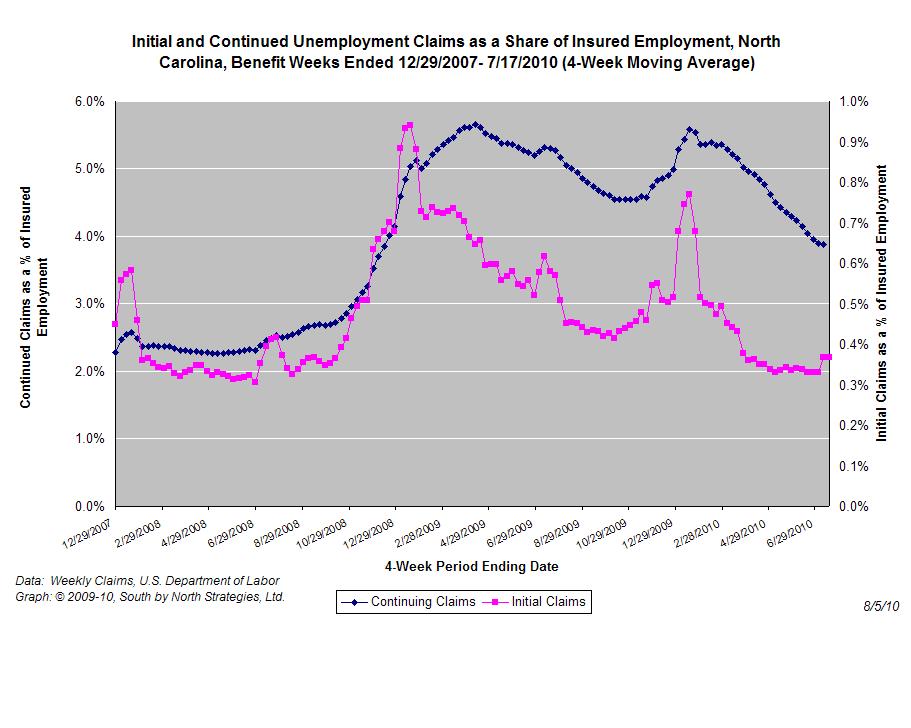
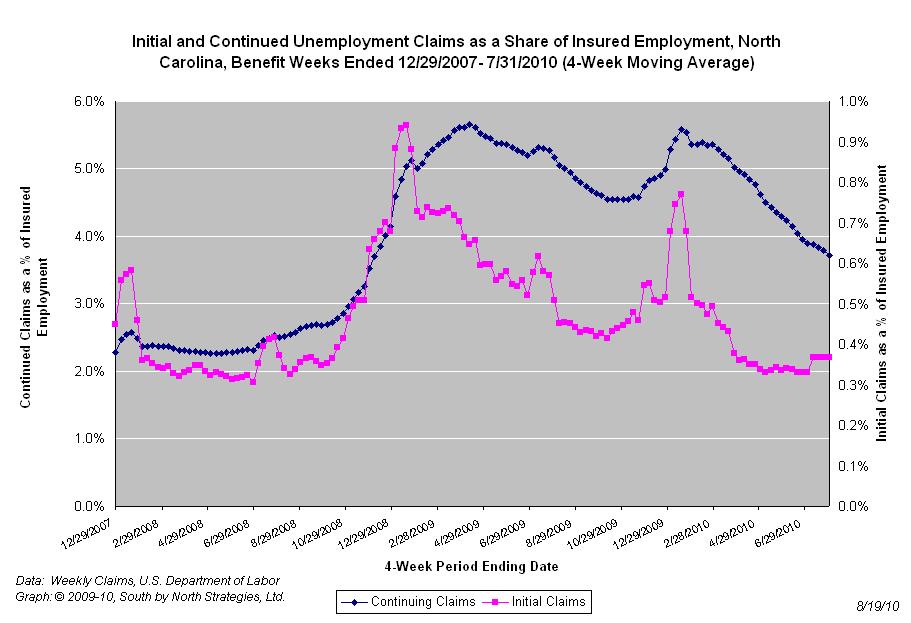
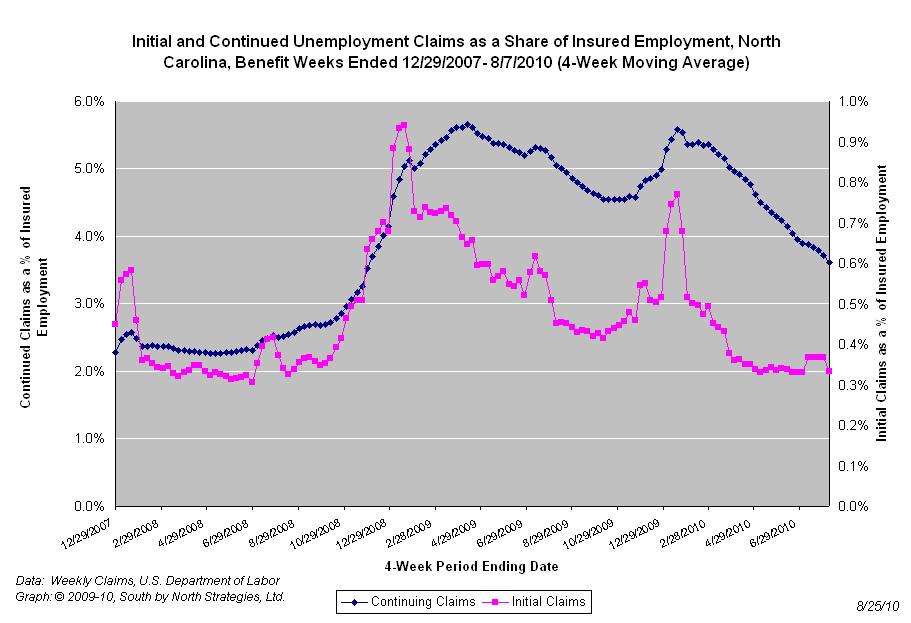
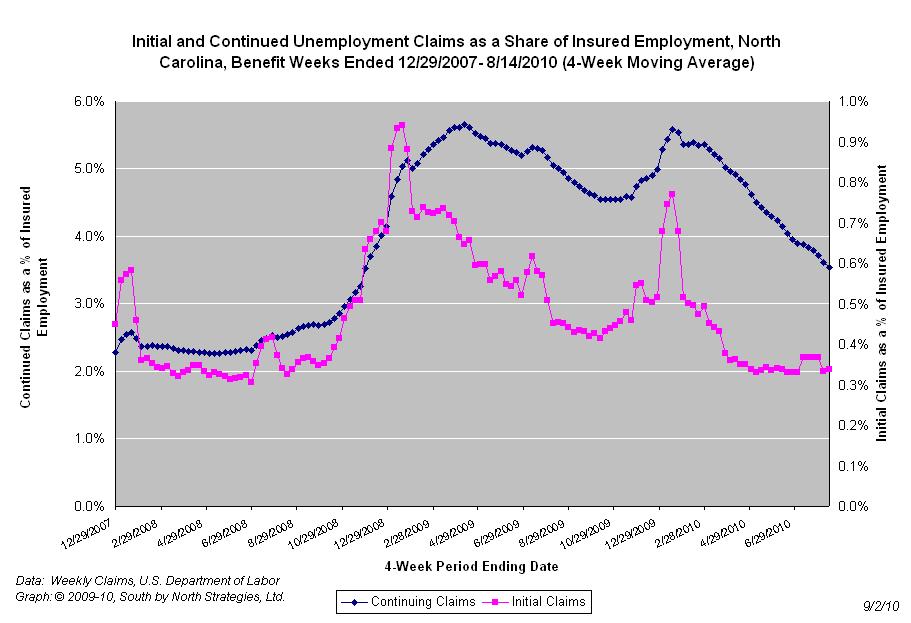
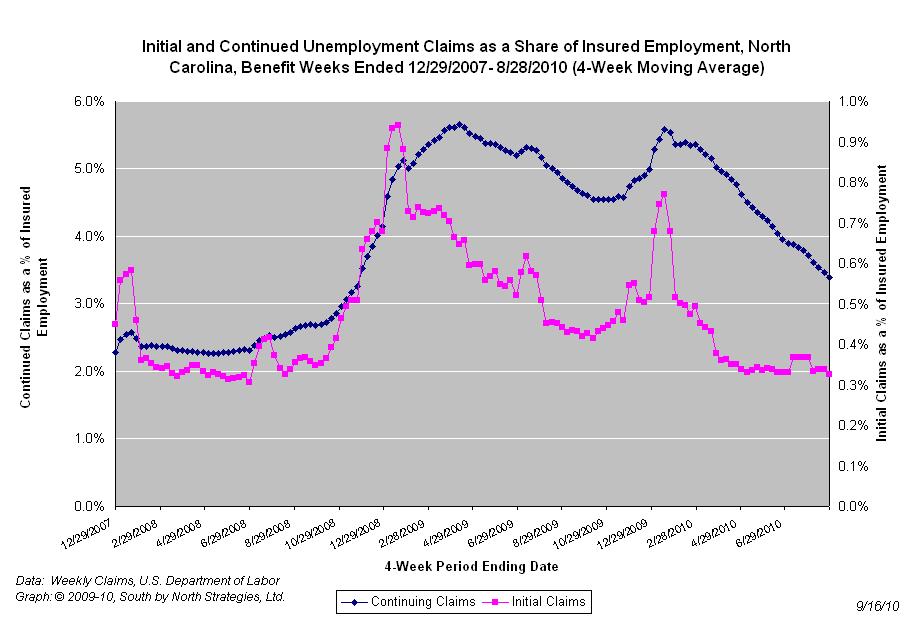
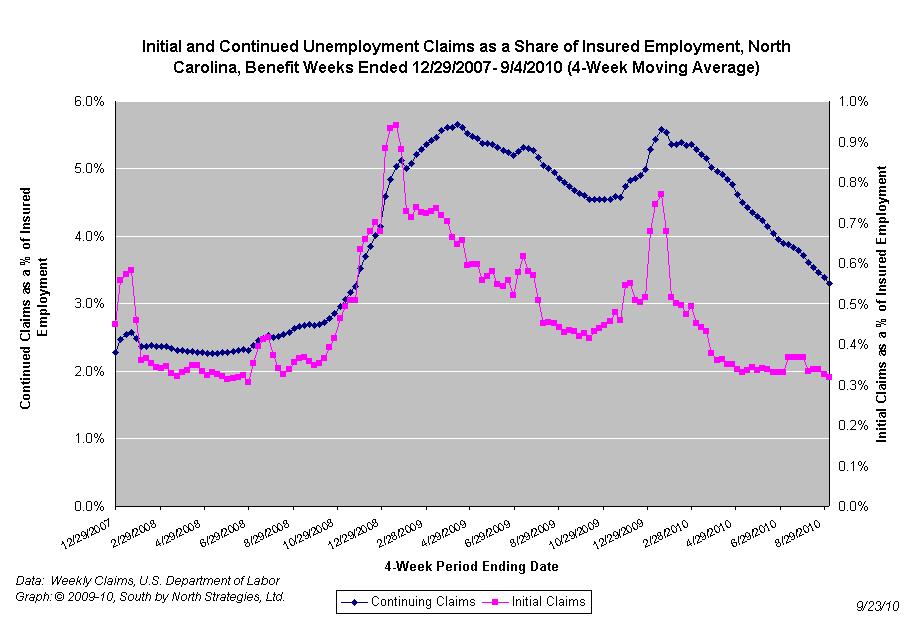
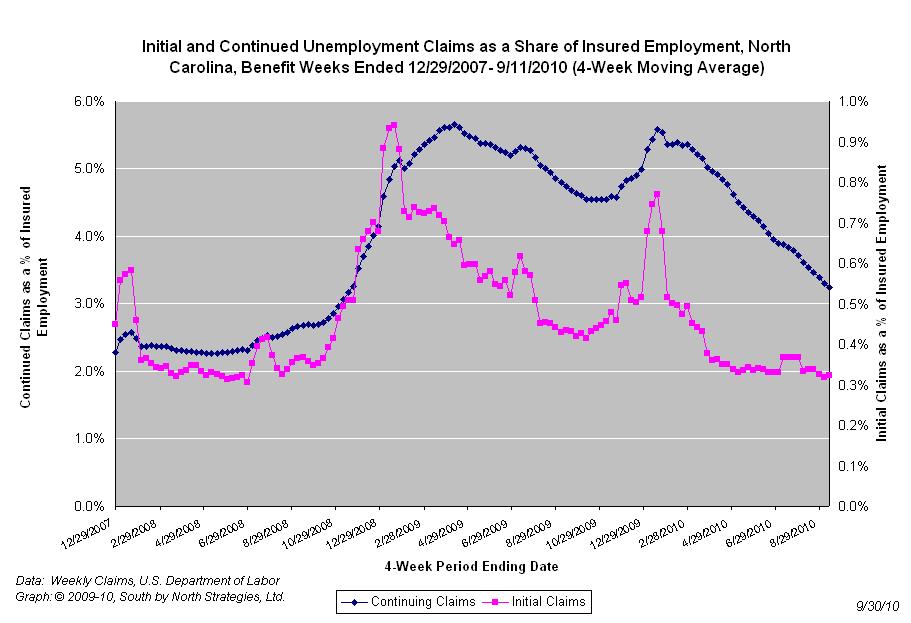
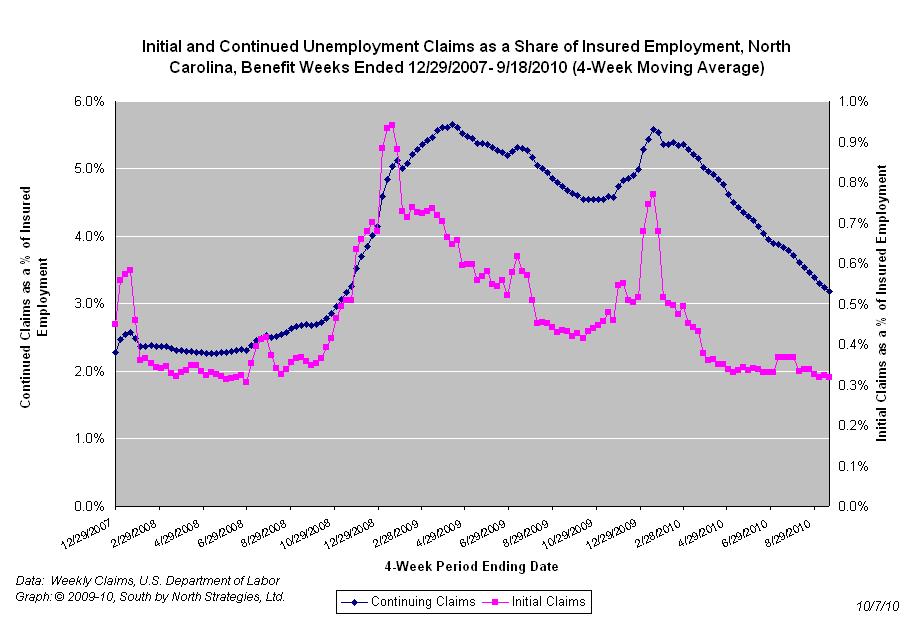
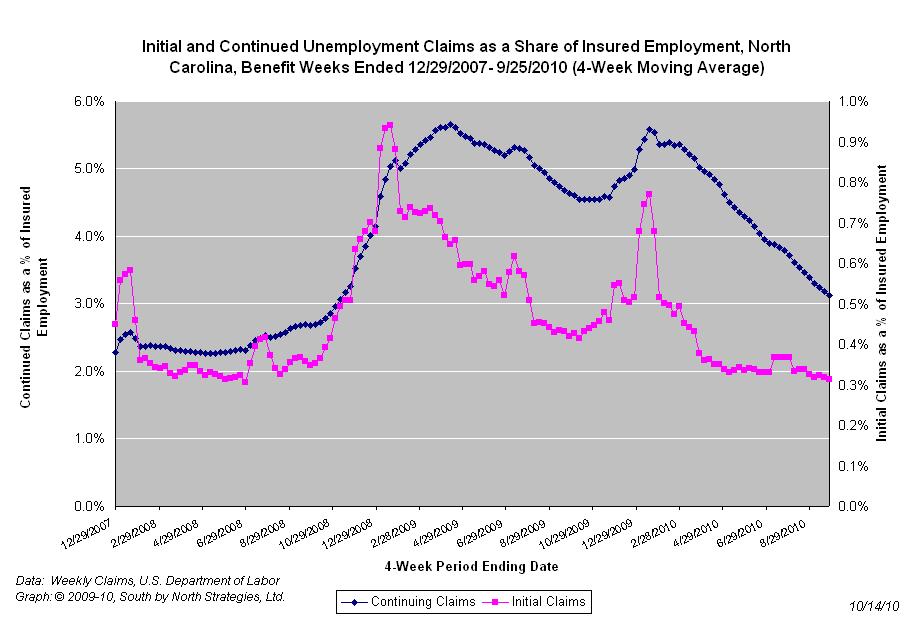
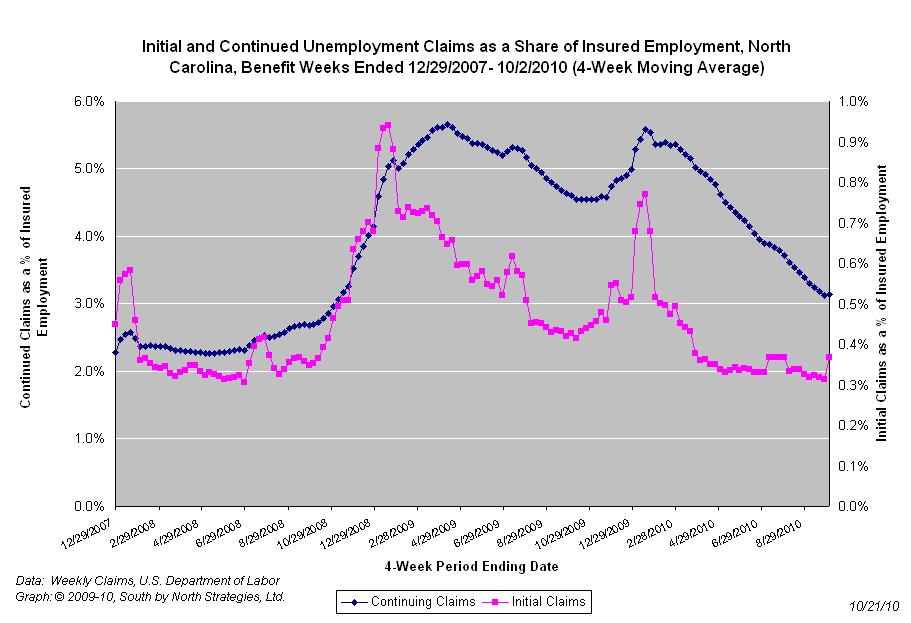
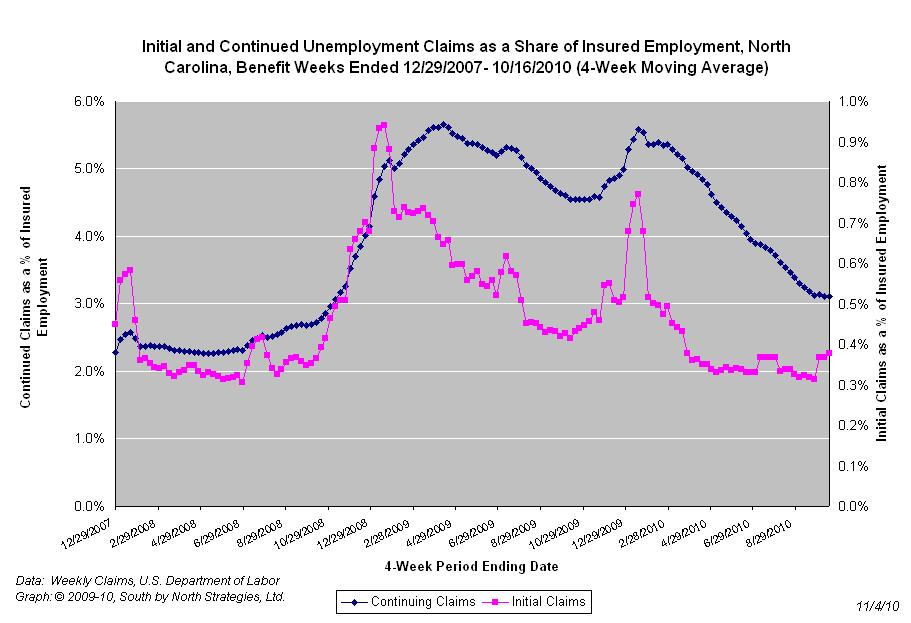
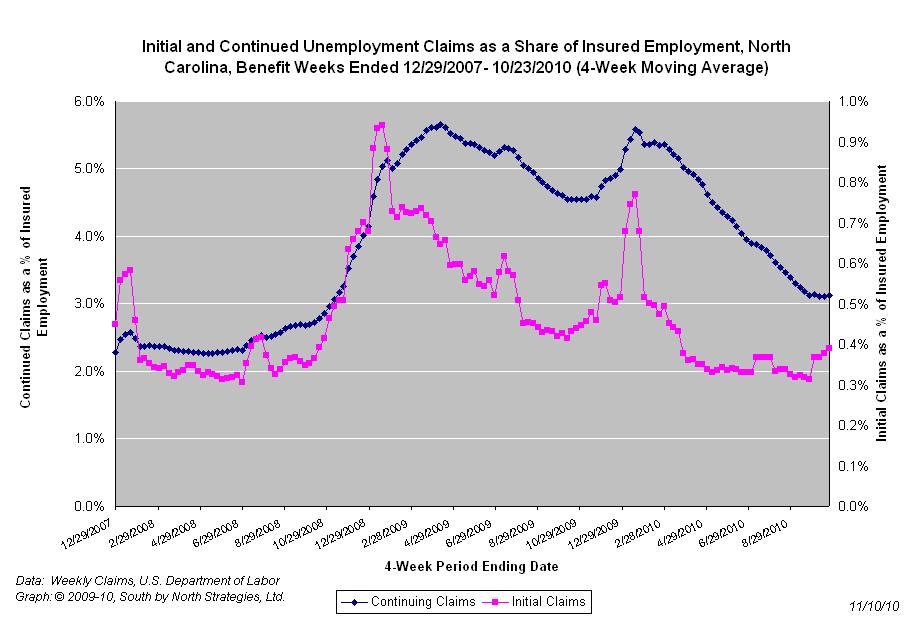
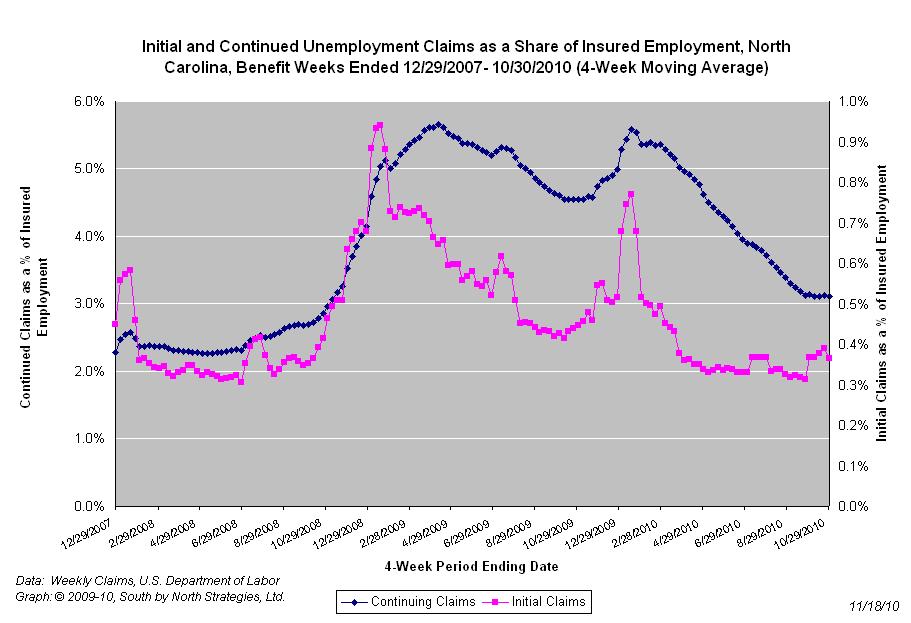
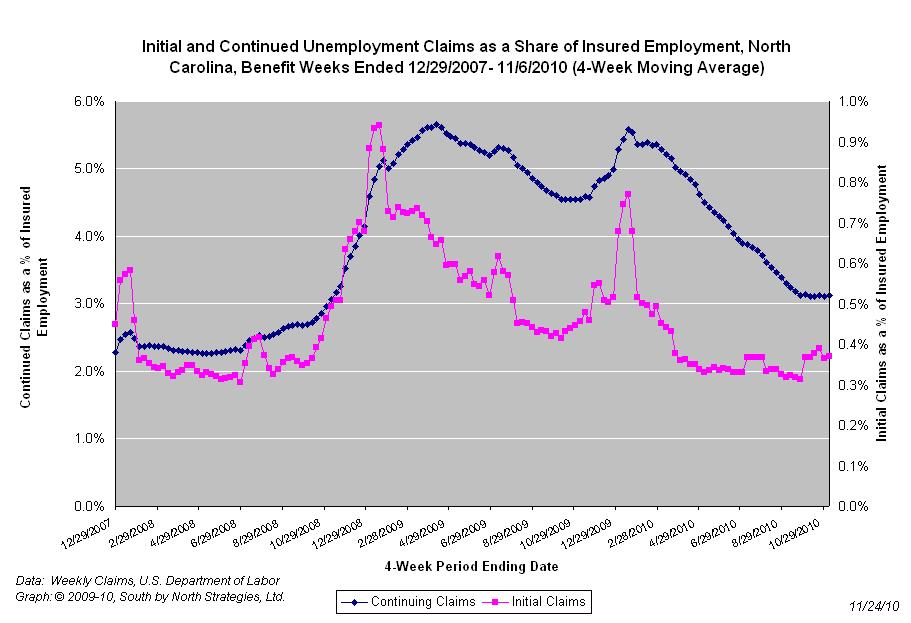
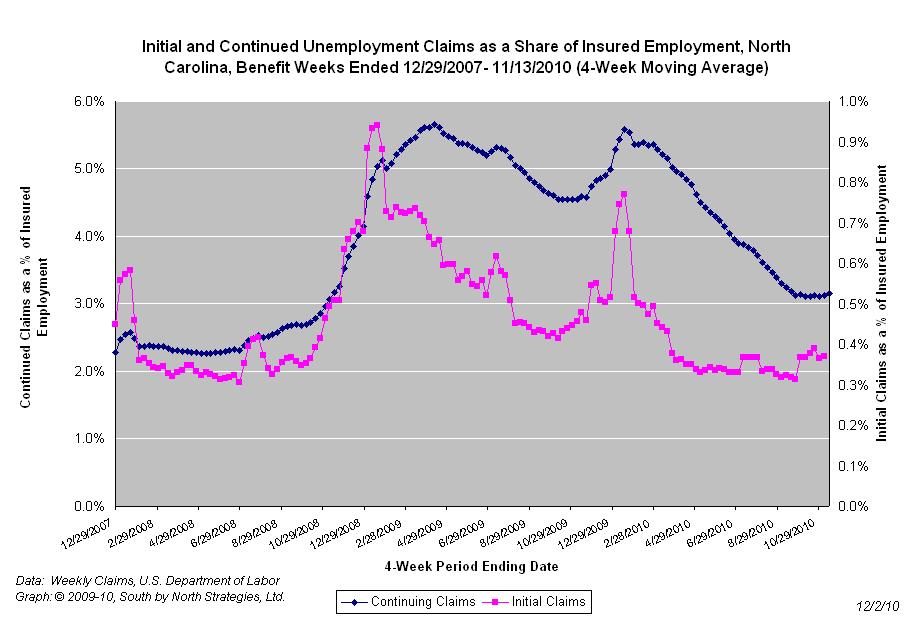
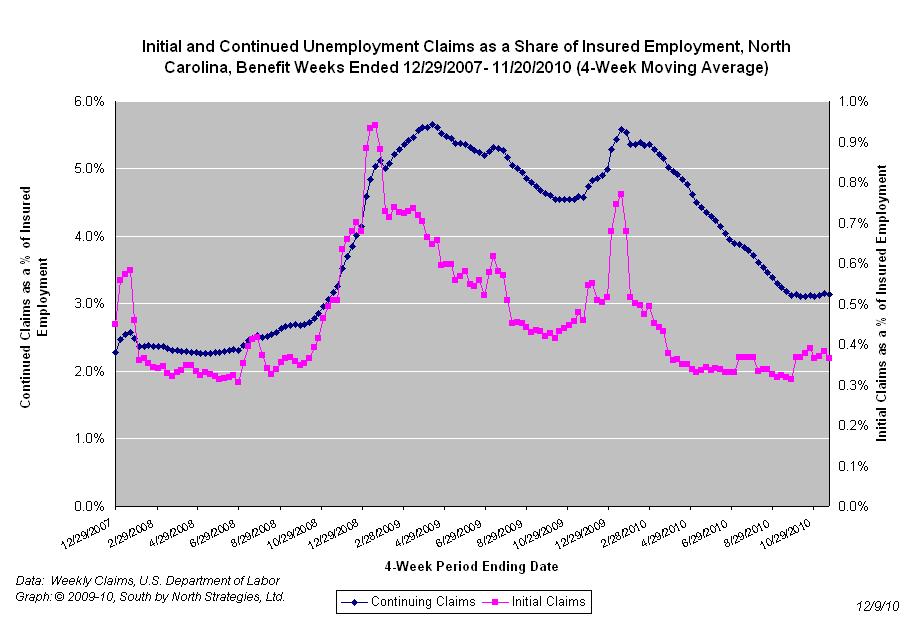
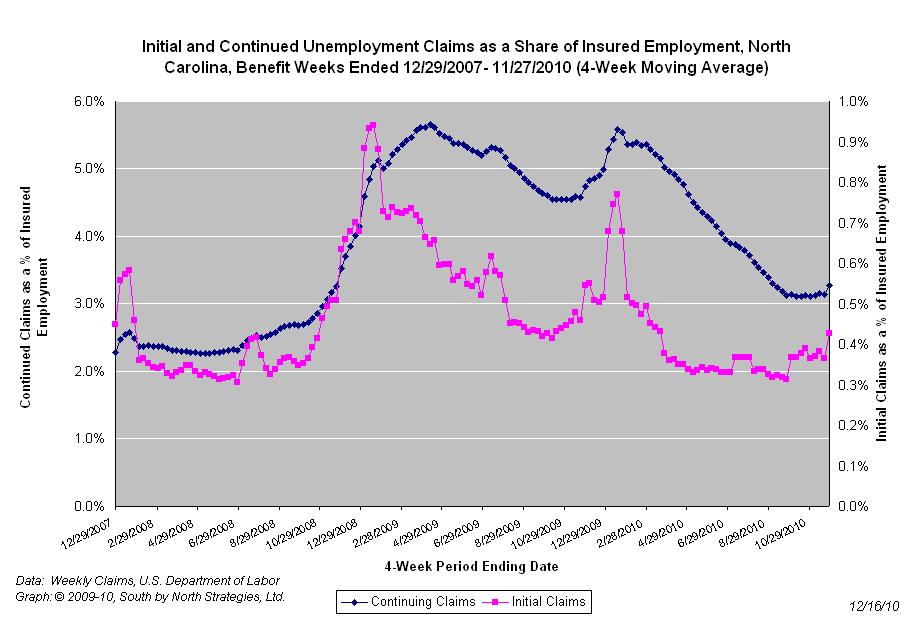
The graph (right) shows the changes in unemployment insurance claims (as a share of covered employment) in North Carolina since the recession’s start in December 2007.
Both new and continuing claims appear to have peaked for this business cycle, and the four-week averages of new and continuing claims have fallen considerably. Yet continuing claims remain at an elevated level, which suggests that unemployed individuals are finding it difficult to find new positions. Also, new claims generally have been on the rise since the end of September.
SBN In The News
South by North Strategies’ analyses of the North Carolina economy have been featured in several recent media stories.
- The Asheville Citizen-Times: “Serious high-cost issues loom in 2011 for Asheville”
- The Durham Herald-Sun: “2010 jobs growth maybe ‘a wash’ “
- The Winston-Salem Journal: “Triad jobless rate rises to 10.2 percent”
- The Durham Herald-Sun: “Jobless rate not the whole story”
- The News & Observer: “Triangle jobless rate inches up”
- N.C. Independent: “NC faces prospect of many left permanently unemployed”
- Richmond County Daily Journal: “Holidays don’t help unemployment rate”
 Email Sign-Up
 RSS Feed