Not Much To See Here
CHAPEL HILL (December 3, 2010) – Despite expectations to the contrary, the national employment situation deteriorated in November. Last month, employers added just 39,000 more positions than they eliminated, while the unemployment rate rose to 9.8 percent.
“The November employment contained almost no positive news,” said John Quinterno, a principal with South by North Strategies, Ltd., a research firm specializing in economic and social policy. “While total payroll employment rose slightly due to some private-sector hiring, the gain was far short of the level needed to keep abreast of workforce growth, let alone bring down joblessness.”
In November, the nation’s employers added 39,000 more payroll positions than they cut. Gains occurred primarily in the private sector (+50,000), while government payrolls fell by 11,000 positions due primarily to cuts at the local level. Additionally, the payroll employment numbers for August and September were revised upwards; with the revisions, the economy gained 148,000 jobs over those two months rather than the 110,000 positions previously reported.
Private-sector gains in November occurred in professional and businesses services (+53,000, primarily in the temporary help services sub-industry), education and health services (+30,000), and leisure and hospitality (+11,000). Private-sector losses occurred in manufacturing (-13,000), trade, transportation, and warehousing (-13,000); financial activities (-9,000); and construction (-5,000). All other private-industry groups experienced little or no change in November.
“The November employment report is evidence that the recovery is bypassing the job market,” noted Quinterno. “The current pace of growth will not bring down joblessness anytime soon.”
Weak conditions were reflected in the November household survey. Last month, 15.1 million Americans (9.8 percent of the labor force) were jobless and seeking work. Proportionally more adult male workers were unemployed than female ones (10 percent vs. 8.4 percent). Similarly, unemployment rates were higher among Black (16 percent) and Hispanic workers (13.2 percent) than among White ones (8.9 percent). The unemployment rate among teenagers was 24.6 percent. With the exception of teenagers, unemployment rates for every major demographic group were higher in November than in October.
Furthermore, newly available data show that 8.6 percent of all veterans were unemployed in November; the rate among recent veterans (served after September 2001) was 10 percent.
“There remains a tremendous amount of idle labor in the American economy,” added Quinterno. “Compared to a year ago, a smaller share of the civilian population is participating in the labor force. The proportion of the population that is underemployed also has remained consistently at or near the November level of 17 percent.”
Jobs remained difficult to find in November. Last month, 41.9 percent of unemployed workers had been jobless for at least six months with the average spell of unemployment lasting for 33.8 weeks. Compared to a year ago, there were more people marginally attached to the labor force (2.5 million, up from 2.3 million).
“The November employment report should serve as a wake-up call for policymakers,” observed Quinterno. “The pace of economic recovery is too sluggish to reverse the problem of joblessness. Without more aggressive policy action, cyclical job losses are apt to crystallize into permanent ones. Millions of Americans are at grave risk of being pushed permanently out of the job market.”
State Coincident Indicators: Oct.
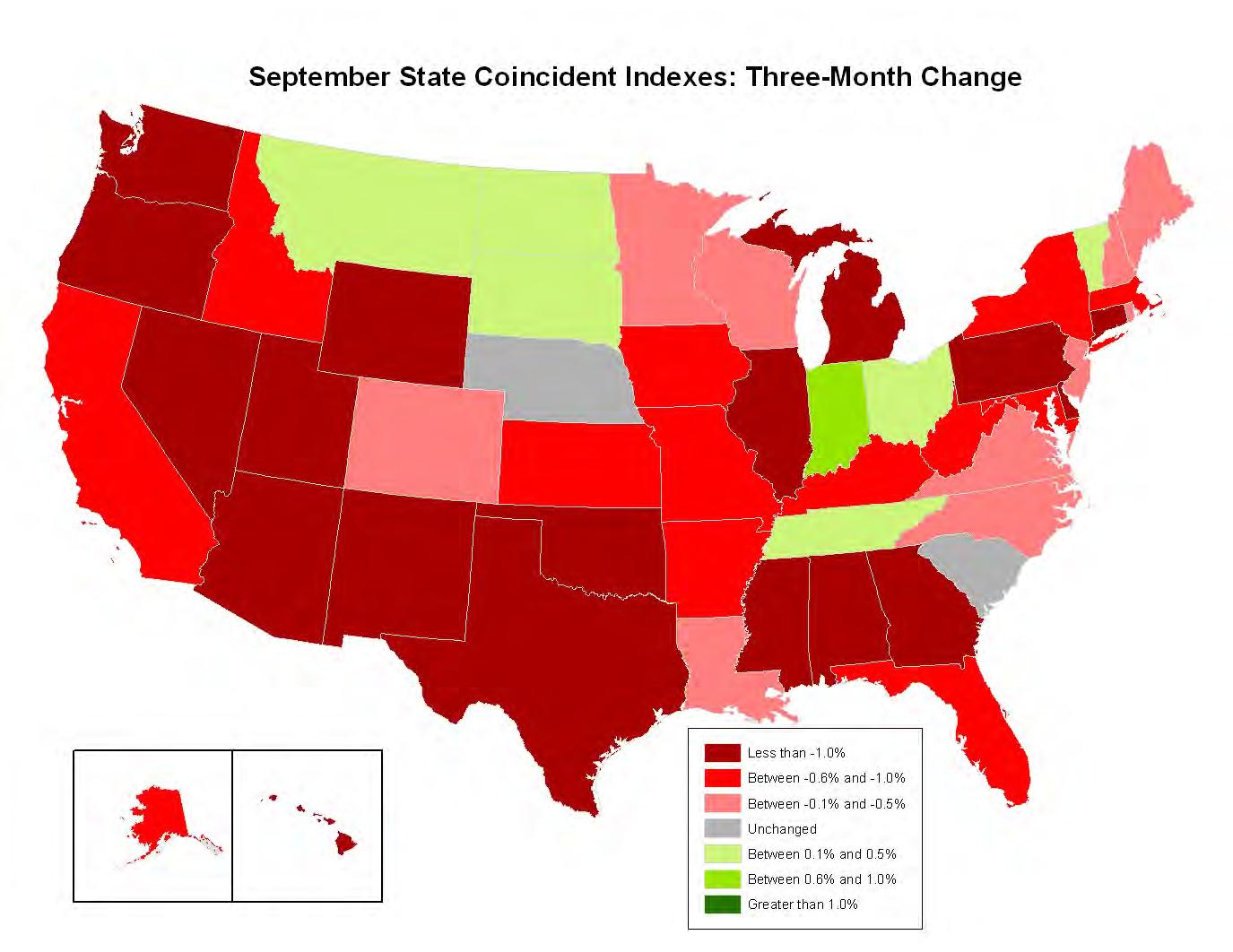
Economic conditions across much of the nation improved slightly in September, according to the newest State Coincident Indexes Report prepared by the Federal Reserve Bank of Philadelphia.
In September coincident indexes moved in a positive direction in 24 states and in a negative direction in 14 states. No changes occurred in 12 states.
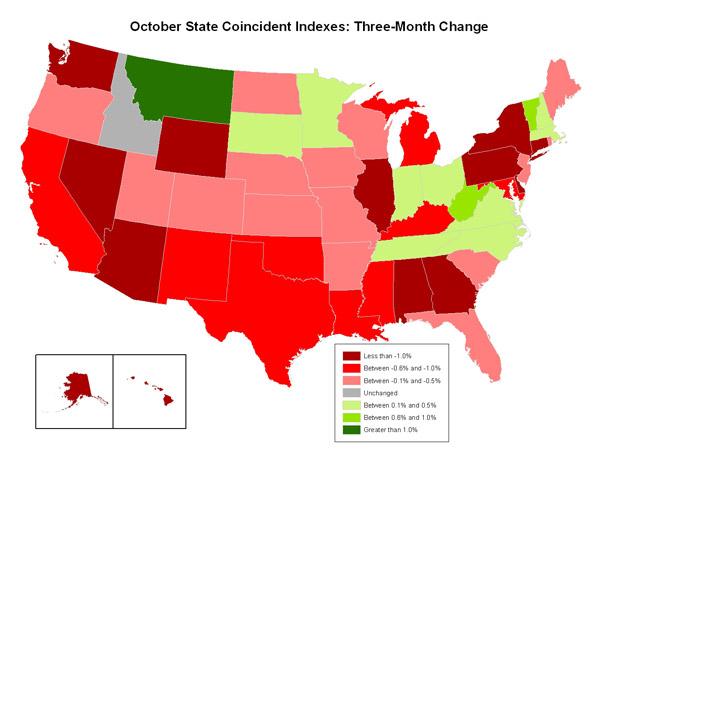
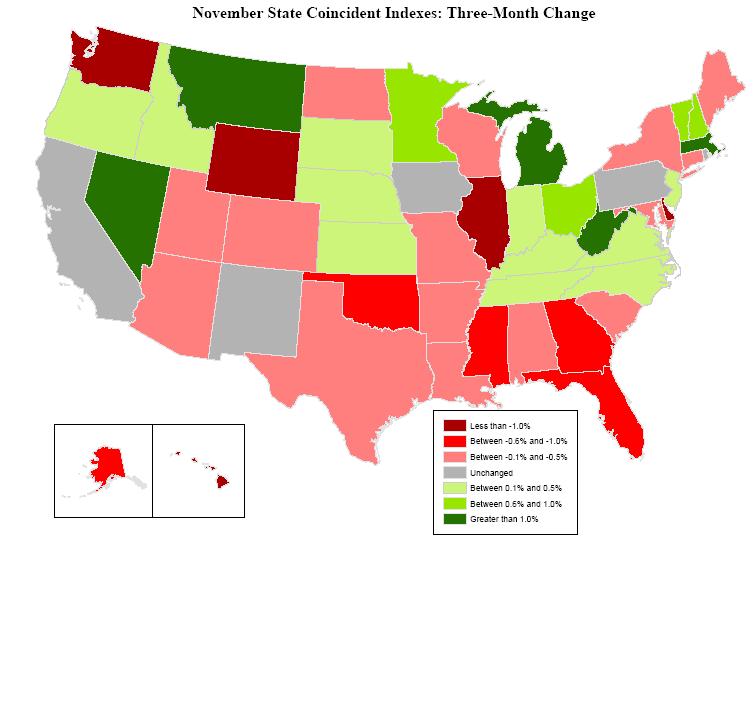
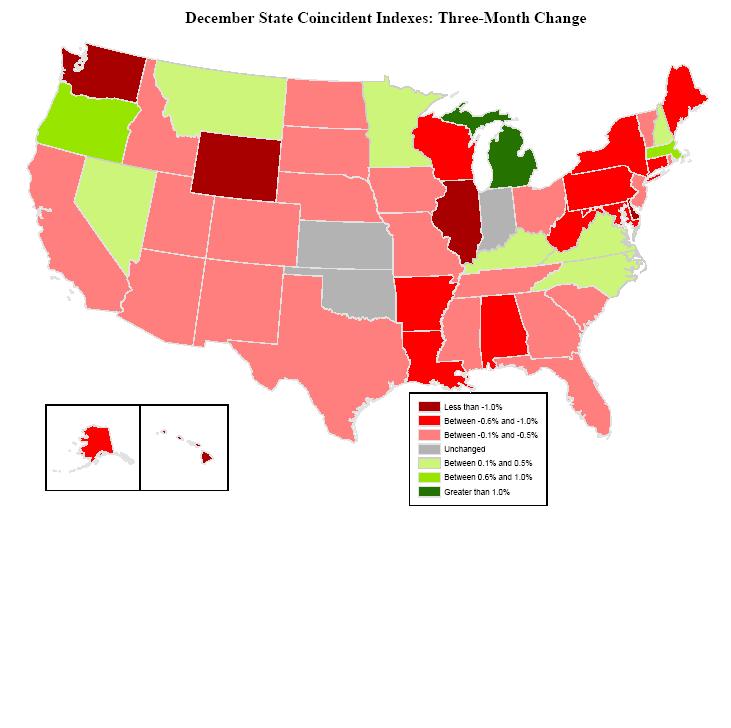
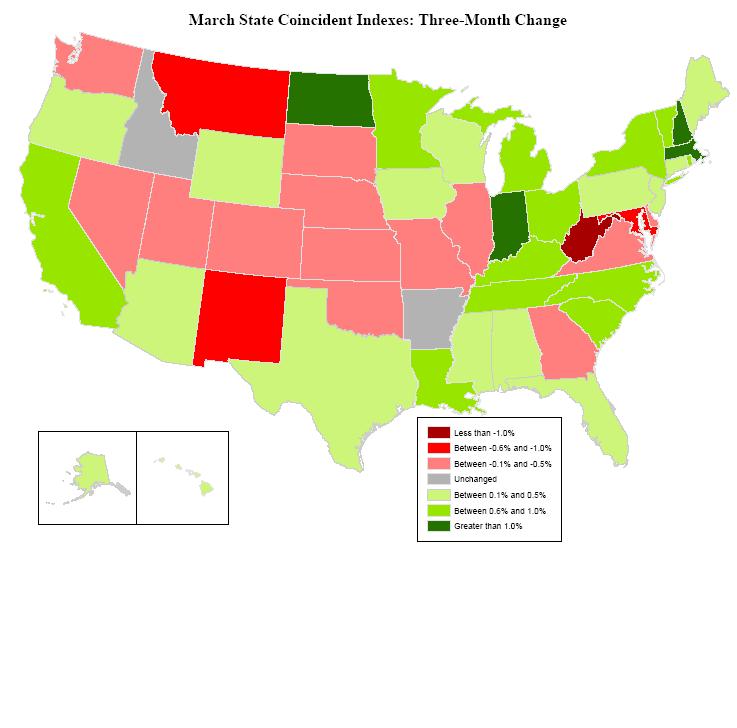
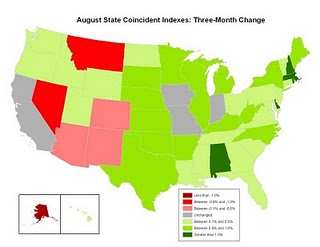
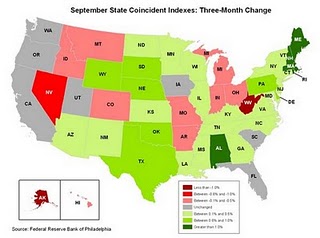 The map to the right, which is taken from the Reserve Bank’s survey, shows the three-month changes in coincident indicators by state. Positive numbers denote improvements in economic conditions, and negative numbers refer to declines.
Over the last three months, coincident indexes increased in 31 states, decreased in 12 states and held steady in seven states.
During the same three-month period, North Carolina’s coincident index moved in a positive direction, which suggests improvements in local economic conditions.
Around The Dial – Dec. 2
Economic policy reports, blog postings, and media stories of interest:
- David Leonhardt looks at the logic for a millionaire’s tax.
- Naked Capitalism argues for better use of economic words.
- Rortybomb wonders “what if Obama prioritizes bondholders over workers?”
- Free Exchange discusses “the Fed’s WikiLeaks moment.”
- CBPP explains what happens without emergency unemployment benefits.
NC Unemployment Claims: Week of 11/13
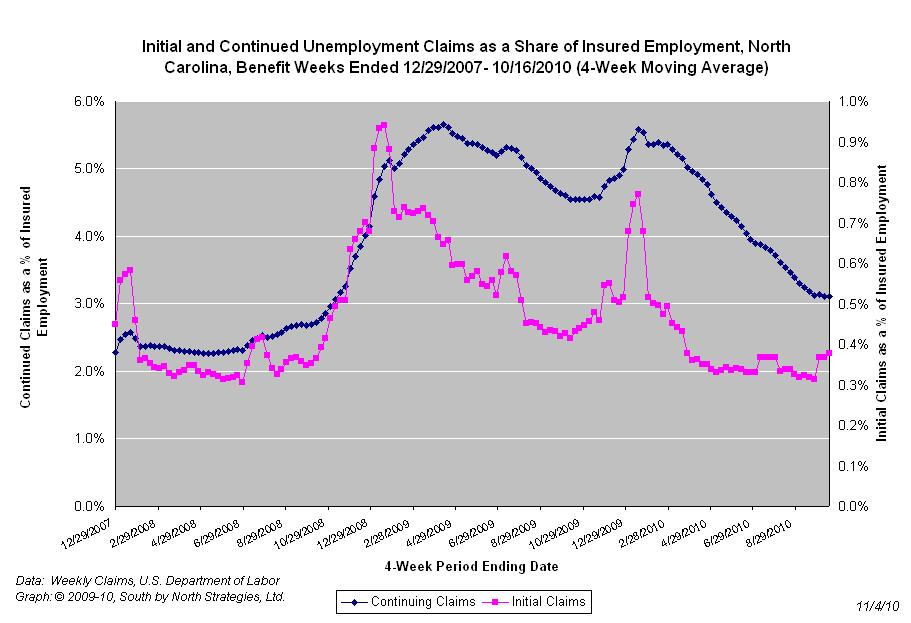
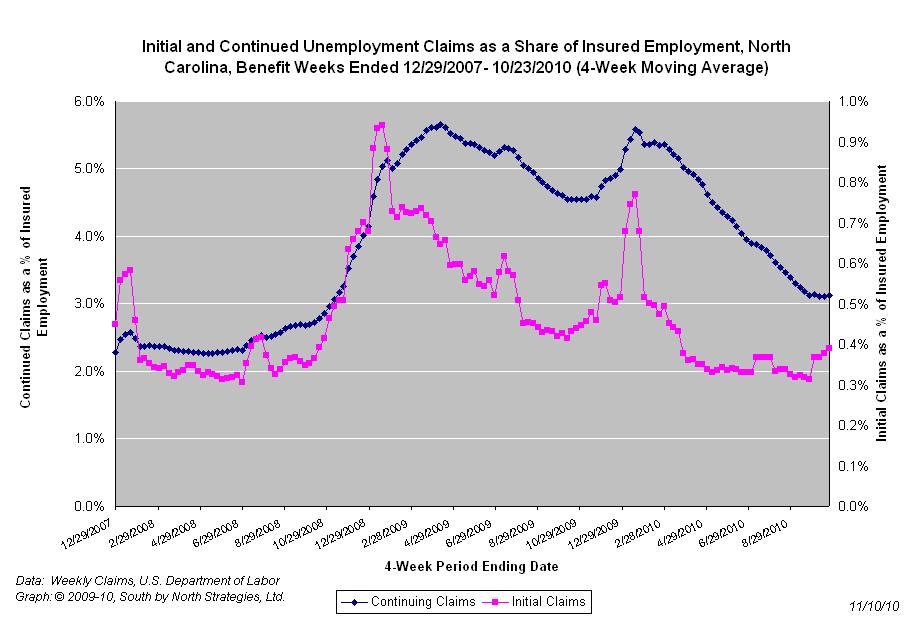
For the benefit week ending on November 13th, 14,340 North Carolinians filed initial claims for state unemployment insurance benefits, and 119,112 individuals applied for state-funded continuing benefits. Compared to the prior week, there were more initial and continuing claims. These figures come from data released by the U.S. Department of Labor.
Averaging new and continuing claims over a four-week period — a process that helps adjust for seasonal fluctuations and better illustrates trends — shows that an average of 14,281 initial claims were filed over the previous four weeks, along with an average of 117,477 continuing claims. Compared to the previous four-week period, there were more initial and continuing claims.
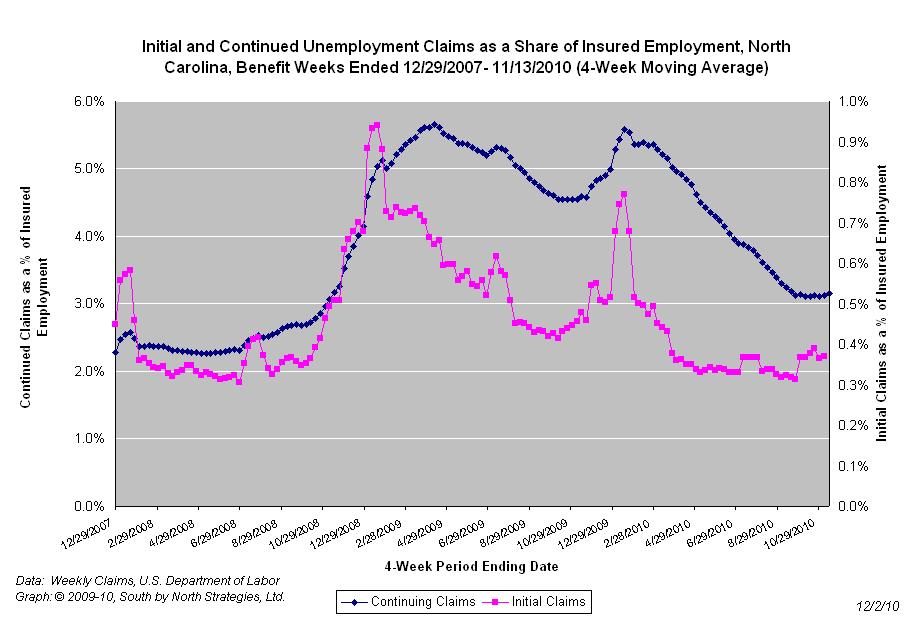 One year ago, the four-week average for initial claims stood at 18,973 and the four-week average of continuing claims equaled 181,445.
While the number of claims has dropped over the past year, so has covered employment. Last week, covered employment totaled 3.7 million, down from 4 million a year ago.
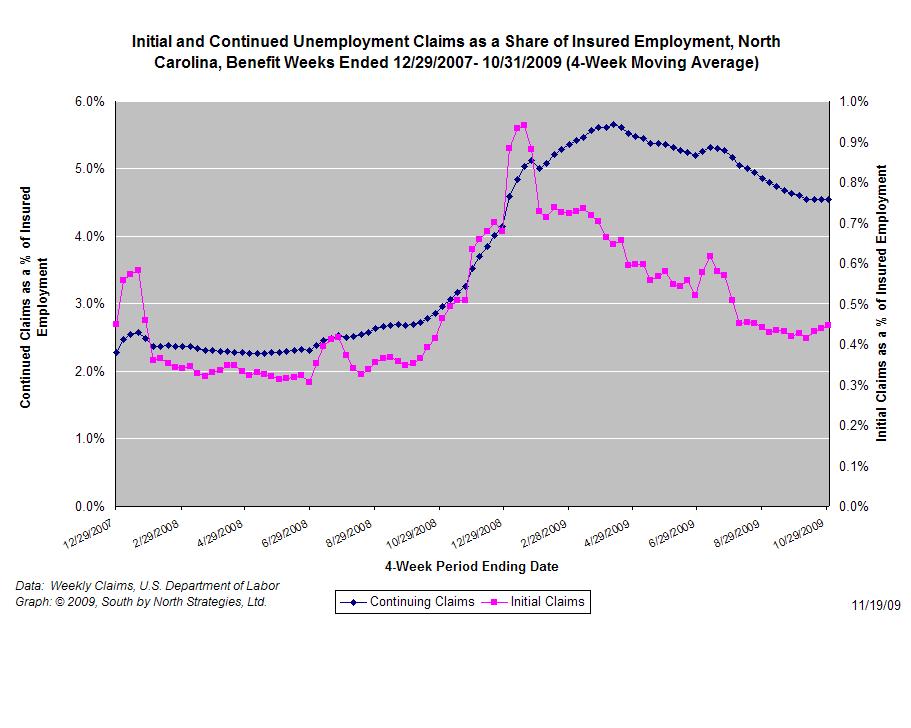
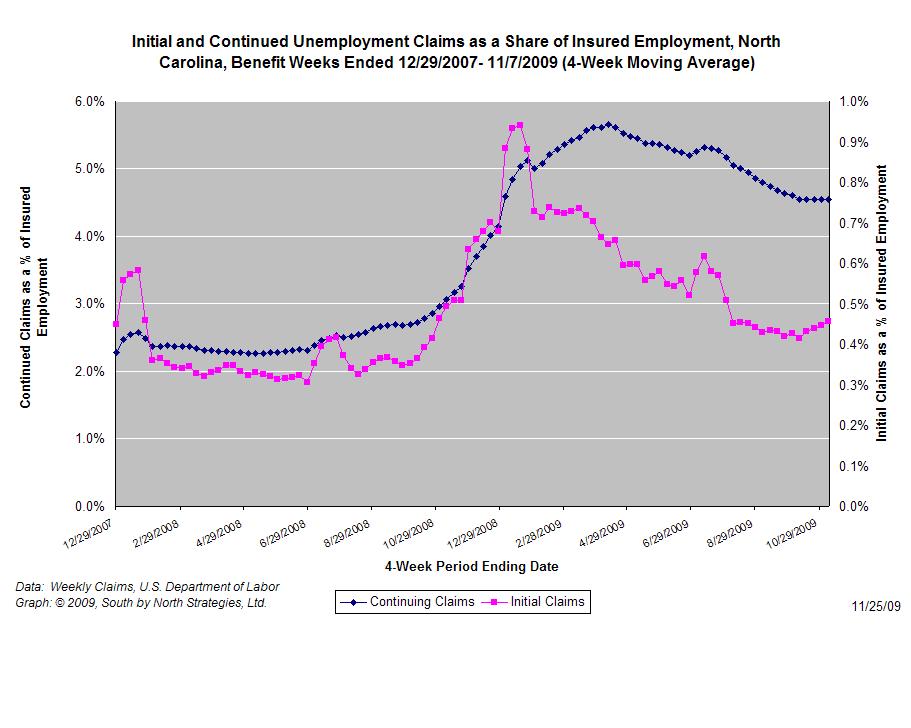
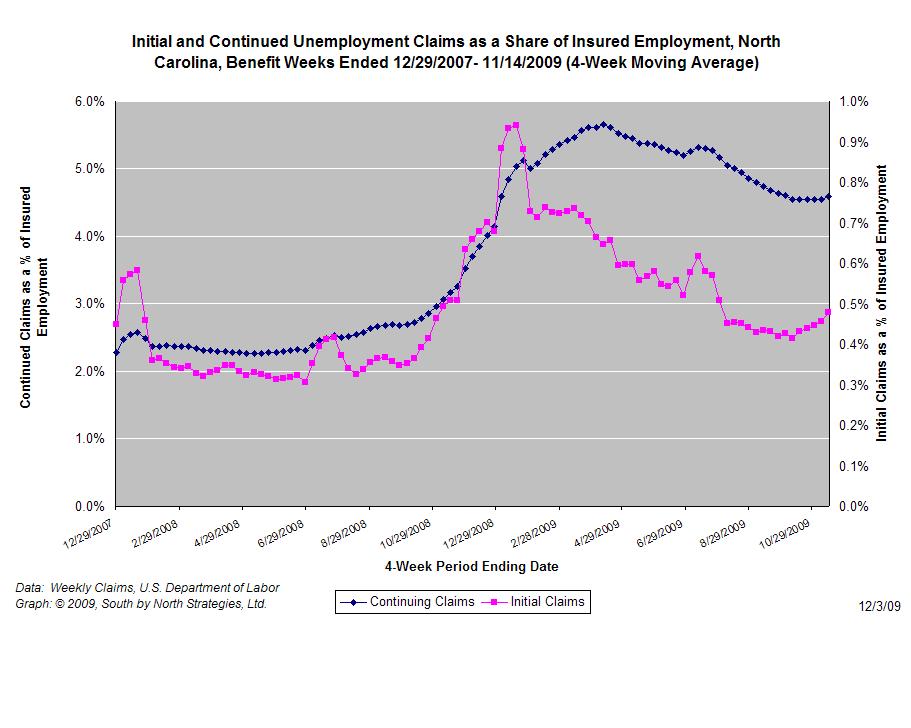
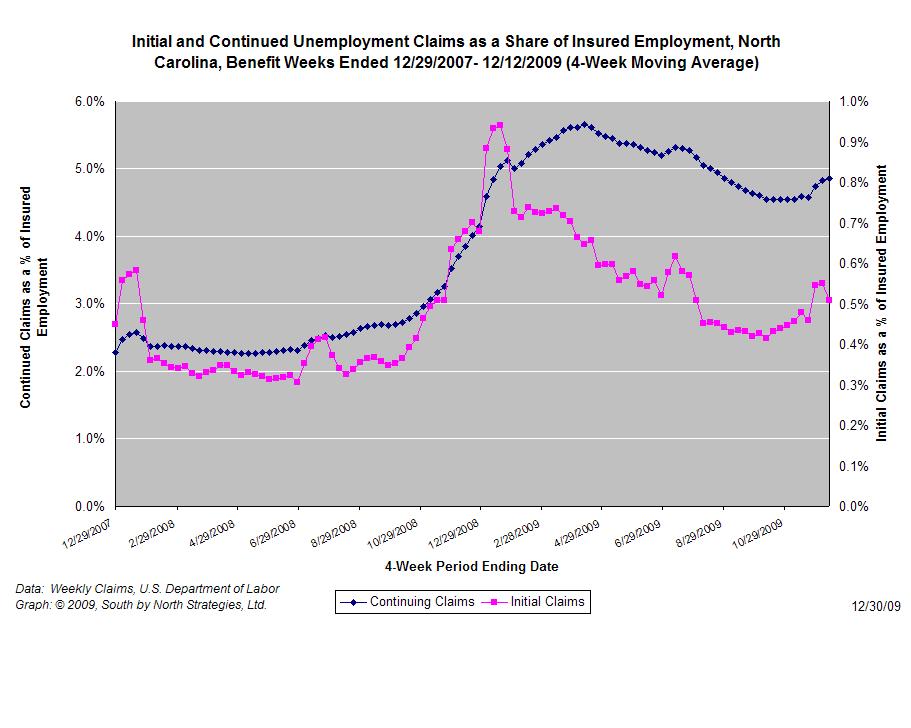
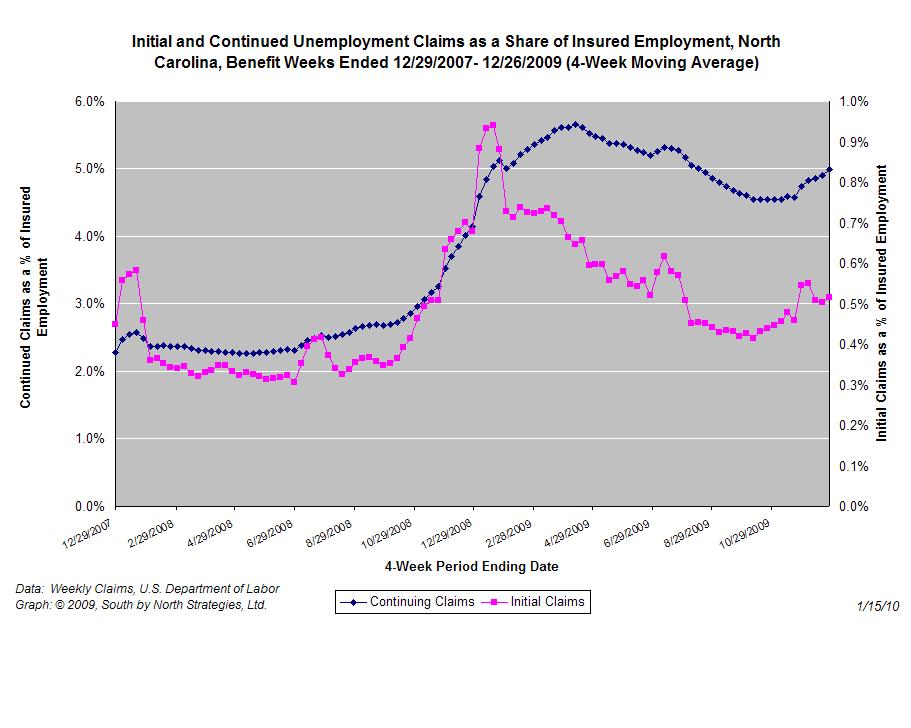
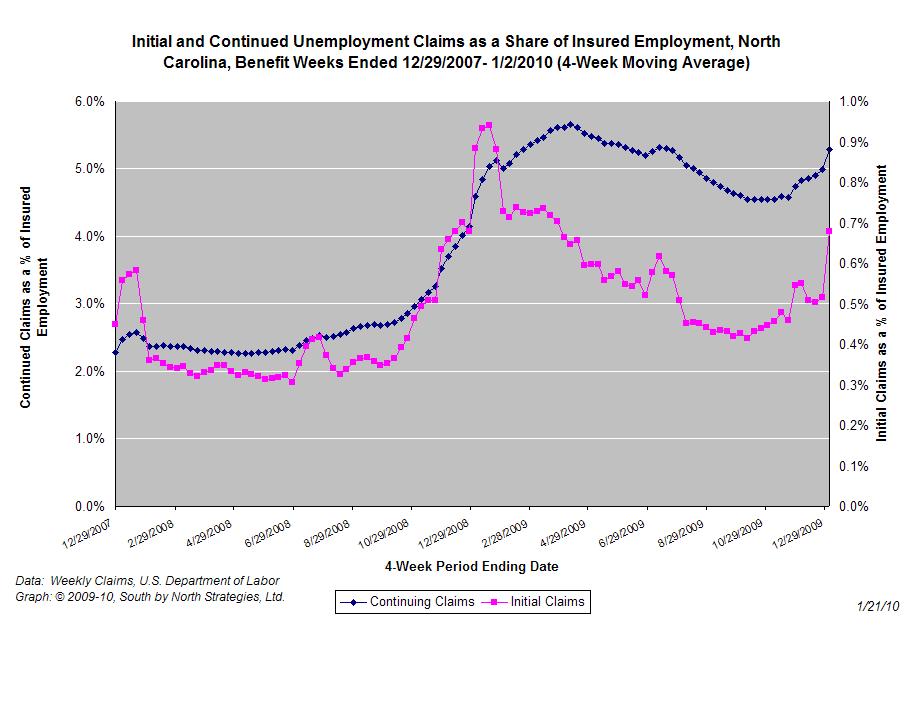
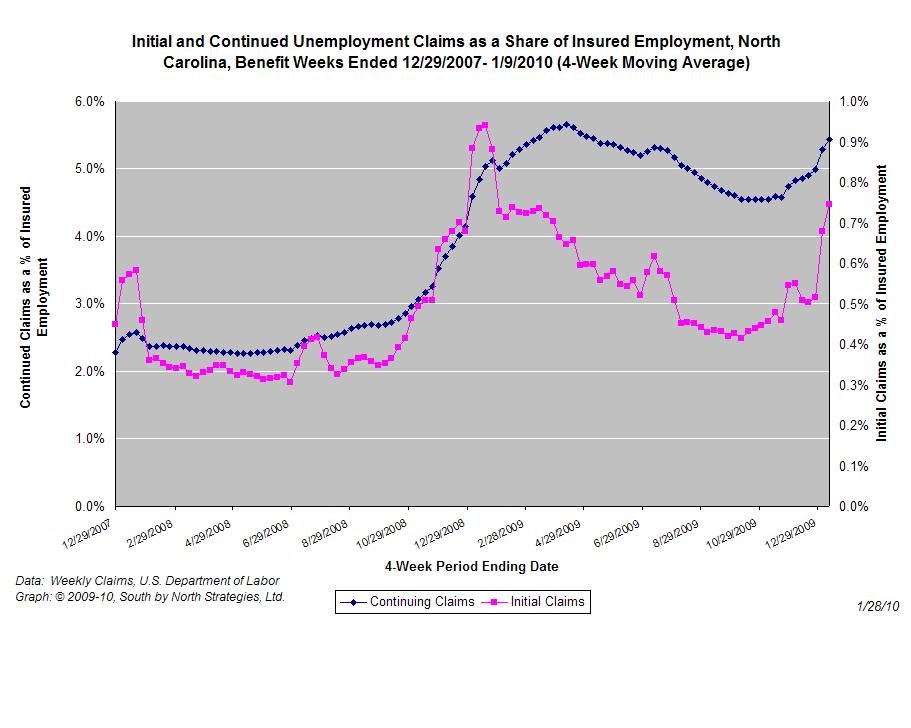
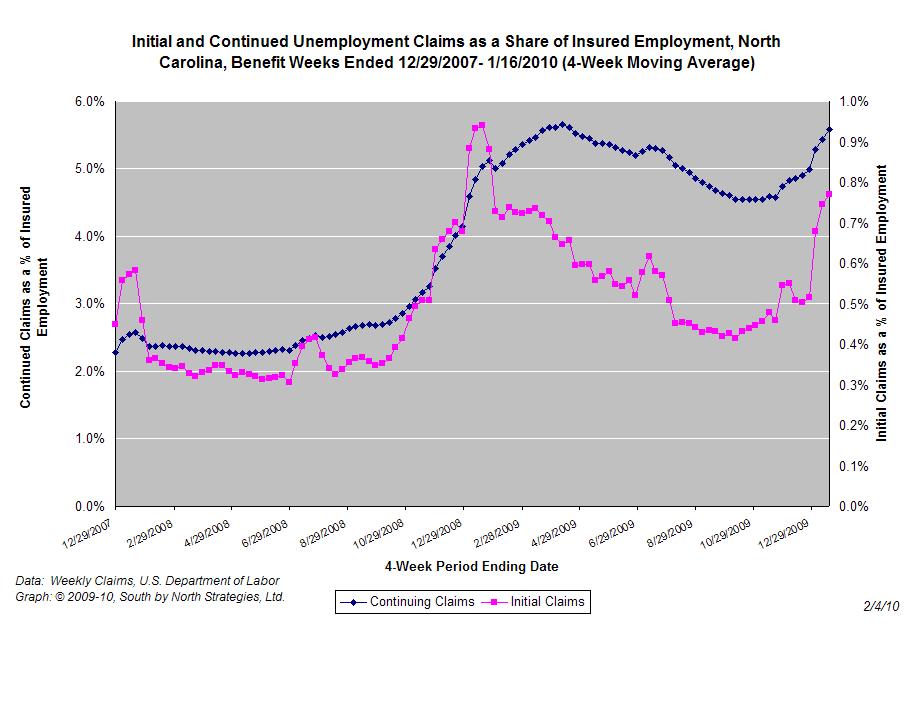
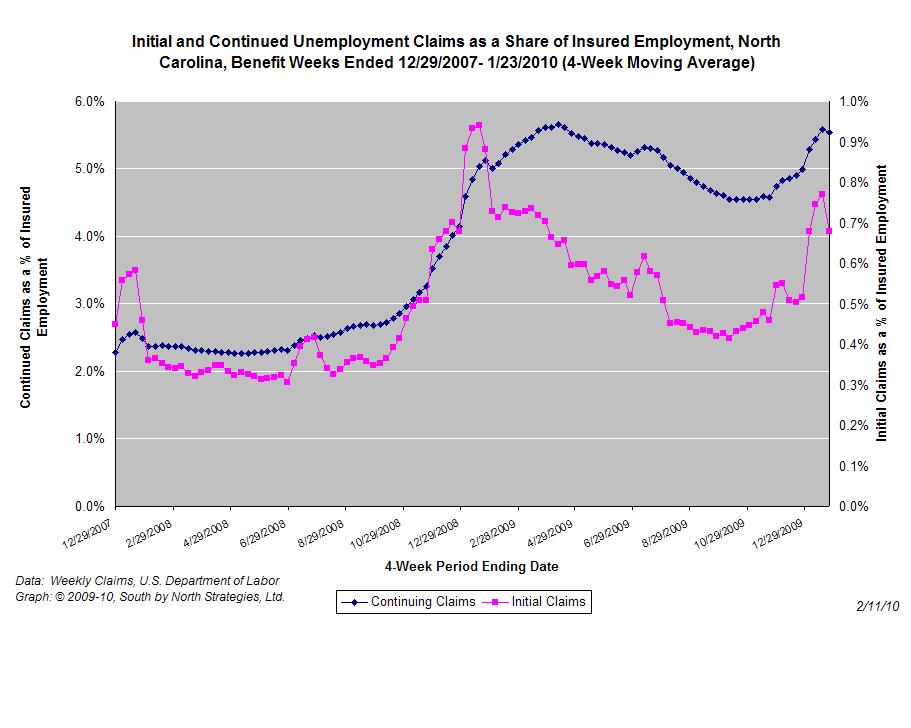
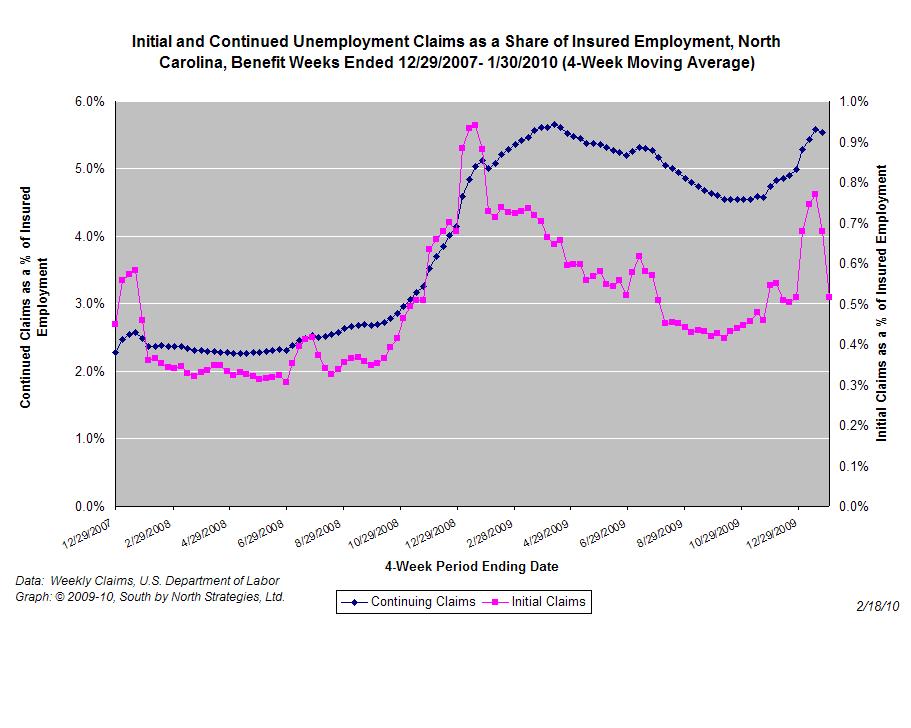
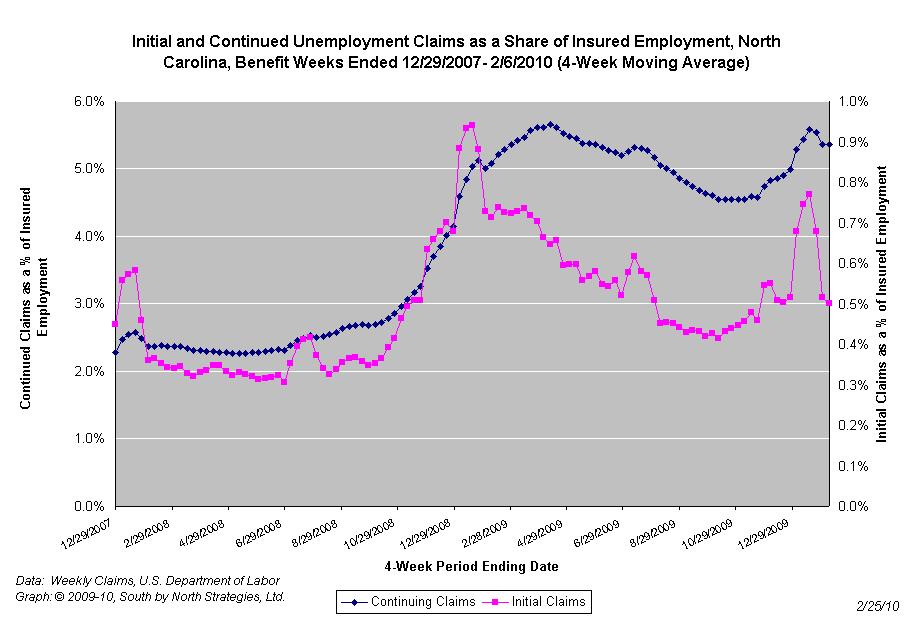
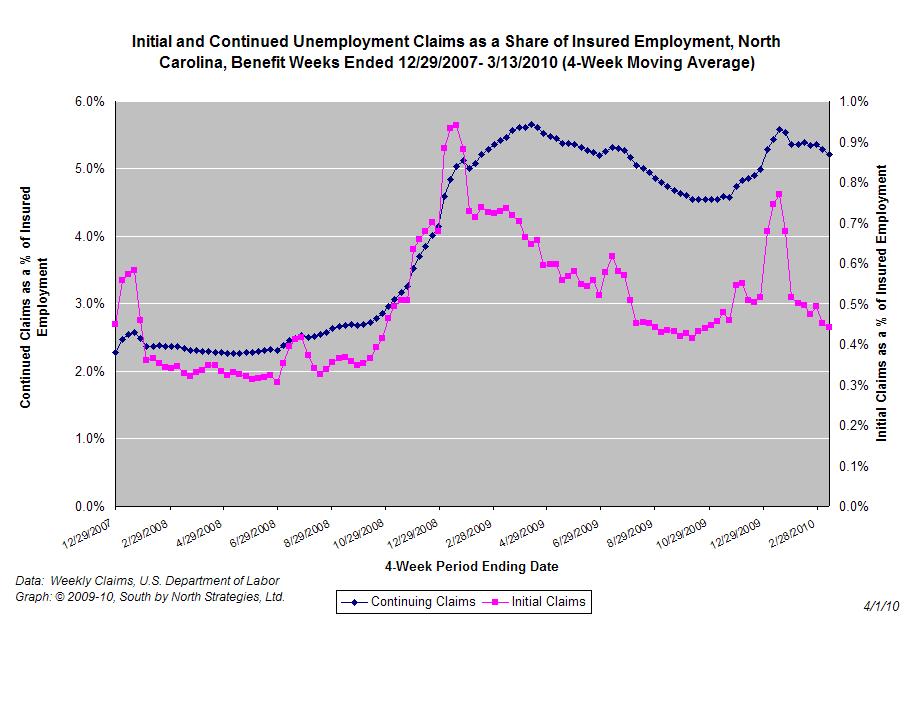
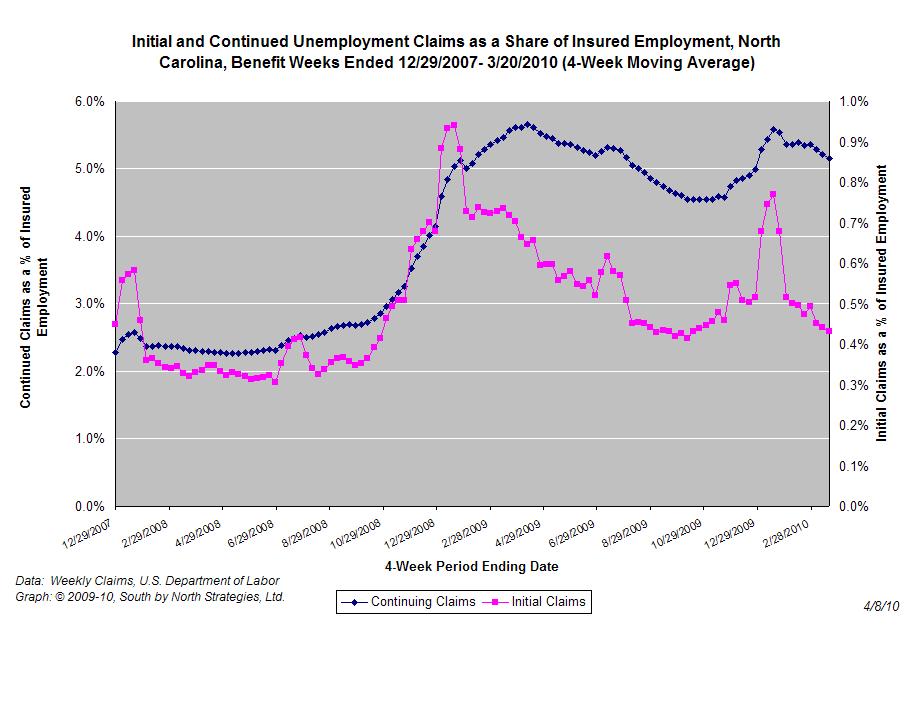
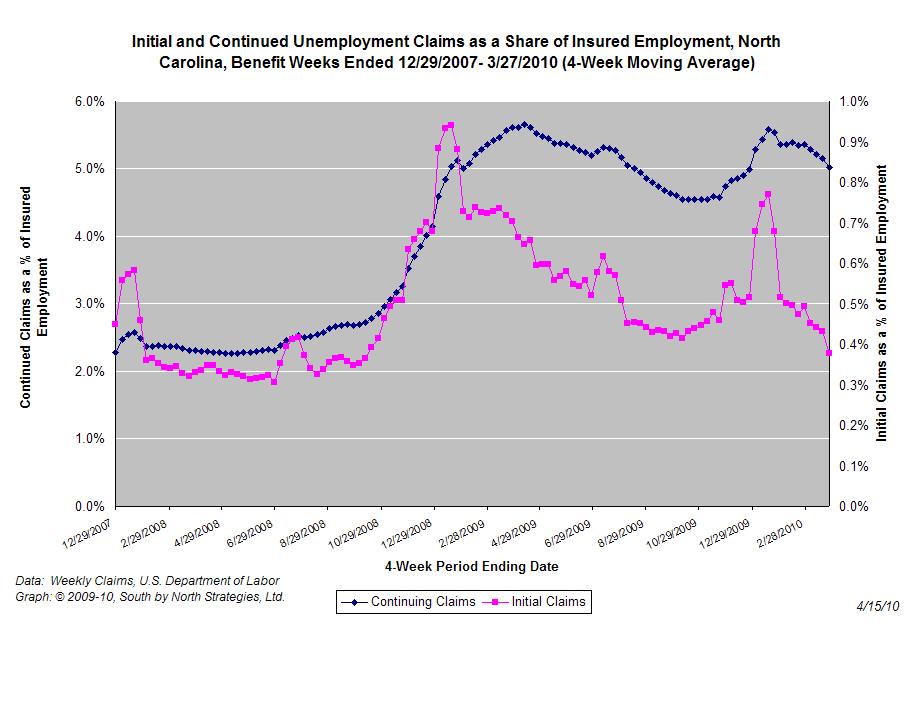
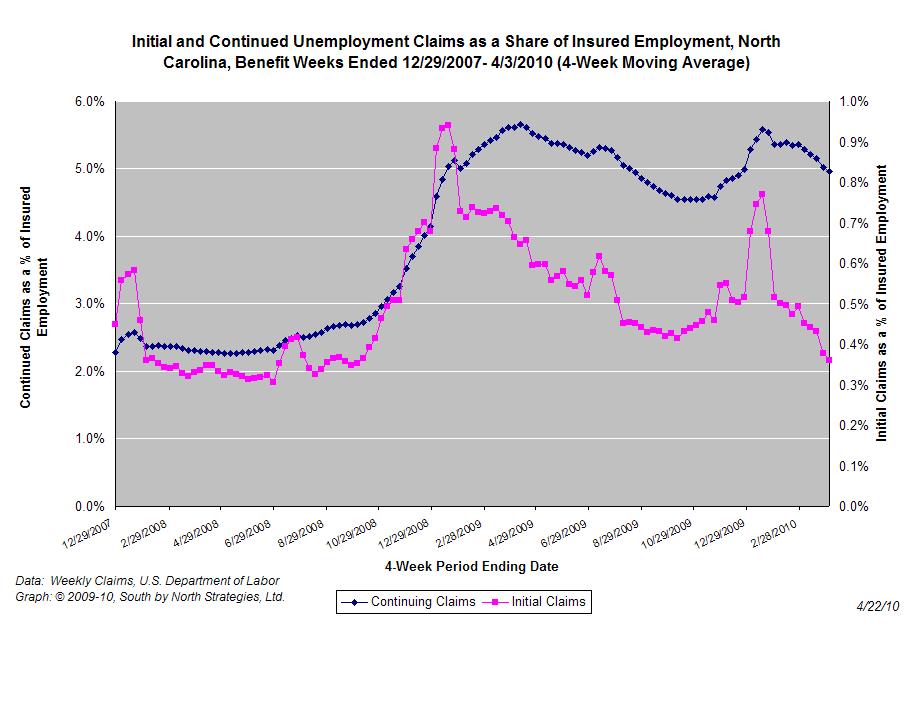
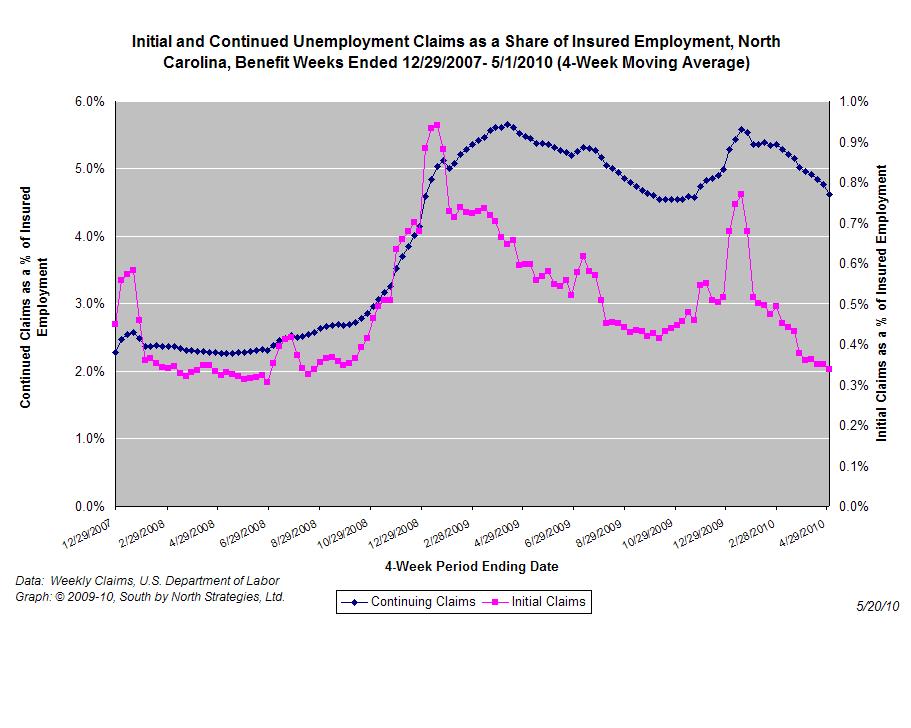
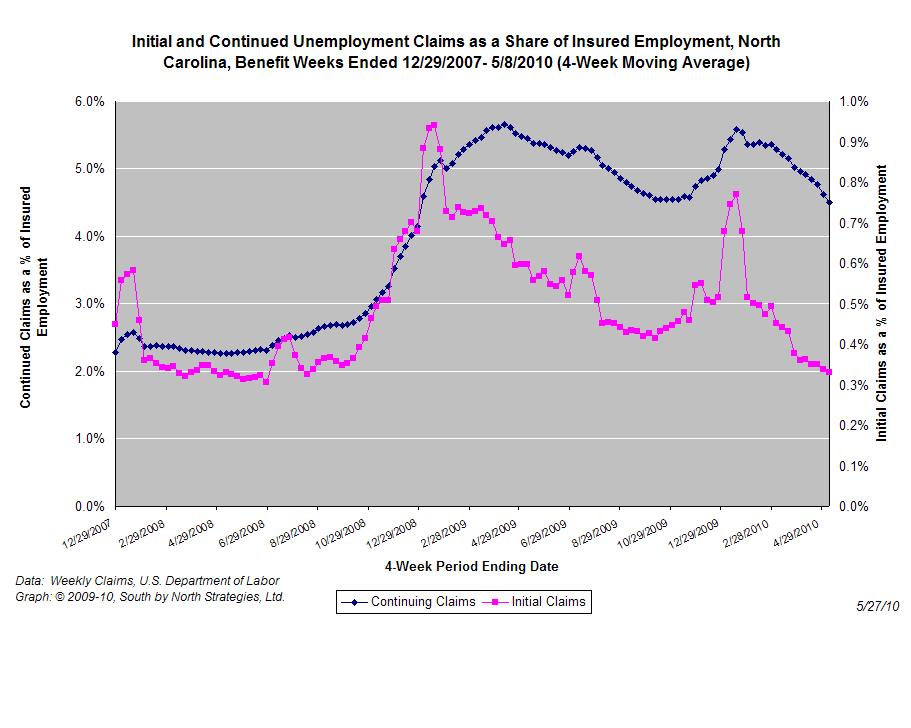
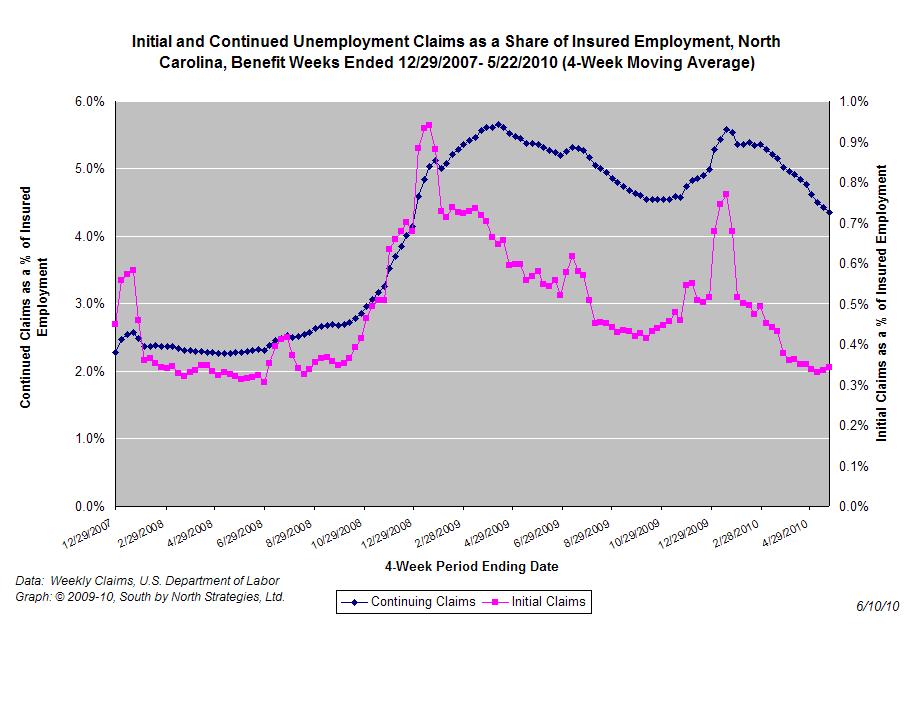
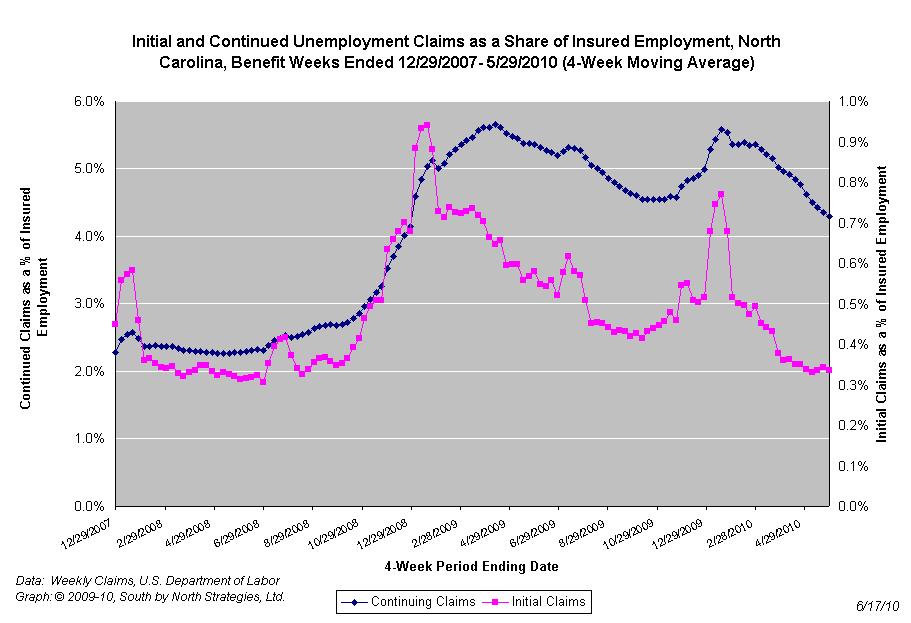
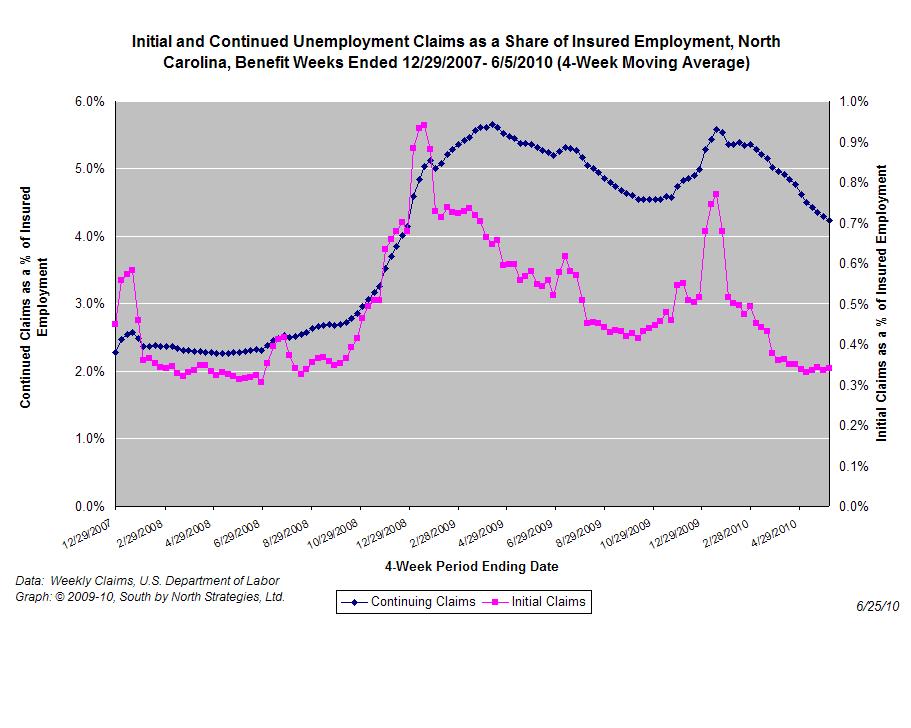
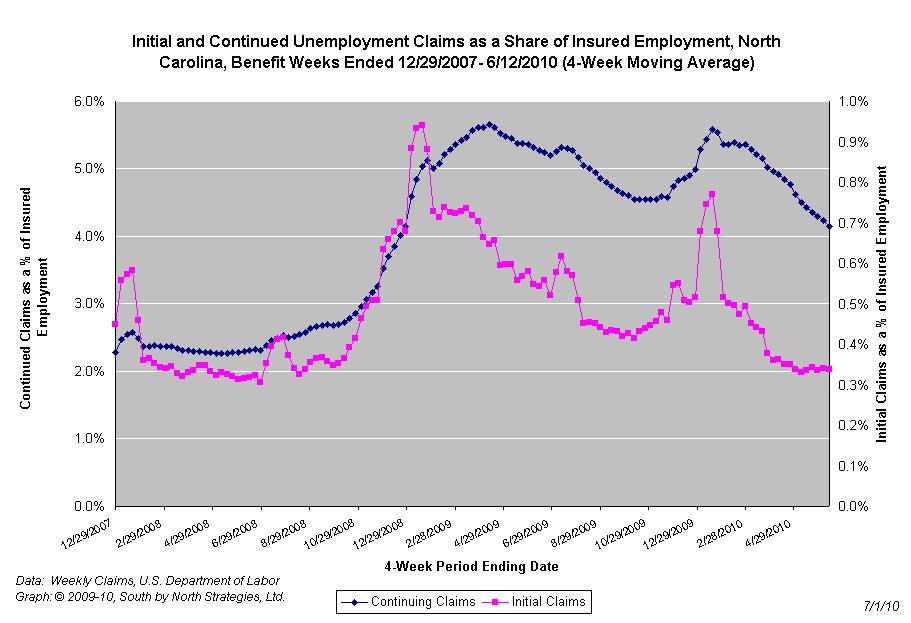
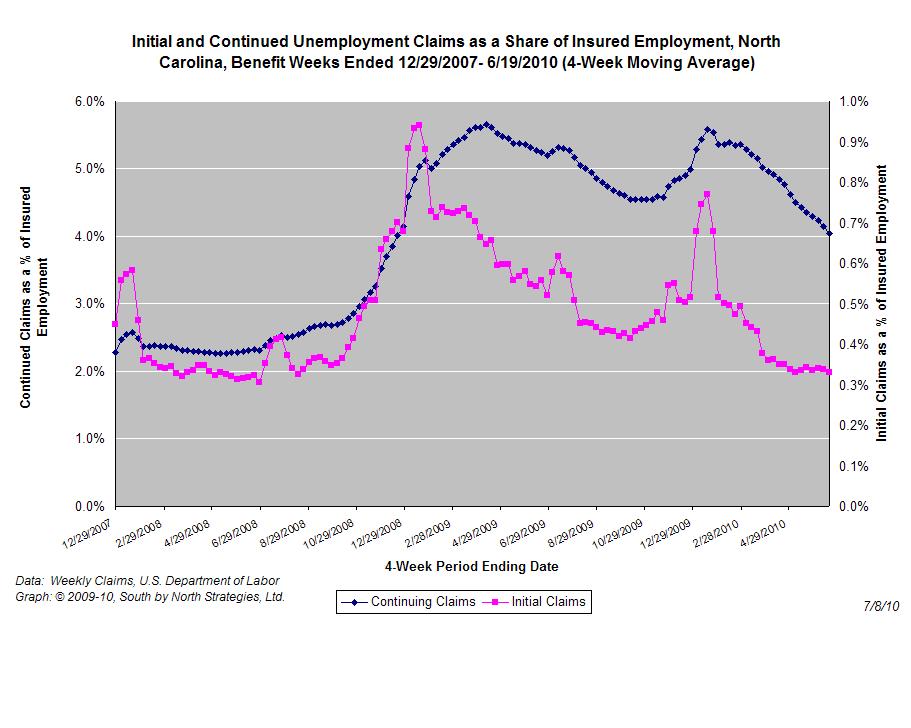
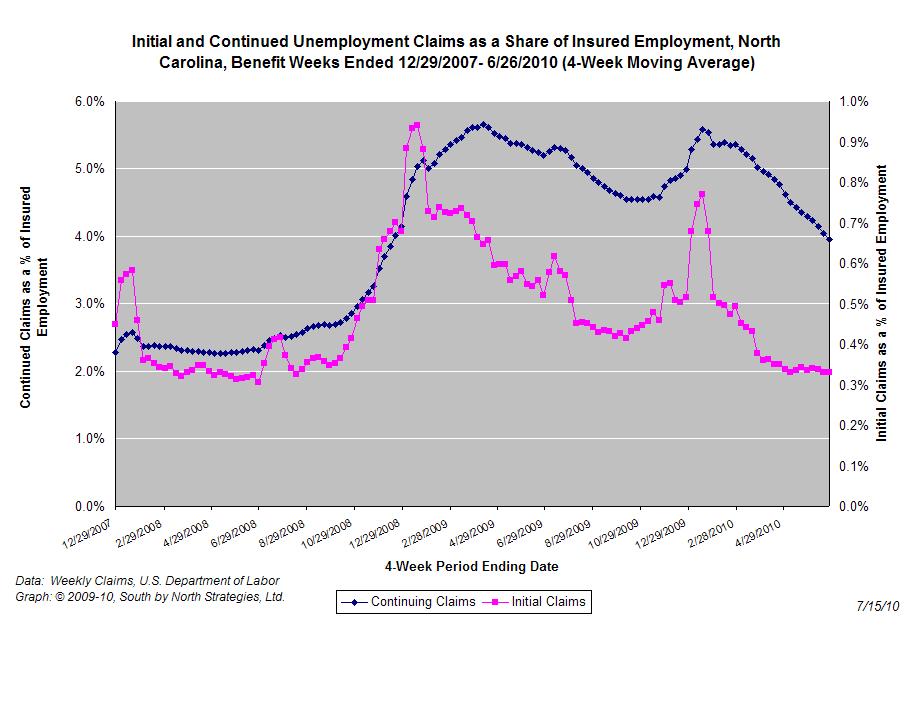
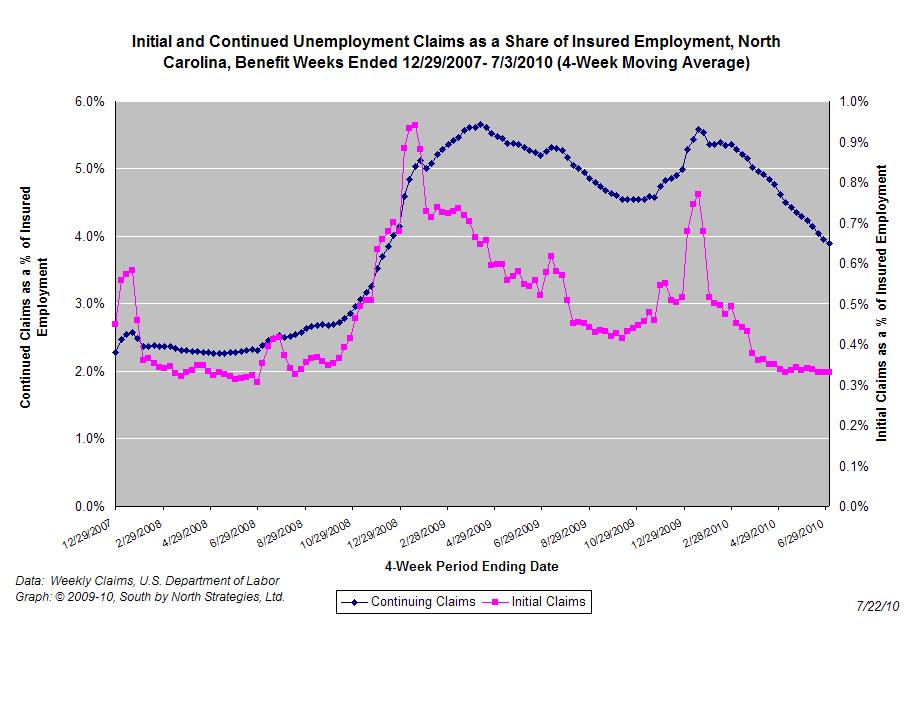
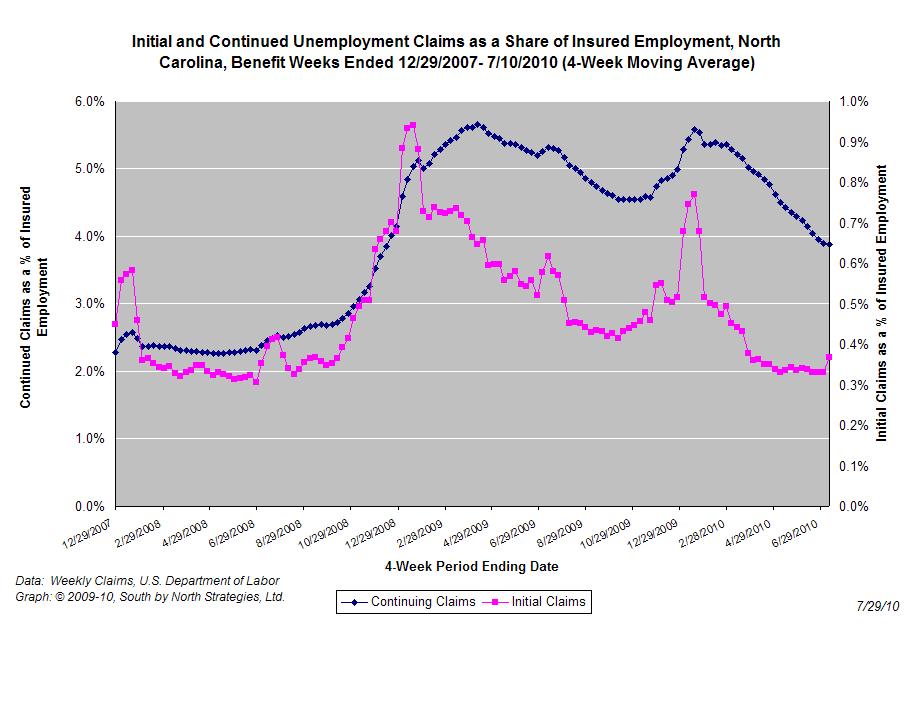
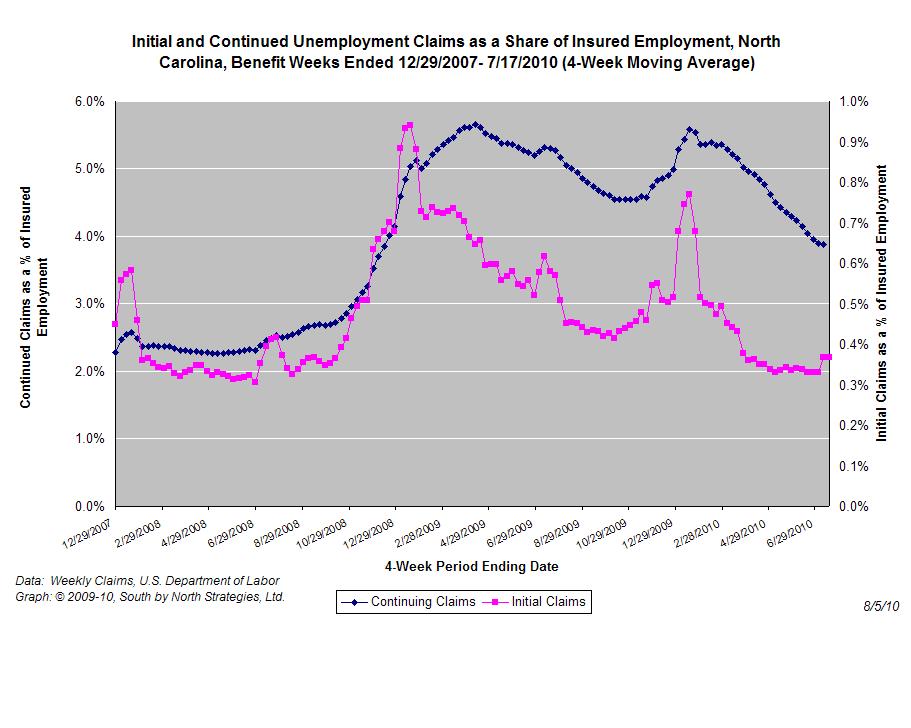
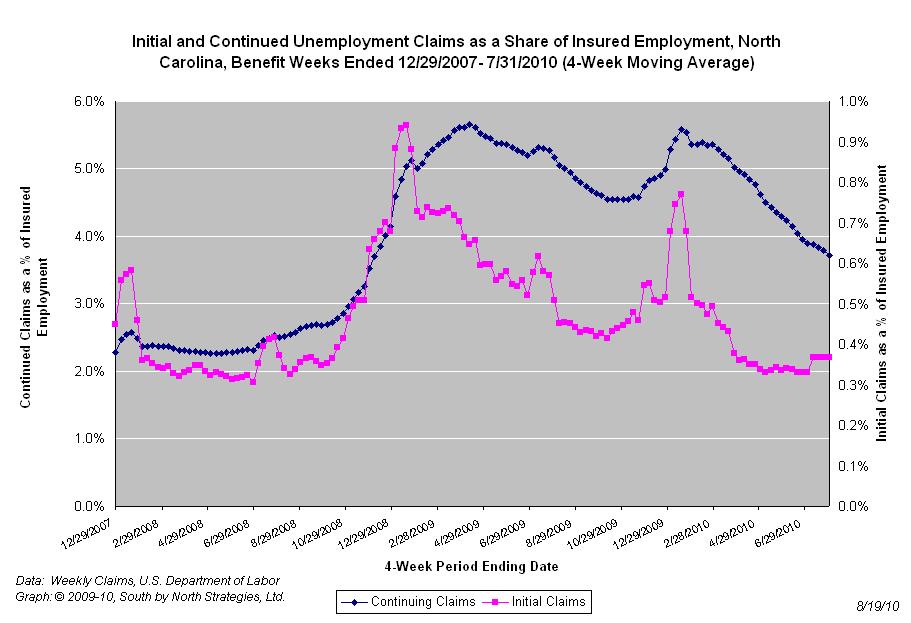
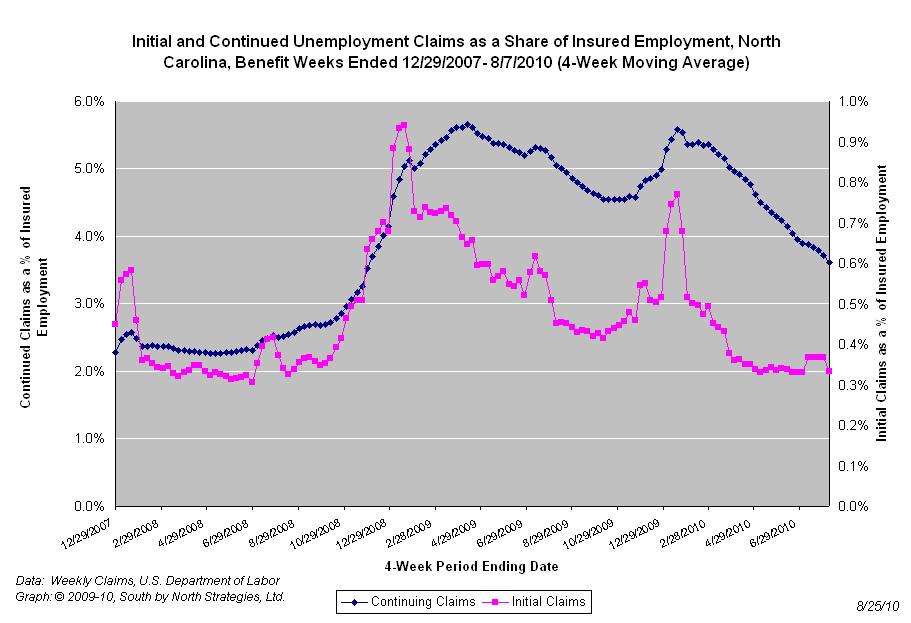
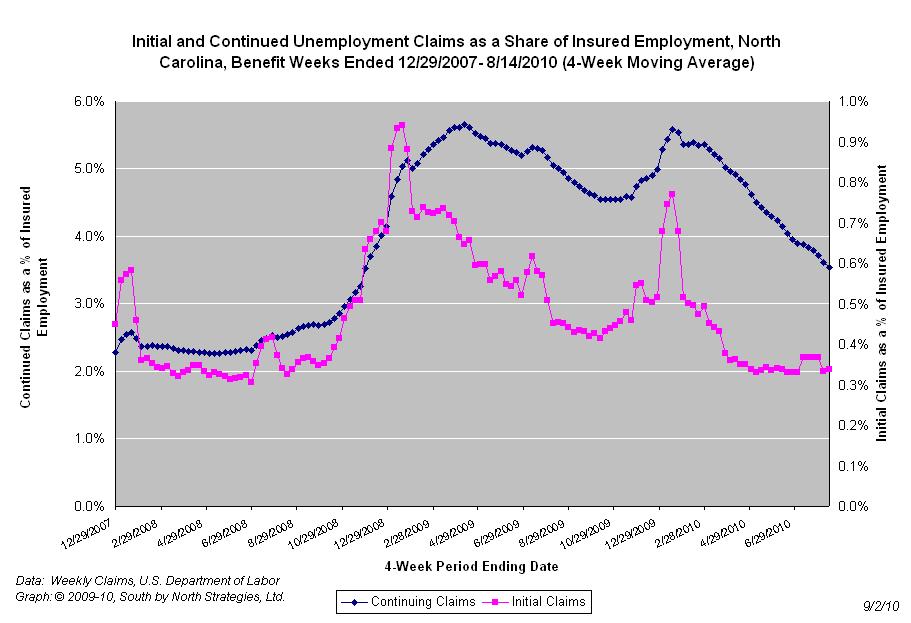
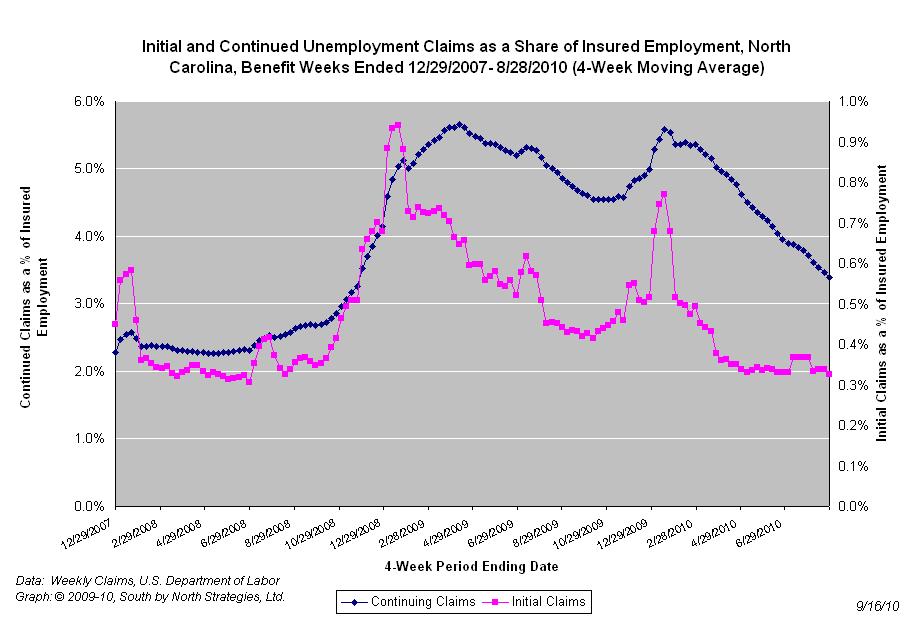
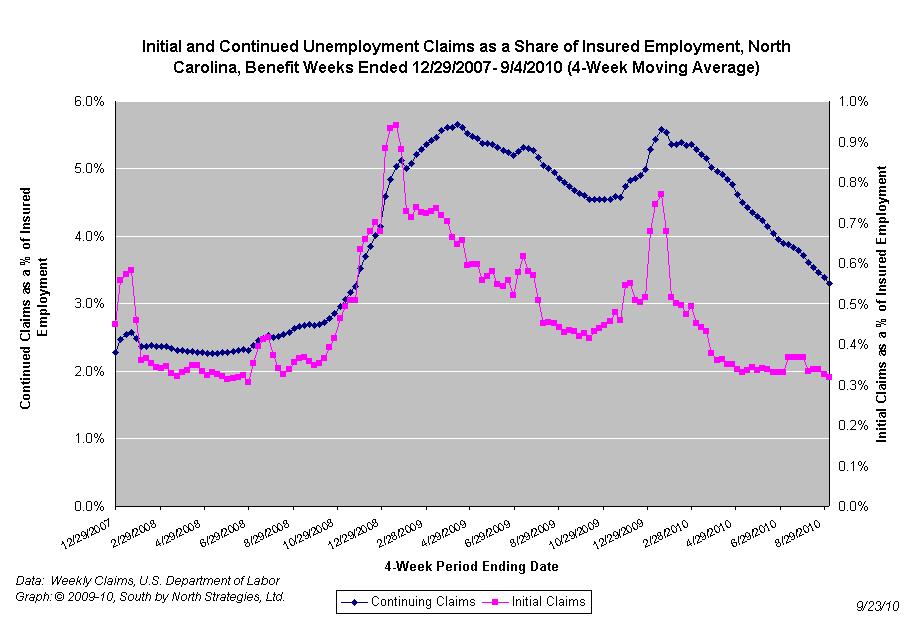
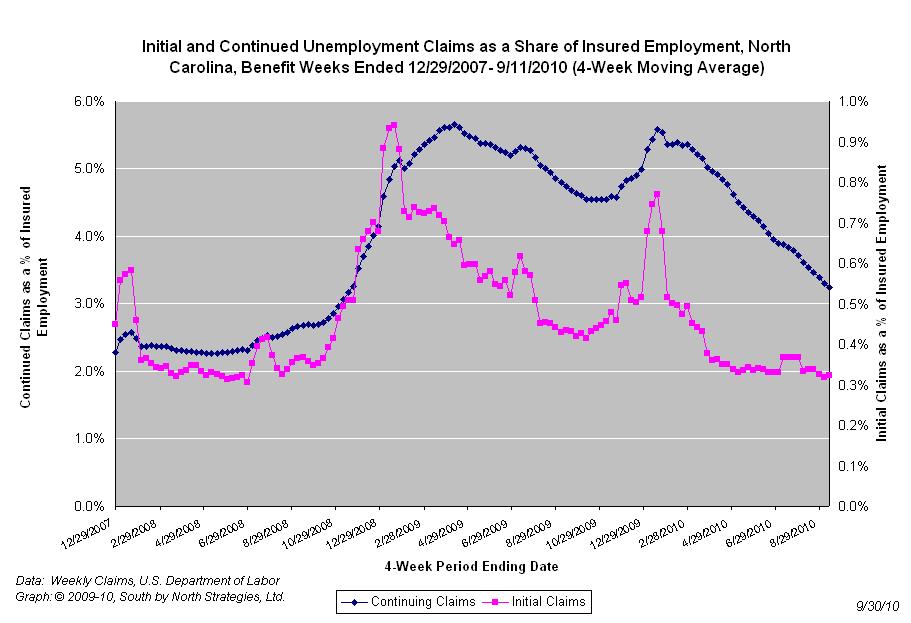
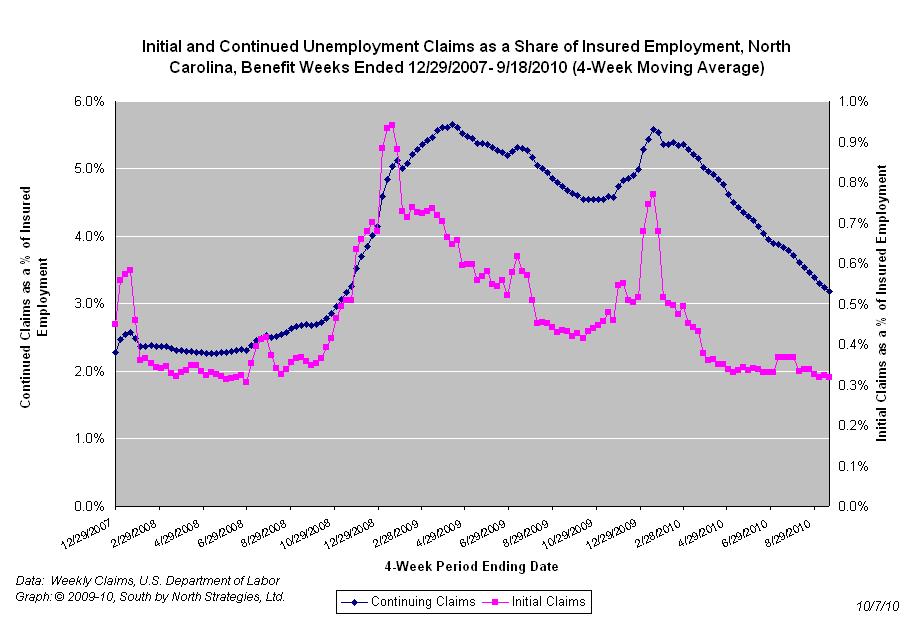
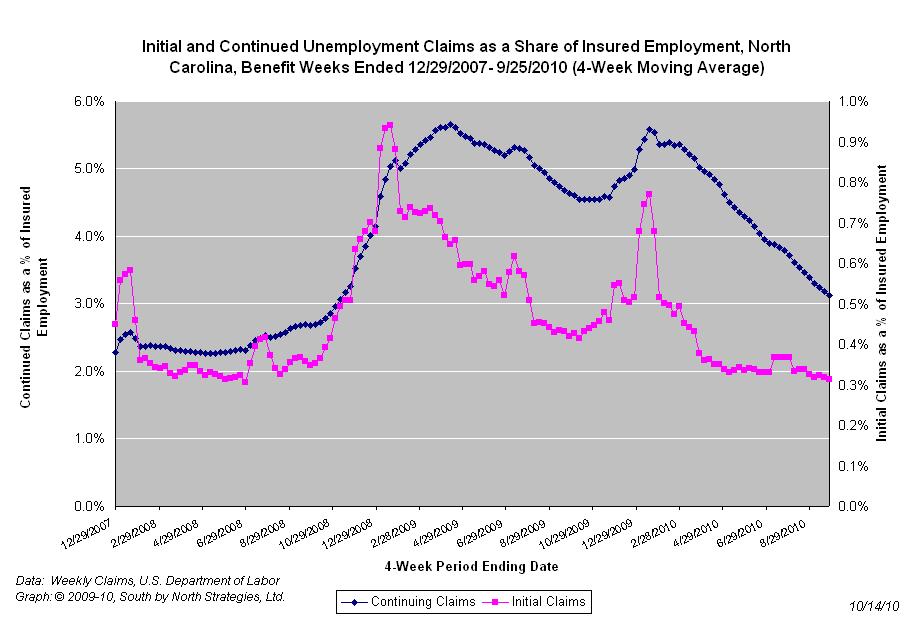
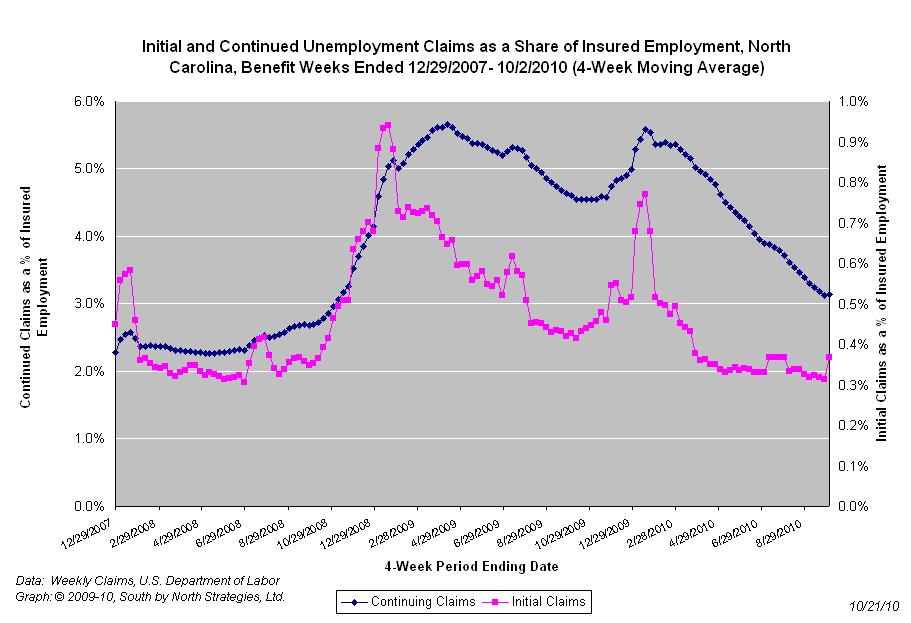
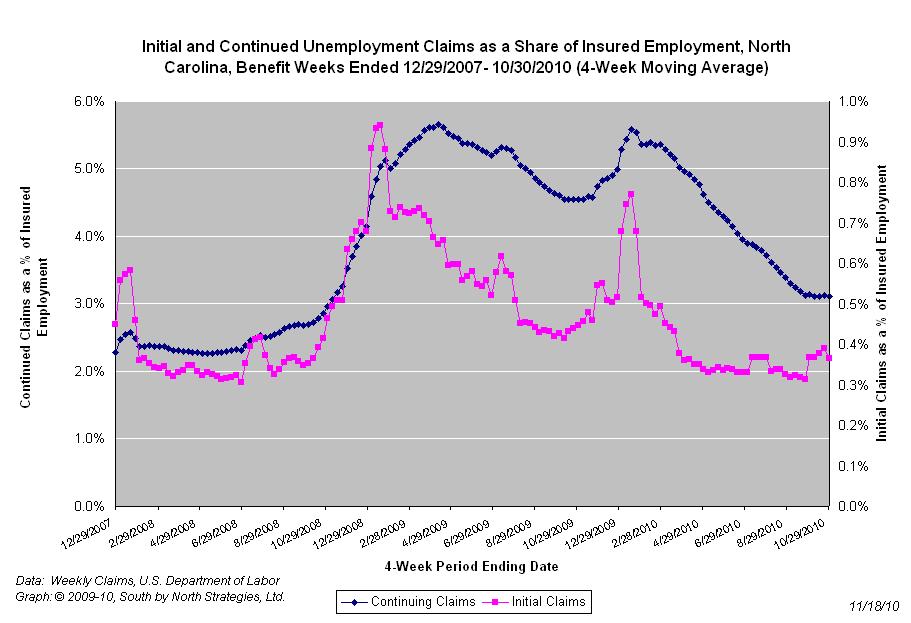
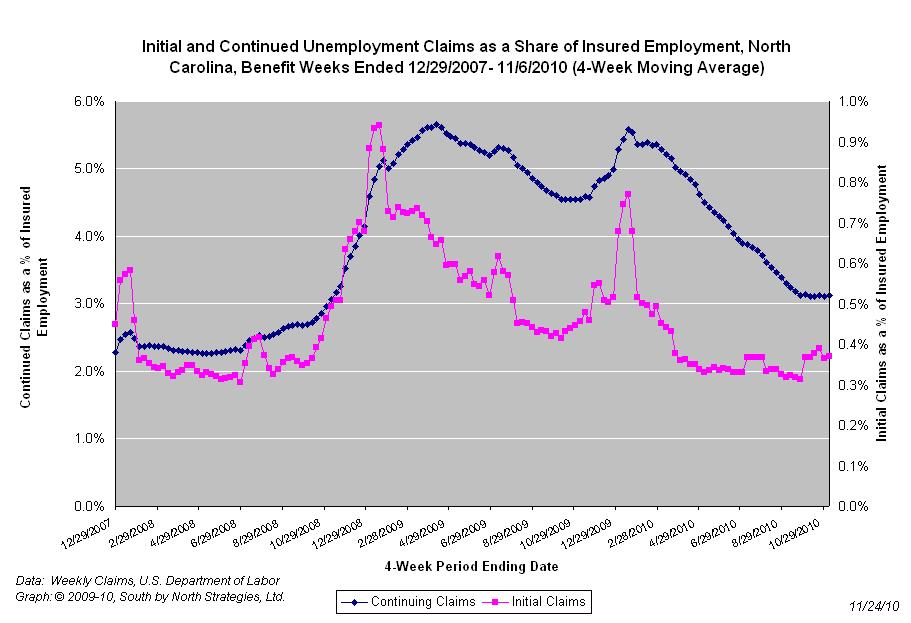
The graph (right) shows the changes in unemployment insurance claims (as a share of covered employment) in North Carolina since the recession’s start in December 2007.
Both new and continuing claims appear to have peaked for this business cycle, and the four-week averages of new and continuing claims have fallen considerably. Yet continuing claims remain at an elevated level, which suggests that unemployed individuals are finding it difficult to find new positions. Also, new claims have been on the rise since the end of September.
Also, little change has occurred within recent months. Since April 2010, the four-week average of initial claims consistently has ranged between 14,281 and 11,200.
The Failure of 401(k) Plans
A recent research report from Demos, a public policy organization in New York City, chronicles the ways in which 401(k) plans have failed to help Americans save enough money for retirement. From the report …
The retirement security of American families has crumbled in the past generation. Workers retiring in the next 20 years can expect to receive only 65 percent during retirement of what they made during their working years, a drop of 16 percent from their parents. Foreboding economic forecasts for flat wages, high unemployment, and rising costs of big-ticket necessities such as education and medical care suggest that young workers today could be on even shakier ground. Only 59 percent of full time workers have access to retirement plans at work, leaving a large part of the workforce to rely solely on Social Security benefits that are inadequate for a comfortable retirement and are under further attack by political opponents.1Much of the decline in retirement security is due to the shift in the private sector from providing retirement benefits through traditional pensions, which guaranteed a lifetime stream of income at retirement, to less secure individual retirement accounts, whose benefits vary with the size of employer and employee contributions, and the volatile swings of the stock market.
 Email Sign-Up
 RSS Feed