State Coincident Indicators: August
Economic conditions remained weak across much of the nation in August, according to the newest State Coincident Indexes Report prepared by the Federal Reserve Bank of Philadelphia.
In August coincident indexes moved in a positive direction in 27 states and in a negative direction in 16 states. No changes occurred in seven states.
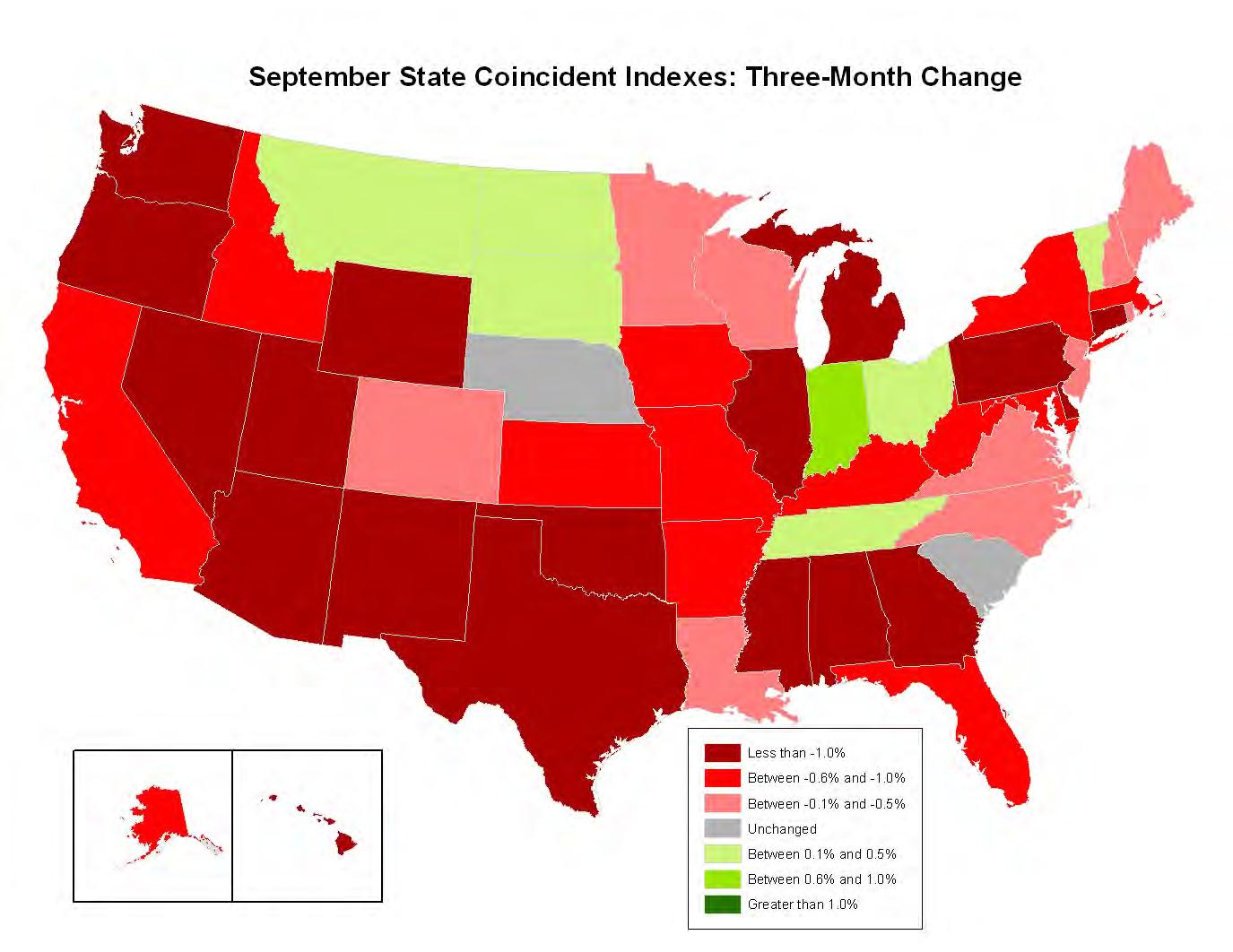
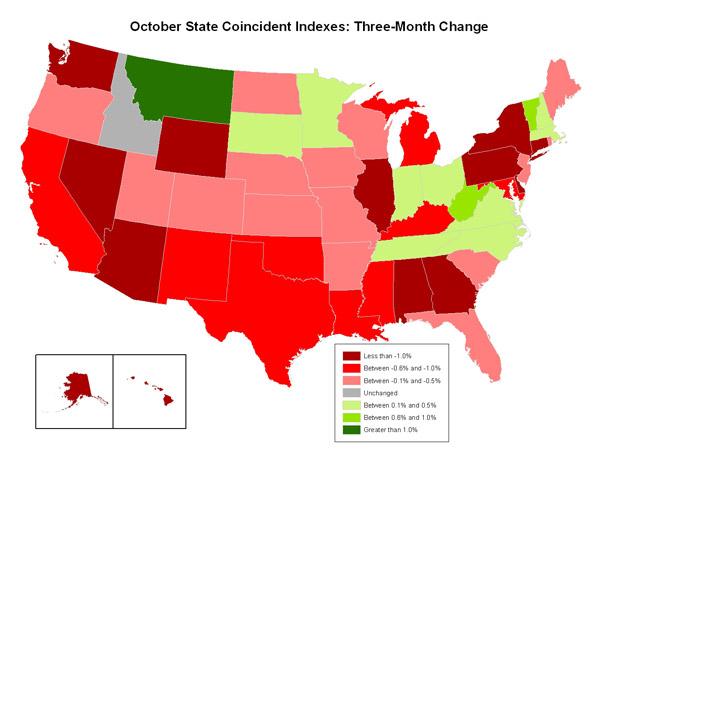
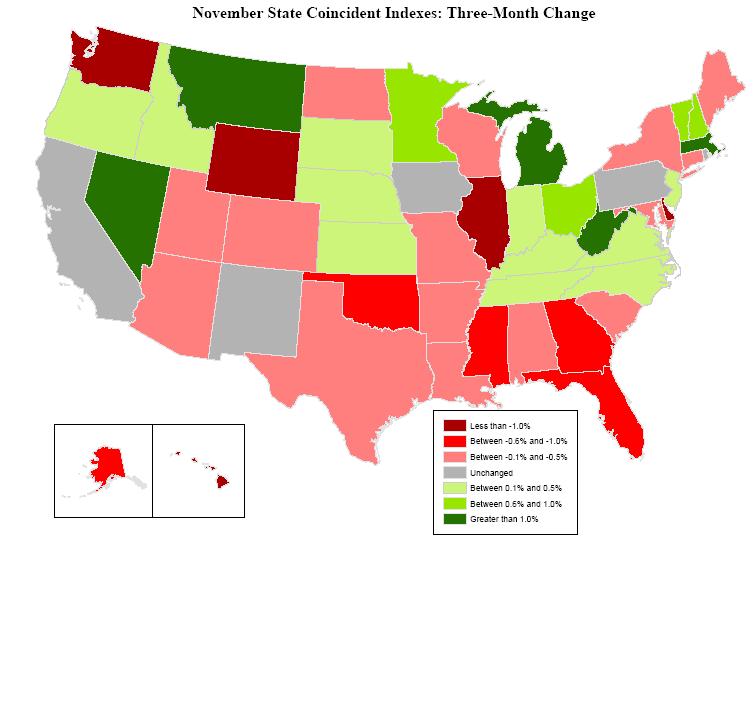
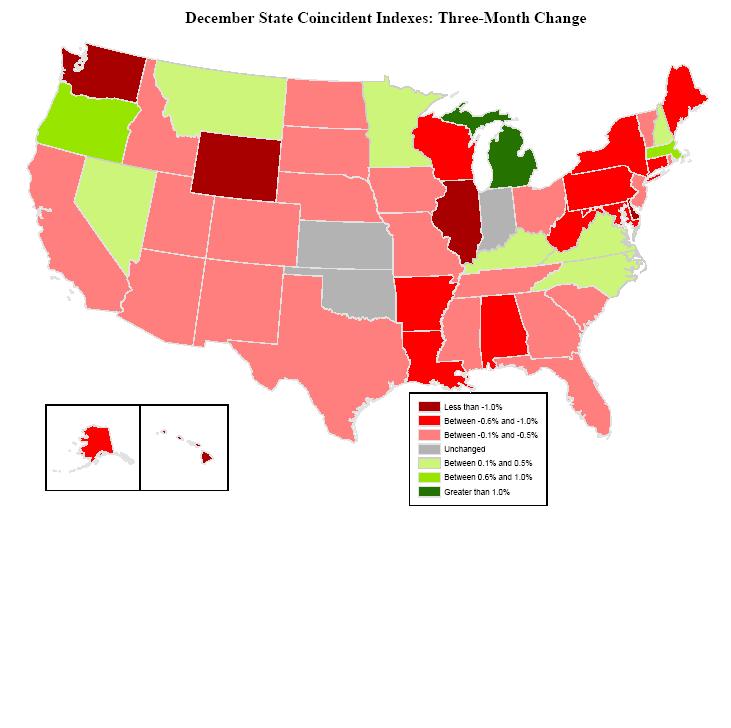
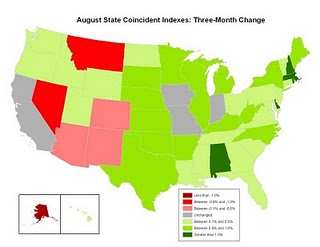 The map to the right, which is taken from the Reserve Bank’s survey, shows the three-month changes in coincident indicators by state. Positive numbers denote improvements in economic conditions, and negative numbers refer to declines.
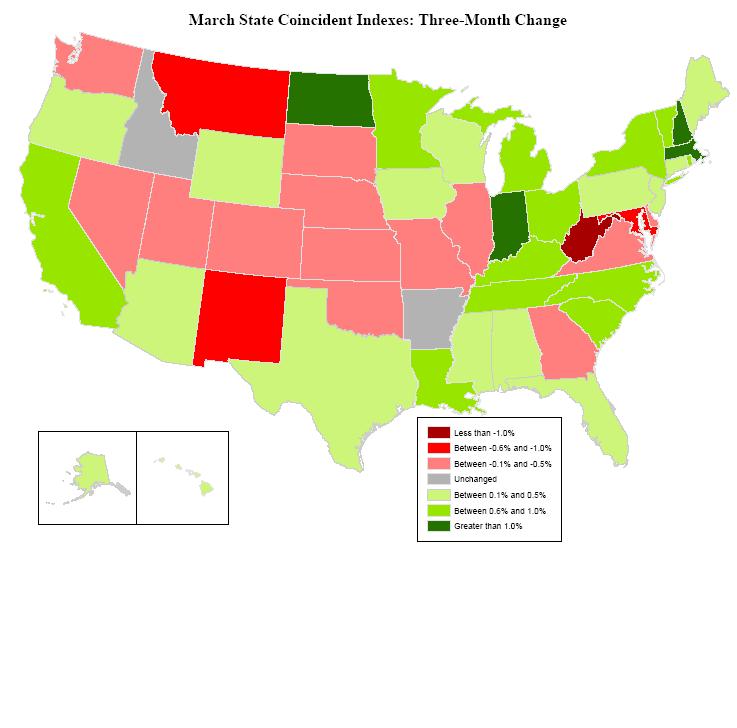
Over the last three months, coincident indexes increased in 40 states, decreased in six states and held steady in four states.
During the same three-month period, North Carolina’s coincident index moved in a positive direction, which suggests improvements in local economic conditions.
Around The Dial – September 27
Economic policy reports, blog postings, and media stories of interest:
- Economist’s View reports on the Bush-era tax cuts.
- The Baseline Scenario looks at “bad” arguments against tax changes.
- Bob Herbert argues that the economy hasn’t hit bottom yet.
- Richard Thaler weighs in on the national tax debate.
South by North Strategies In The News
The research and perspectives of South by North Strategies, Ltd. has been featured in numerous media stories over the past few weeks. Most of the stories touch on issues related to the job market, current economic conditions, and public policy.
- The News & Observer: “Area jobless rate shows uptick”
- The Winston-Salem Journal: “Slight job shift hopeful”
- The High Point Enterprise: “August unemployment rate inches down”
Additionally, last week South by North Strategies present its recent report, Widening the Doorways of Opportunity, to the rural affinity group of the National Fund for Workforce Solutions.
The Recovery Act at Work
A new policy brief from the N.C. Budget & Tax Center finds that the American Recovery and Reinvestment Act has helped to keep 206,000 North Carolinians out of poverty. Recovery act provisions also have shielded an additional one million Tar Heels from additional economic hardship. From the center’s brief …
The Make Work Pay tax credit, improvements to the Child Tax Credit, Earned Income Tax Credit, unemployment insurance benefits and food stamp levels as well as one-time payments to the elderly and disabled. This aid not only lessened the economic hardship for these families but also spurred the economic recovery as low-income families are most likely to spend quickly the money they receive. Thus, the Recovery Act was estimated to create or save between 1.3 and 2.7 million jobs maintaining workers source of income and reducing the risk of being pushed into poverty by job loss.
…
For North Carolinians, the rough estimates by the Center on Budget and Policy Priorities in December 2009 suggested that 206,000 North Carolinians were kept out of poverty as a result of the Recovery Act. A million North Carolinians did not experience the full severity of economic hardship because their incomes were lifted through these provisions.
Around The Dial – September 24
Economic policy reports, blog postings, and media stories of interest:
- Calculated Risk breaks down the new HMAP data.
- The Charlotte Observer reports on North Carolina’s “benefit bank.”
- The Baseline Scenario asks what is next for the Federal Reserve.
- TaxVox looks at the GOP plan to raise deficit spending.
- Triangle Business Journal reports on the TAA program.
 Email Sign-Up
 RSS Feed