Weak Economic Conditions Prevail in August
CHAPEL HILL (September 24, 2010) – Local labor market conditions remained weak across much of North Carolina in August, according to preliminary data released today by the Employment Security Commission. Last month, 50 counties posted double-digit unemployment rates, while 17 counties recorded rates of at least 12 percent.
“The basic local employment picture was unchanged in August,” says John Quinterno, a principal with South by North Strategies, Ltd., a research firm specializing in economic and social policy. “Although conditions in some communities improved somewhat, joblessness and the accompanying problems remained widespread.”
Since the onset of the recession in December 2007, North Carolina has shed 6.2 percent of its payroll employment base (-259,500 positions) and has watched its unadjusted unemployment rate climb from 4.7 percent to 9.8 percent. Although the state gained 18,600 more positions than it lost in August, almost all of those gains were due to an expected rise in public education employment. After accounting for that development, the state netted just 4,800 positions.
Every part of the state experienced weak labor markets in August. Unemployment rates exceeded 10 percent in 50 counties, and in 17 counties, at least 12 percent of the labor force was jobless and actively seeking work. County unemployment rates ranged from 4.1 percent in Currituck County to 15.7 percent in Scotland County.
“Labor markets in non-metropolitan communities remain quite weak,” adds Quinterno. “Last month, 10.6 percent of the non-metro labor force was unemployed, compared to 9.4 percent of the metro one. More alarmingly, the non-metropolitan labor force continued to shrink. Between August 2009 and August 2010, the non-metropolitan labor force contracted by 2.5 percent. Many of those missing individuals are effectively jobless.”
Last month, unemployment rates fell in all 14 of the state’s metropolitan areas. Rocky Mount had the highest unemployment rate (12.7 percent), followed by the Hickory-Morganton-Lenoir area (12.6 percent). Durham-Chapel Hill had the lowest rate at 7.3 percent.
“Because of the lack of seasonal adjustments, monthly fluctuations in local unemployment rates must be interpreted cautiously, particularly during the volatile summer months,” warns Quinterno. “A better comparison is an annual one.”
Compared to August 2009, unemployment rates were lower in 90 counties and every metro area. Yet compared to a year ago, 71 counties and 8 metro areas had smaller labor forces. Among metros, Hickory-Morganton-Lenoir posted the largest decline in the size of its labor force (-3.6 percent), followed by Rocky Mount (-2.5 percent). Jacksonville posted the largest gain (+6.8 percent).
“Recent drops in unemployment rates have been driven not by improvements in underlying conditions, but by workers abandoning the job market,” cautions Quinterno. “The robust job growth needed to absorb displaced individuals and new workers is not happening.”
In the long term, any meaningful recovery will be driven by growth in the state’s three major metro regions: Charlotte, the Research Triangle, and the Piedmont Triad. Yet job growth in 2010 has been sluggish. Collectively, employment in these three major metro regions has fallen by 4.2 percent since the start of the recession. The overall August unemployment rate in the major metros equaled 9.4 percent. Of the three areas, the Research Triangle had the lowest unemployment rate (8 percent), followed by the Piedmont Triad (10.2 percent) and Charlotte (11.4 percent).
“The August jobs report illustrates just how weak local economies really are,” observes Quinterno. “Private-sector employers are not creating positions in any meaningful way, so many North Carolinians who are ready, willing, and able to work are finding themselves blocked out of the labor market. The basic pattern has not changed much since early 2009.”
One somewhat bright spot in the August report was the boost that unemployment insurance benefits provided to individual households and the state’s economy. Explains Quinterno: “Over the past 12 months, unemployed North Carolinians received $5.5 billion in regular state payments and federal emergency benefits. Those payments sparked an estimated $9 billion in statewide economic activity.”
A Long Road Ahead
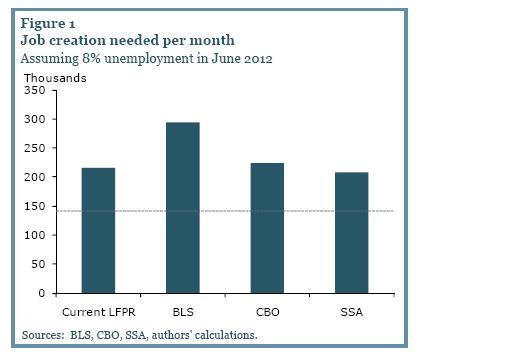
An economic letter from the Federal Reserve Bank of San Francisco argues that reductions in the national unemployment rate depend in part on changes in the labor force participation rate.
As the graph below shows, higher participation rates require the economy to generate more jobs to maintain and/or reduce the unemployment rate. To bring the rate to 8 percent by June 2012, for instance, the economy will need to generate between 208,000 and 294,000 jobs per month.
Around The Dial – September 23
Economic policy reports, blog postings, and media stories of interest:
- Martin Wolf asks what might stop the Chinese juggernaut.
- Economist’s View analyzes the Fed’s “wait- and-see” approach.
- The Charlotte Observer reports on Bank of America & regulatory reform.
- The Wall St. Journal looks at the endangered “Making Work Pay” tax credit.
NC Unemployment Claims: Week of 9/4
For the benefit week ending on September 4th, 11,800 North Carolinians filed initial claims for state unemployment insurance benefits, and 120,085 individuals applied for state-funded continuing benefits. Compared to the prior week, there were fewer initial and continuing claims. These figures come from new data released by the U.S. Department of Labor.
Averaging new and continuing claims over a four-week period — a process that helps adjust for seasonal fluctuations and better illustrates trends — shows that an average of 11,982 initial claims were filed over the previous four weeks, along with an average of 124,362 continuing claims. Compared to the previous four-week period, there were fewer initial and continuing claims.
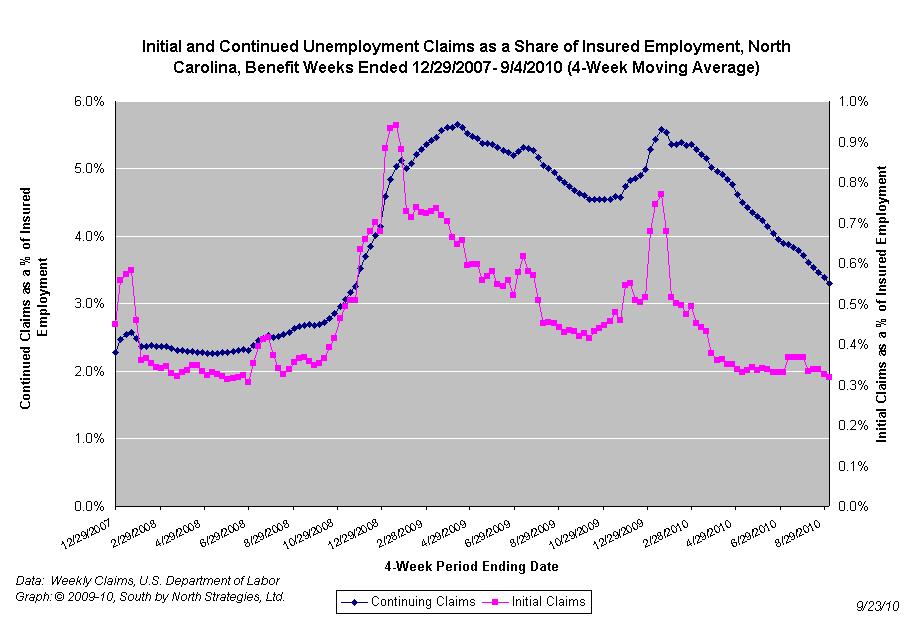 One year ago, the four-week average for initial claims stood at 17,214 and the four-week average of continuing claims equaled 191,855.
While the number of claims has dropped over the past year, so has covered employment. Last week, covered employment totaled 3.8 million, down from 4 million a year ago.
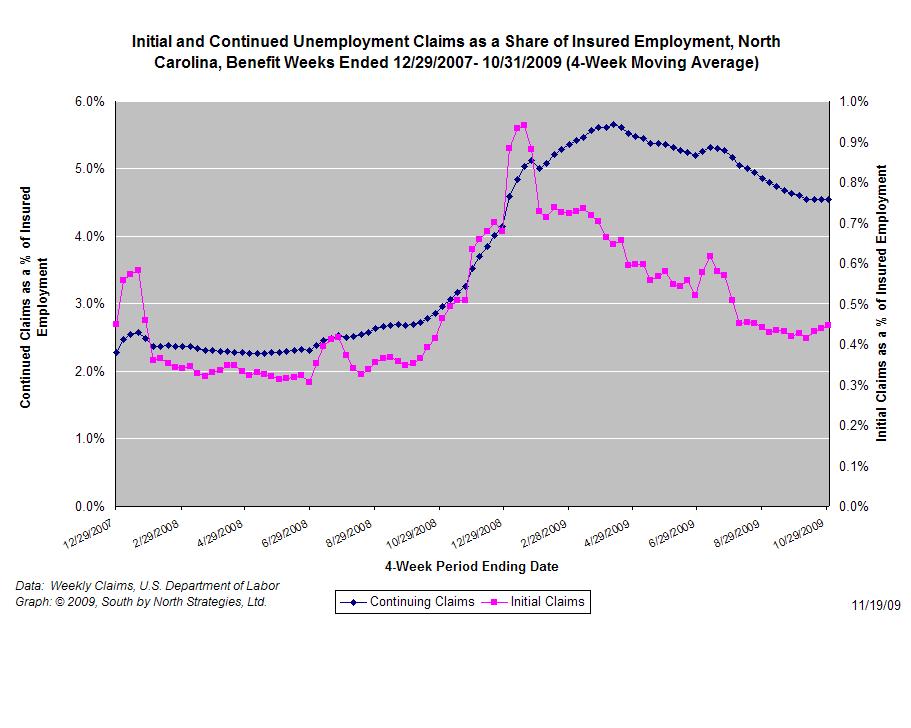
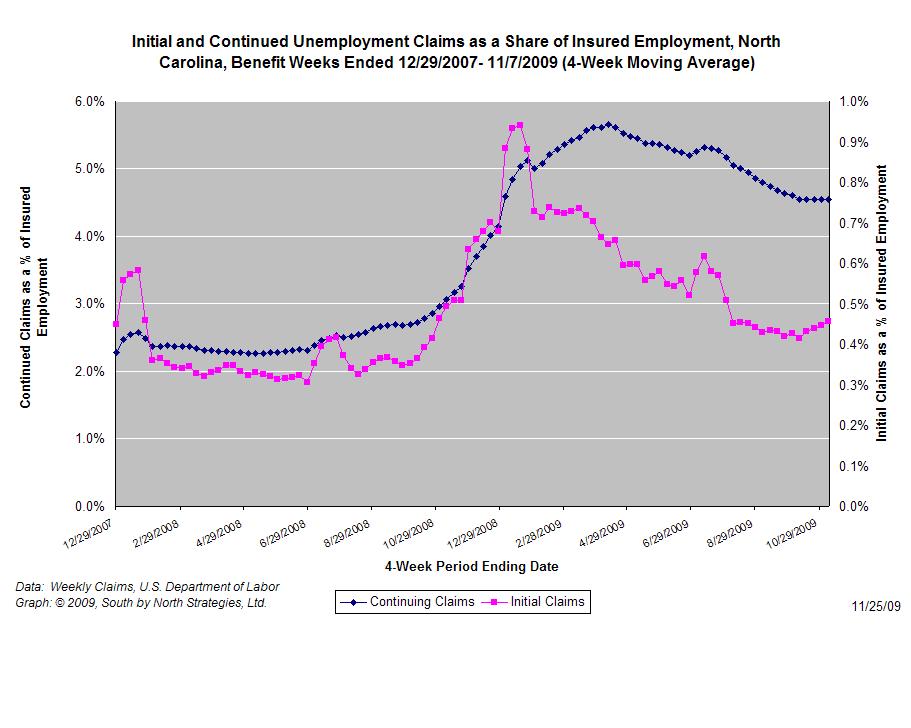
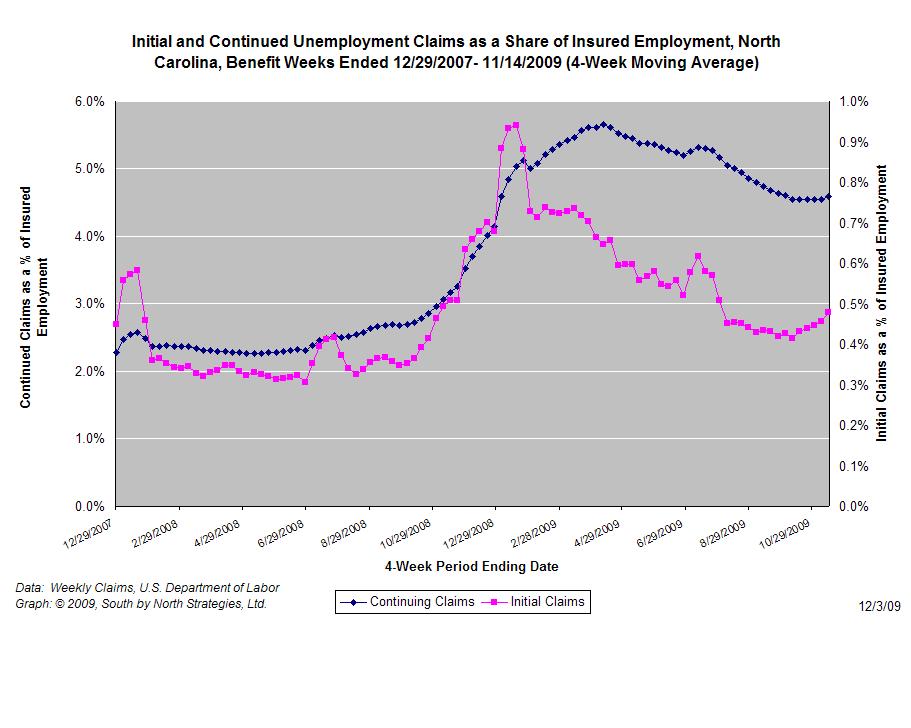
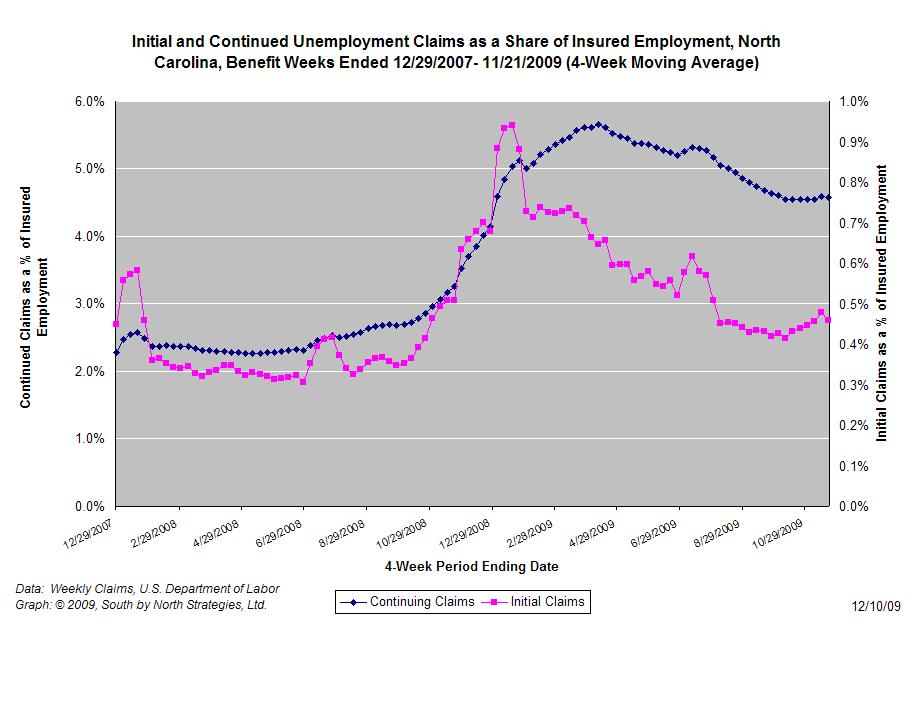
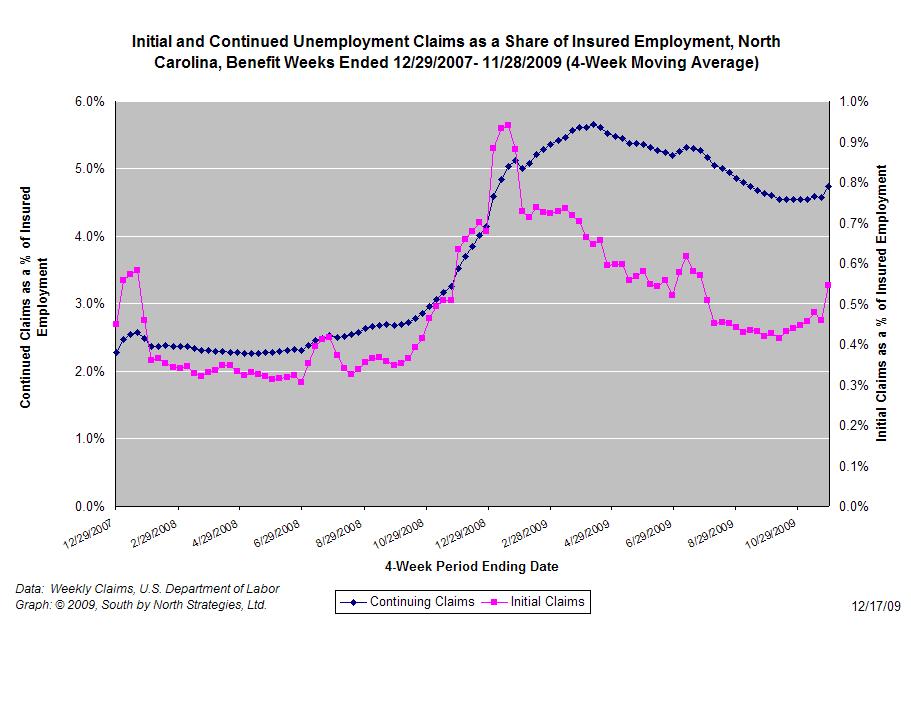
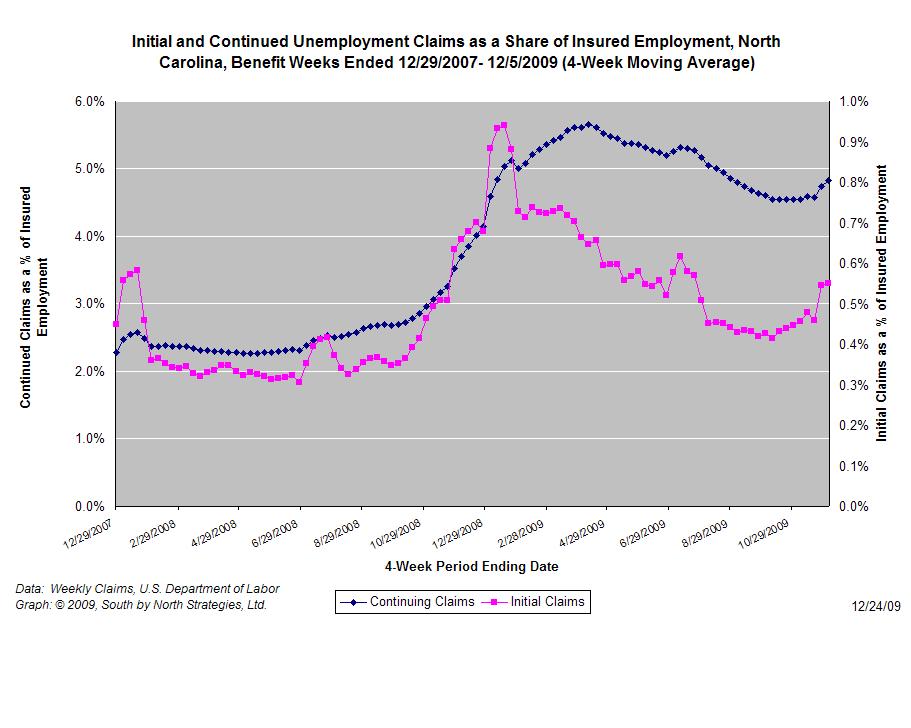
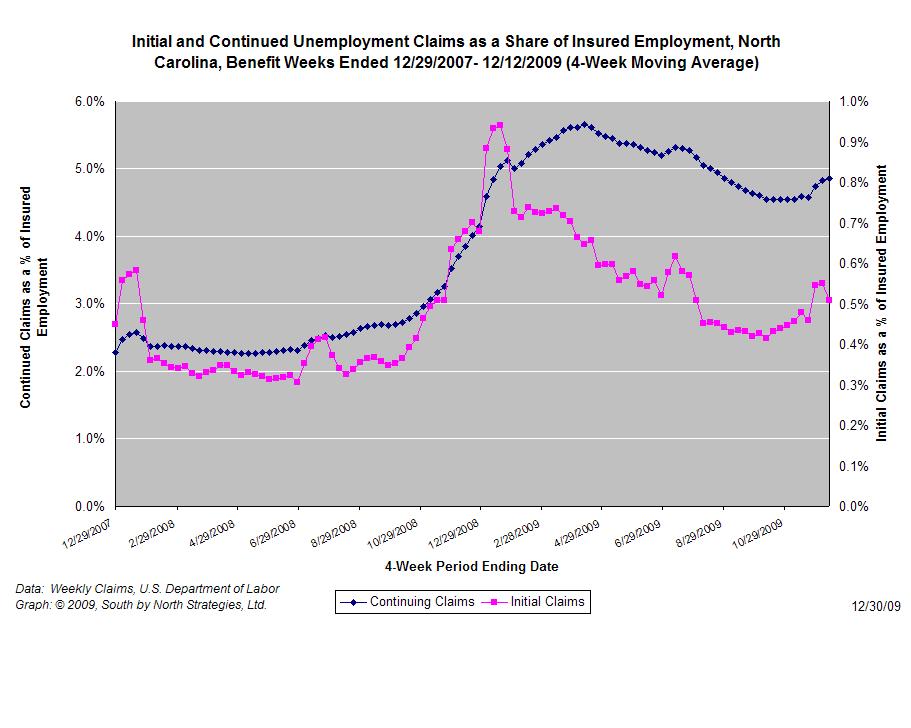
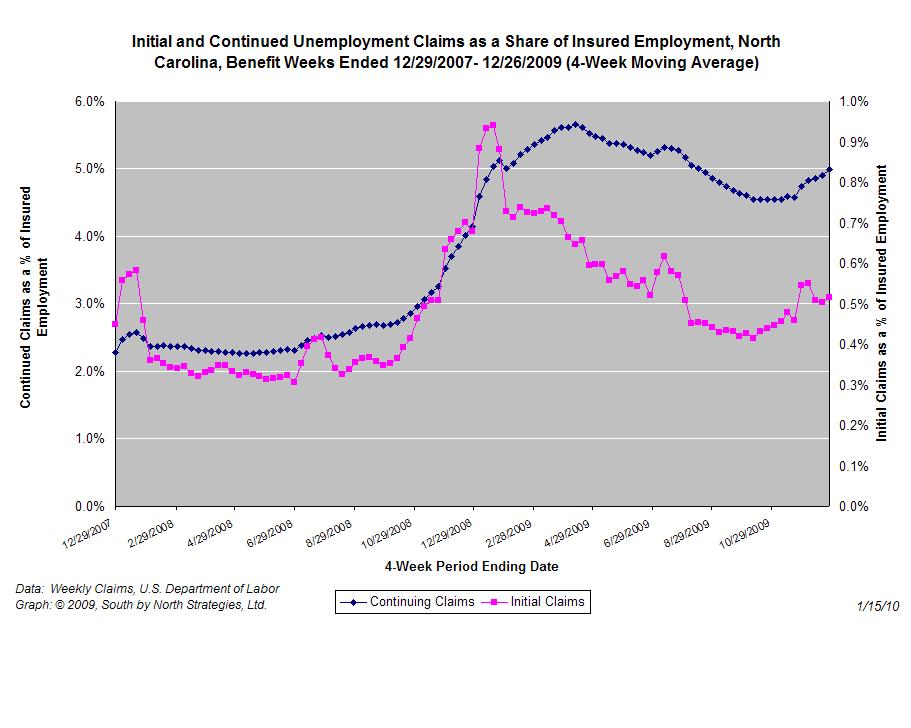
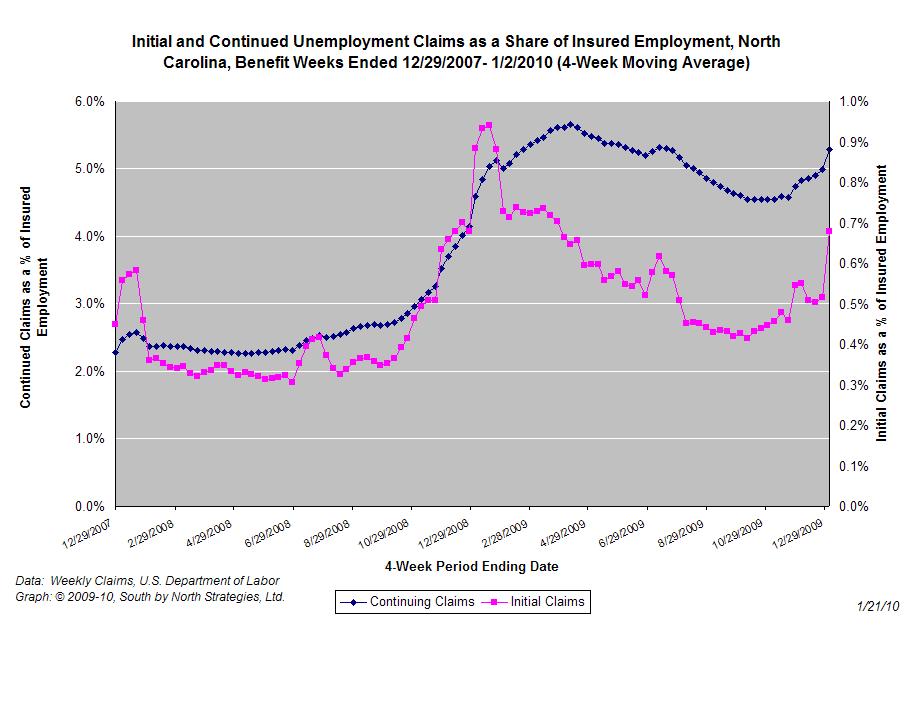
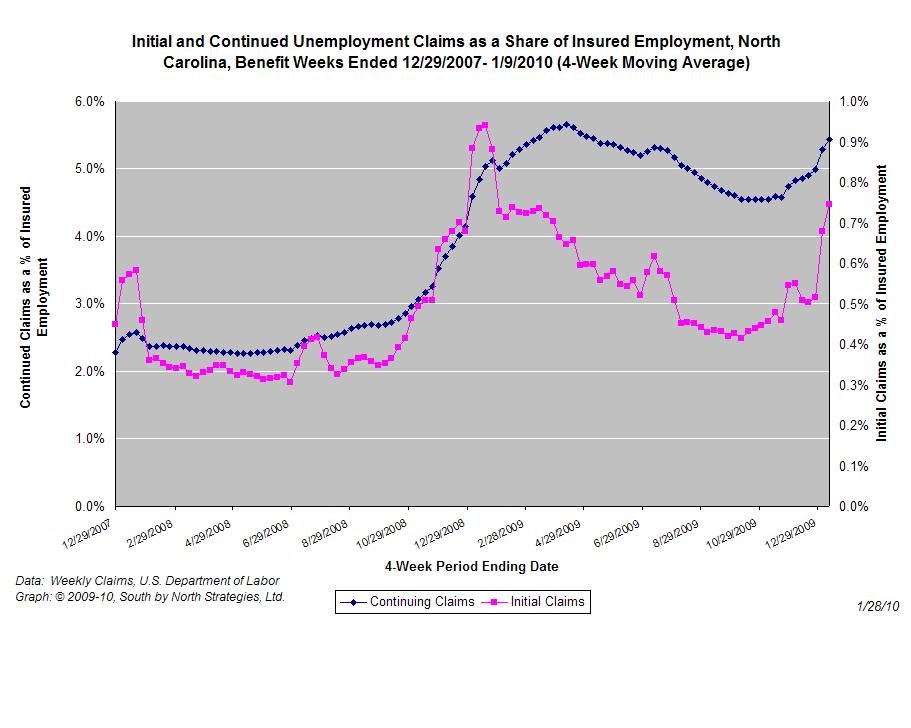
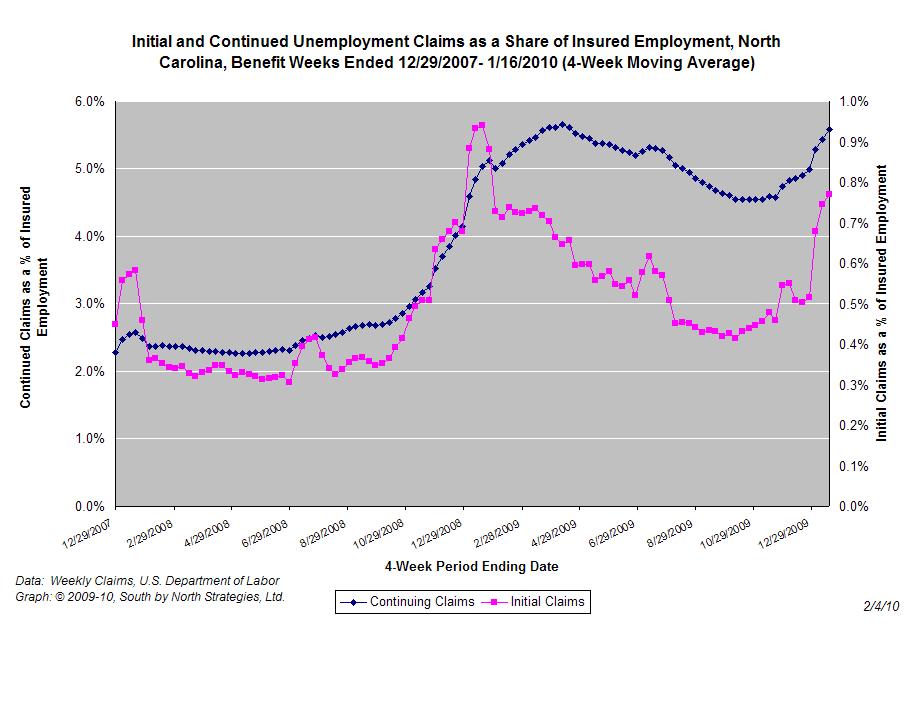
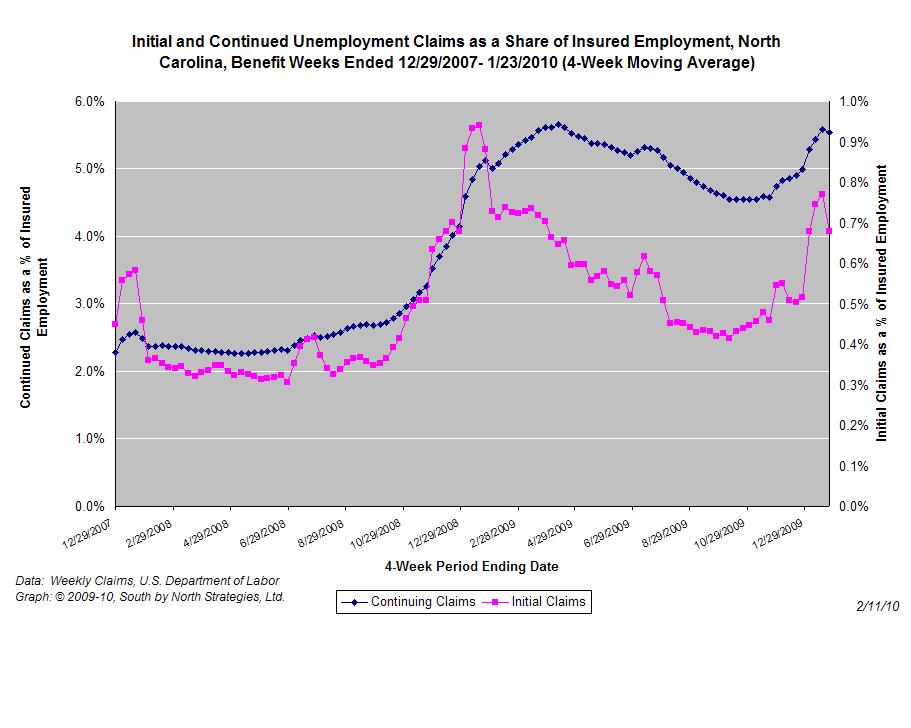
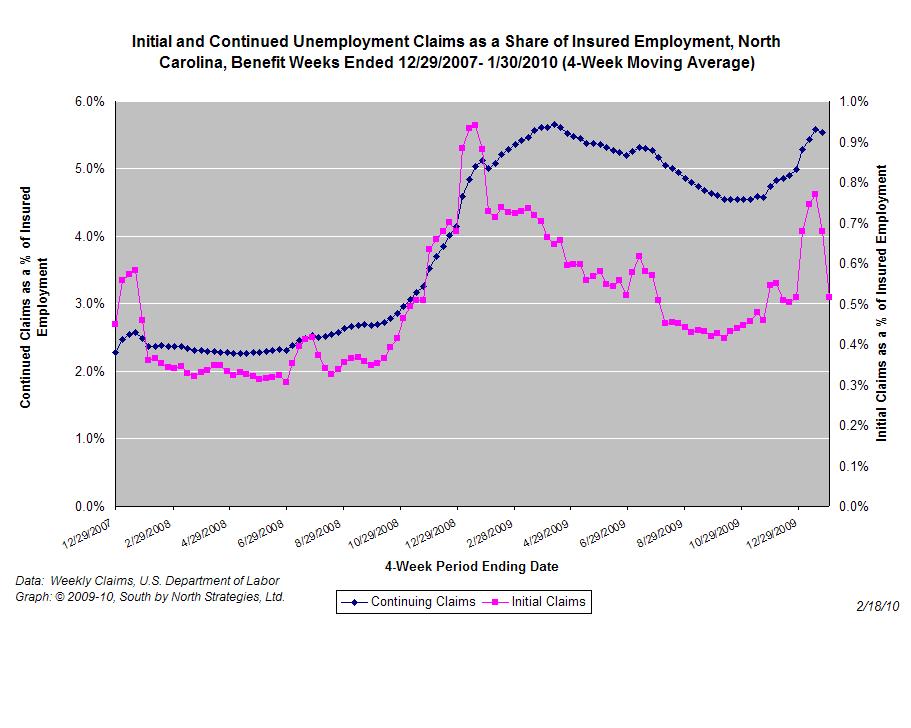
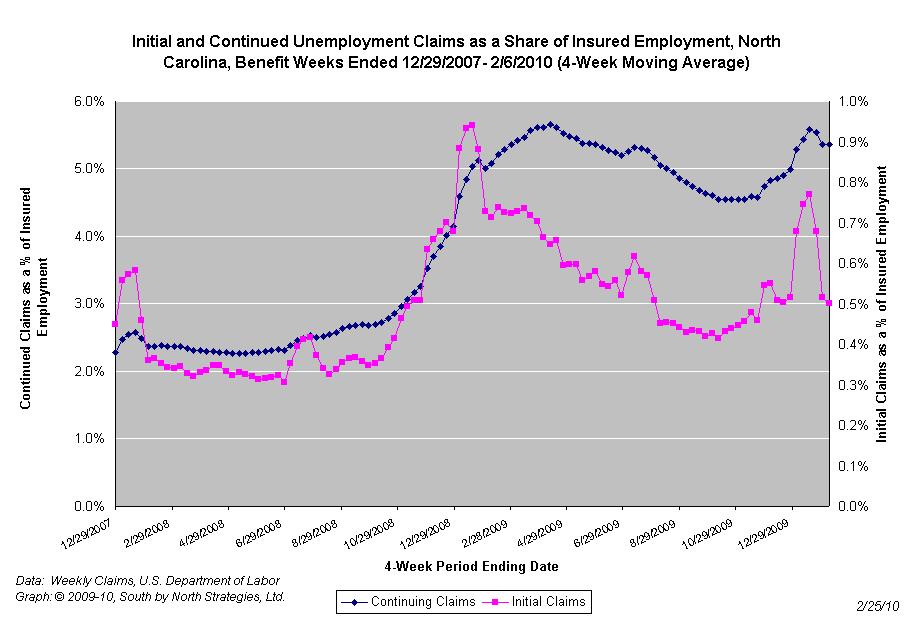
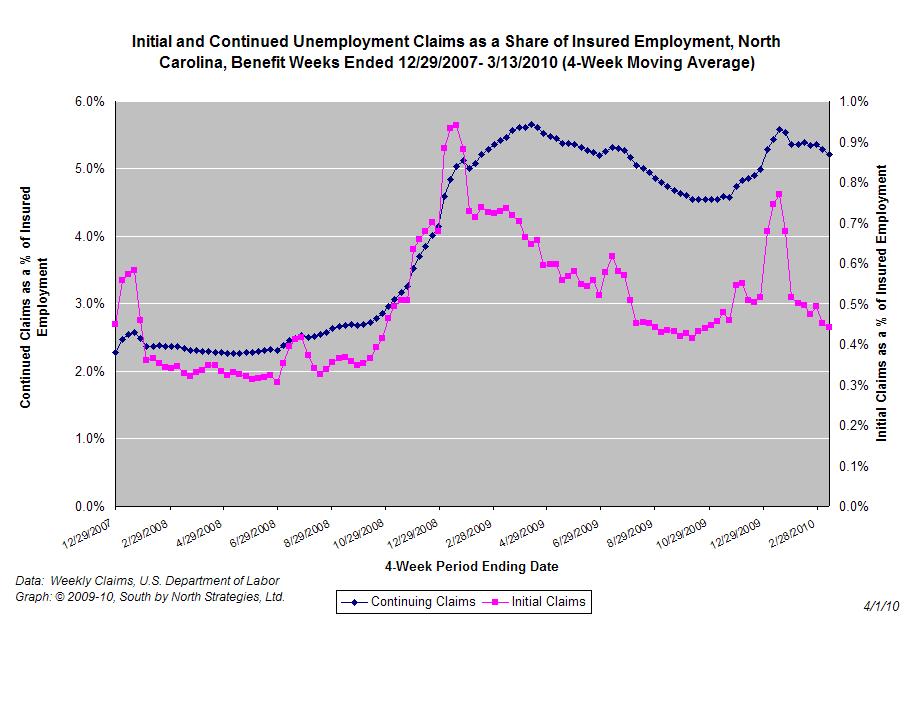
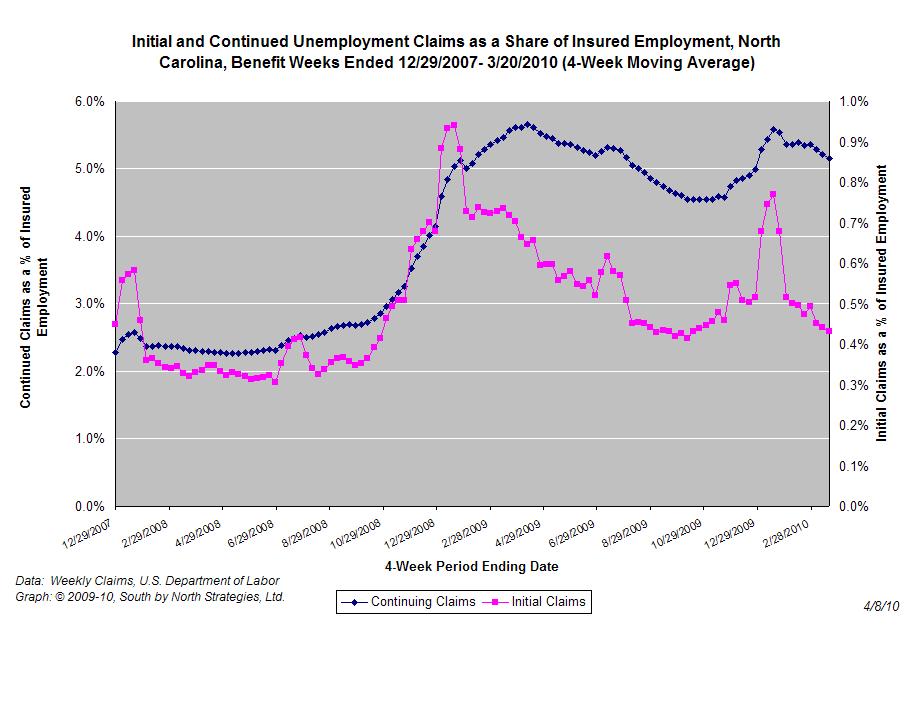
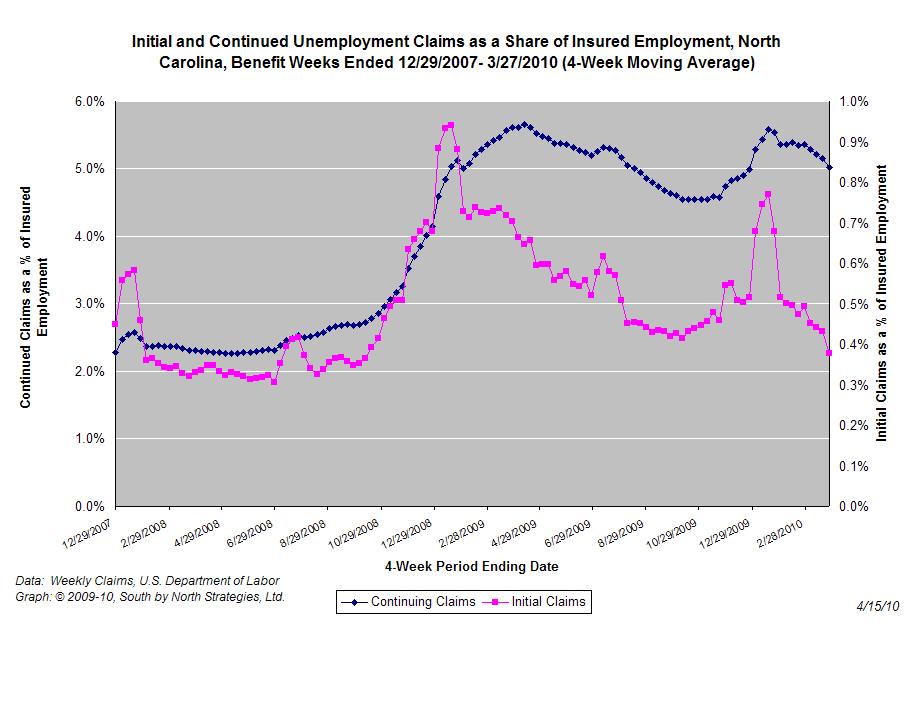
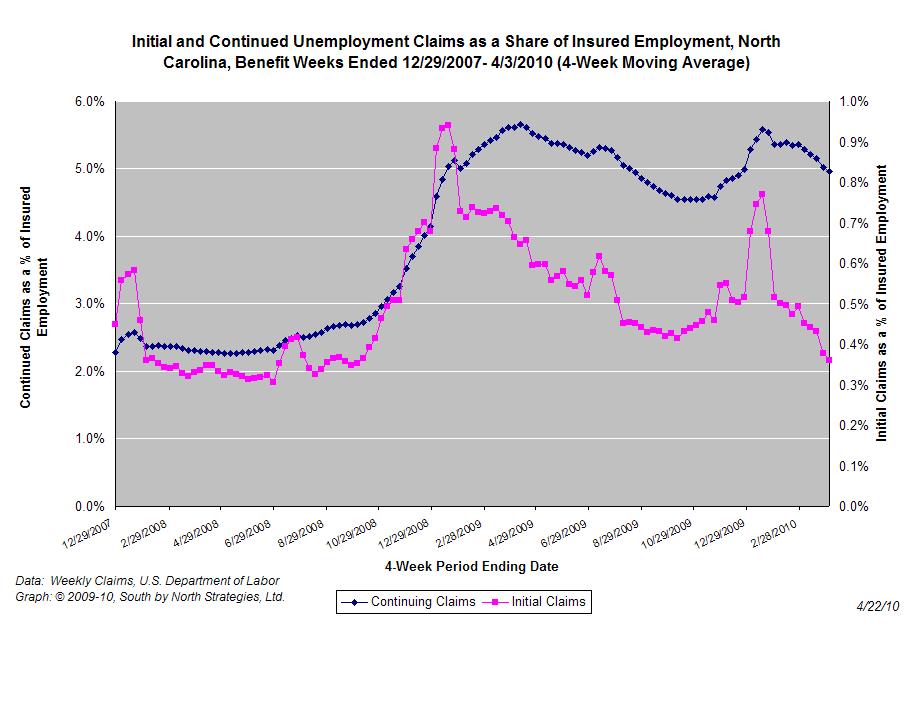
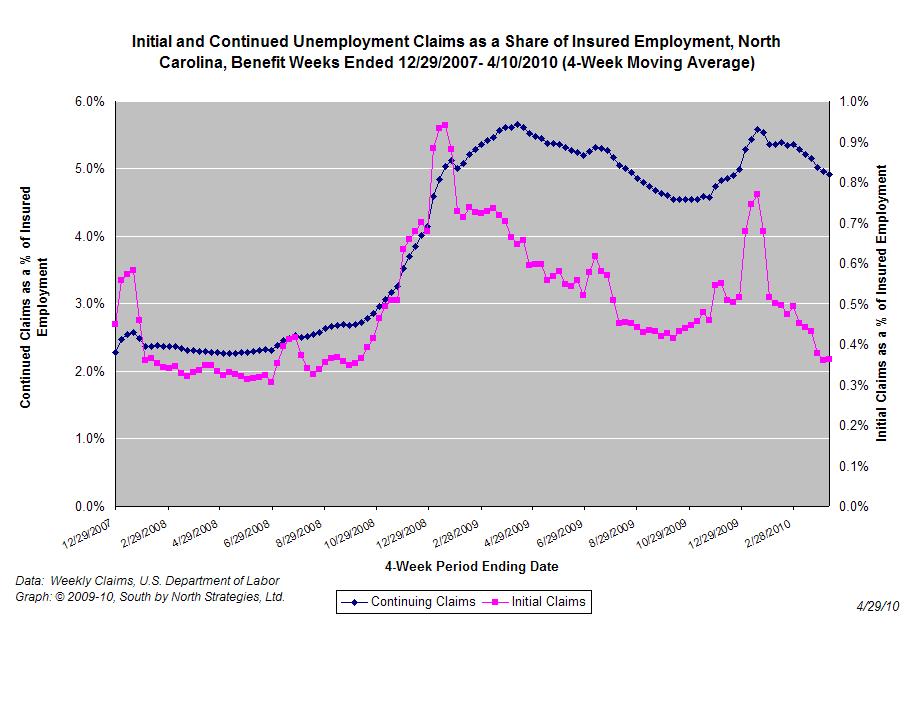
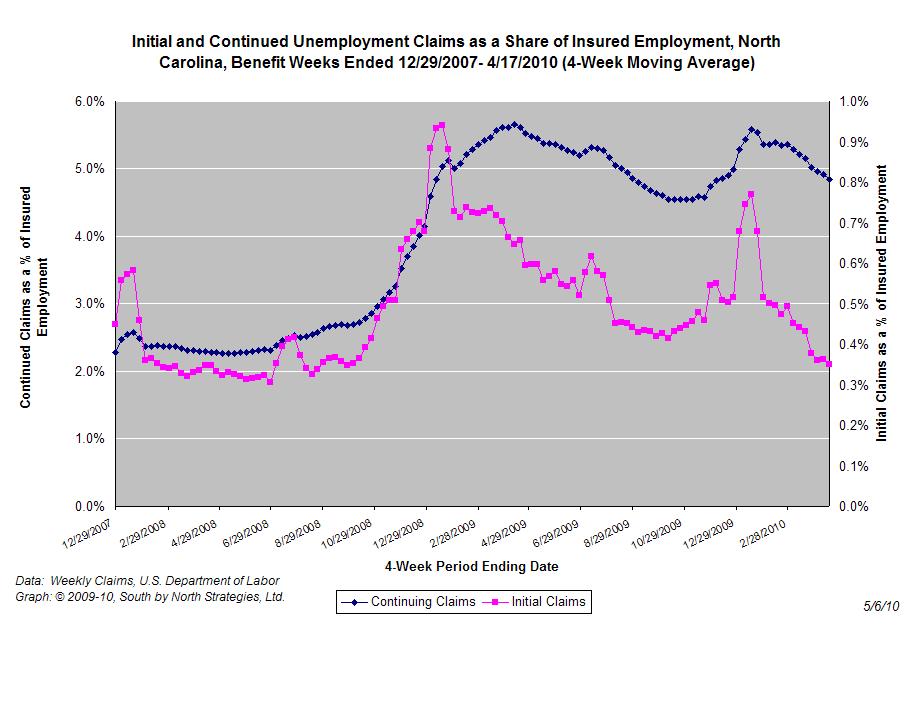
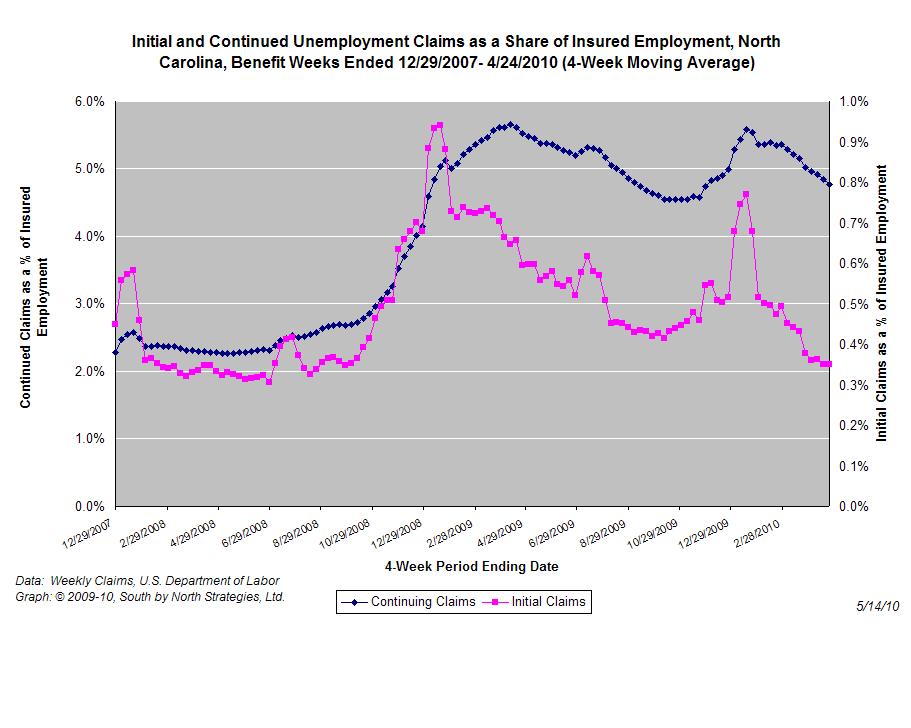
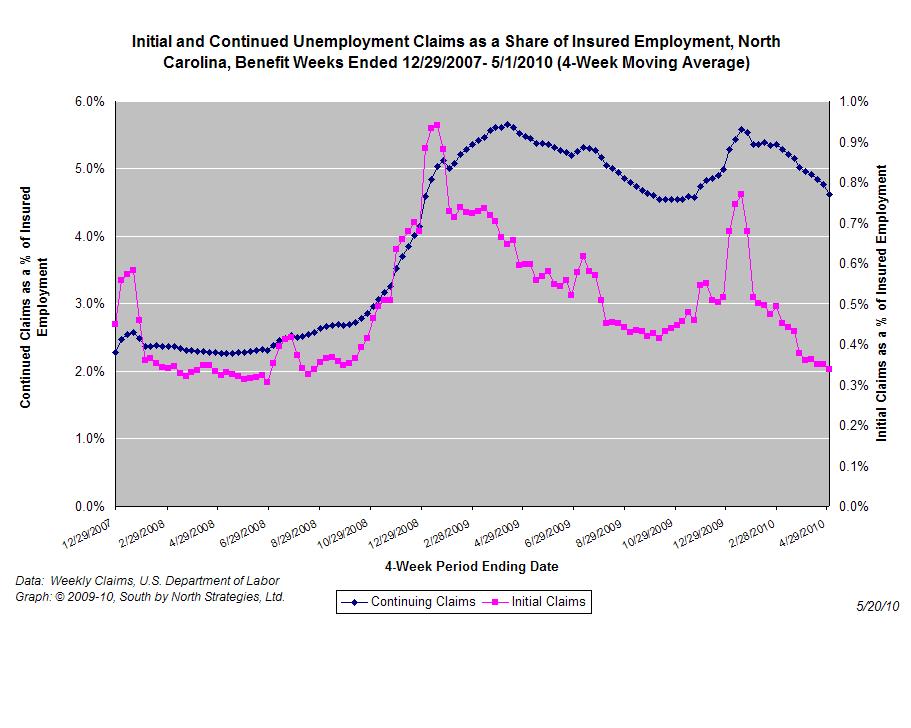
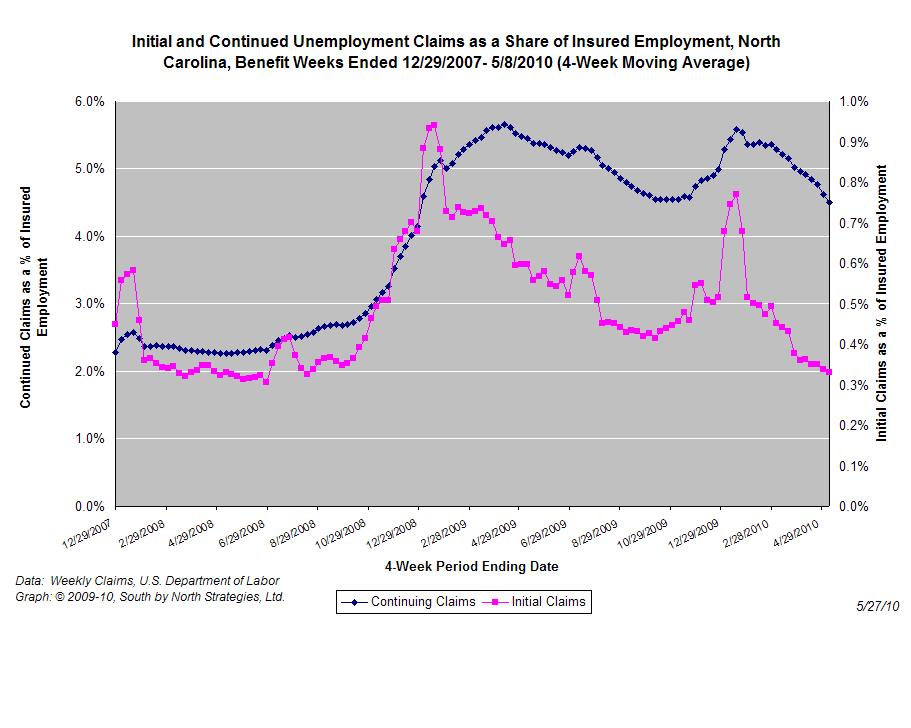
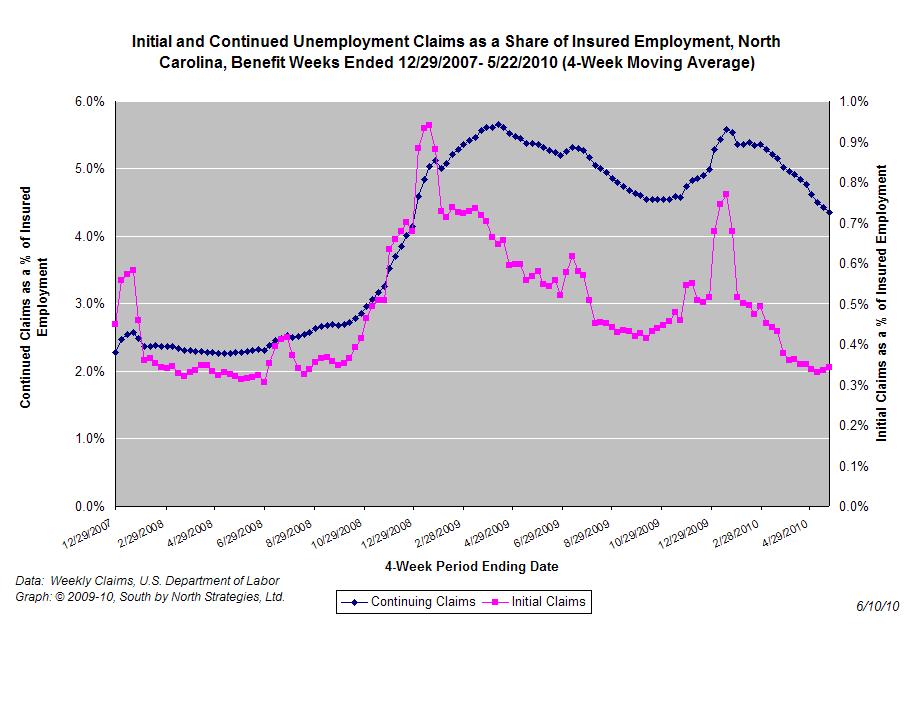
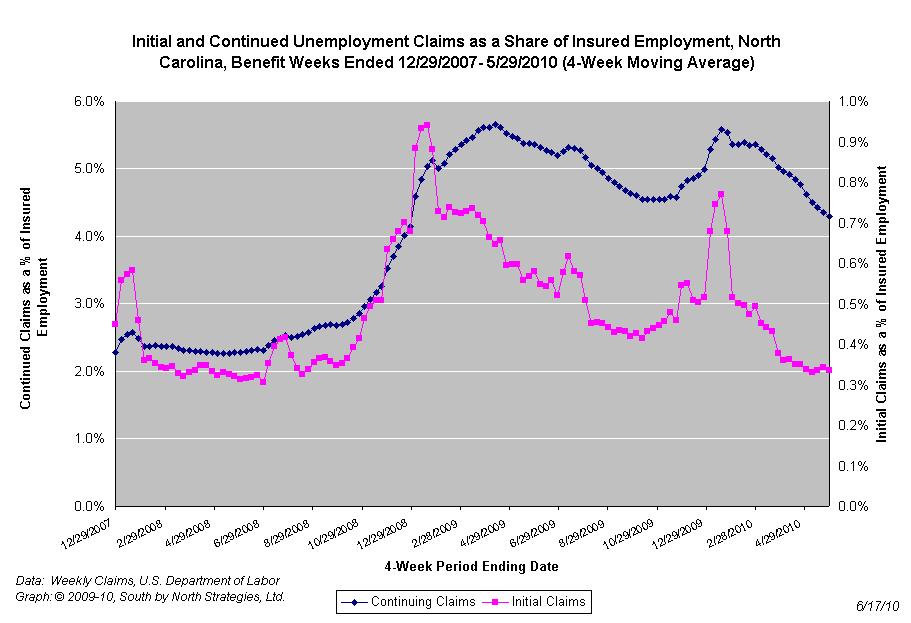
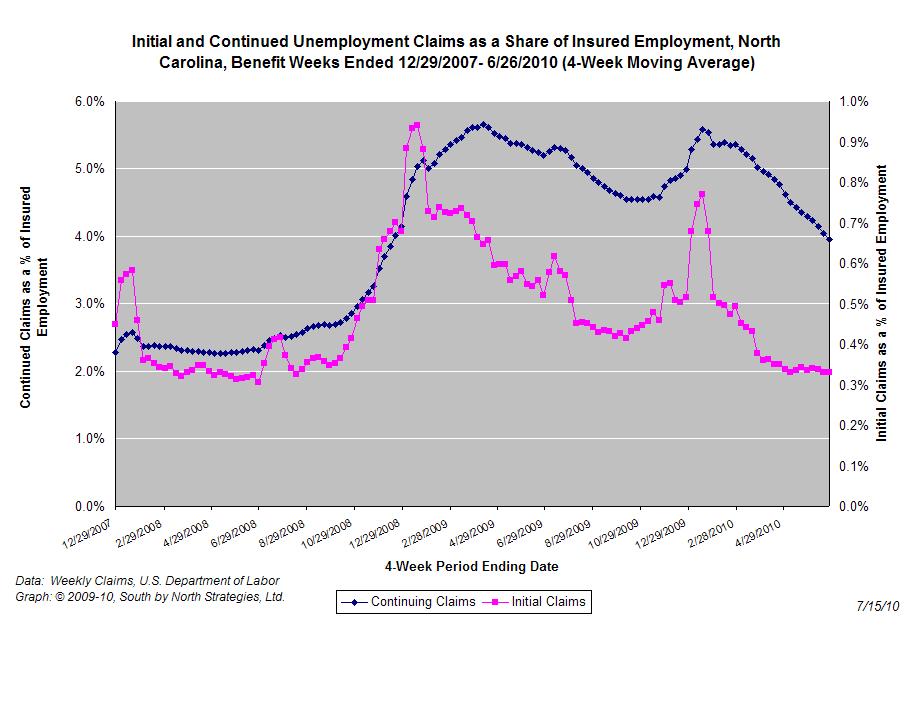
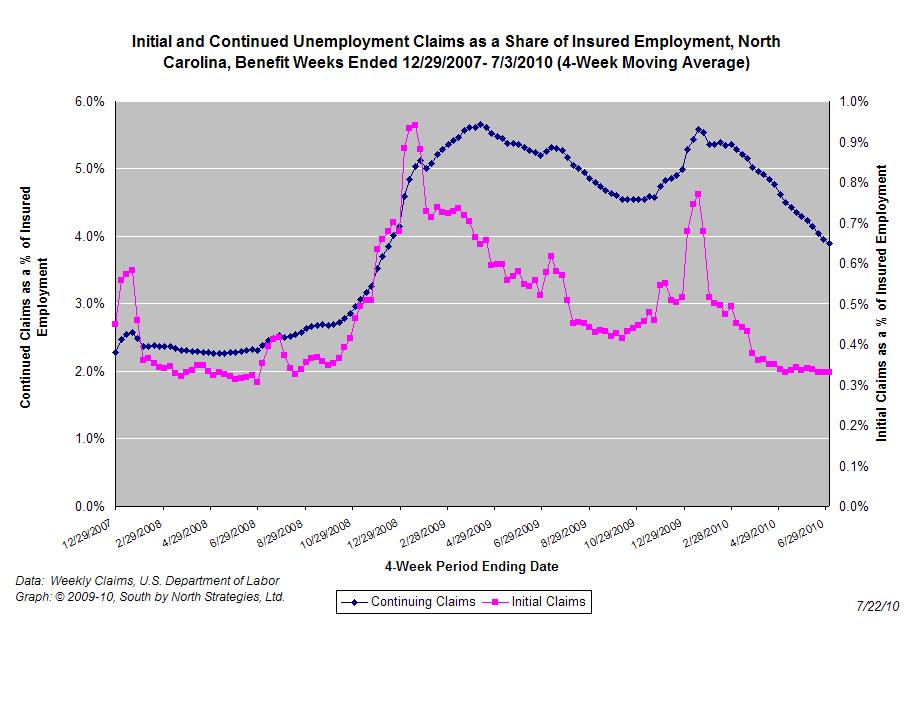
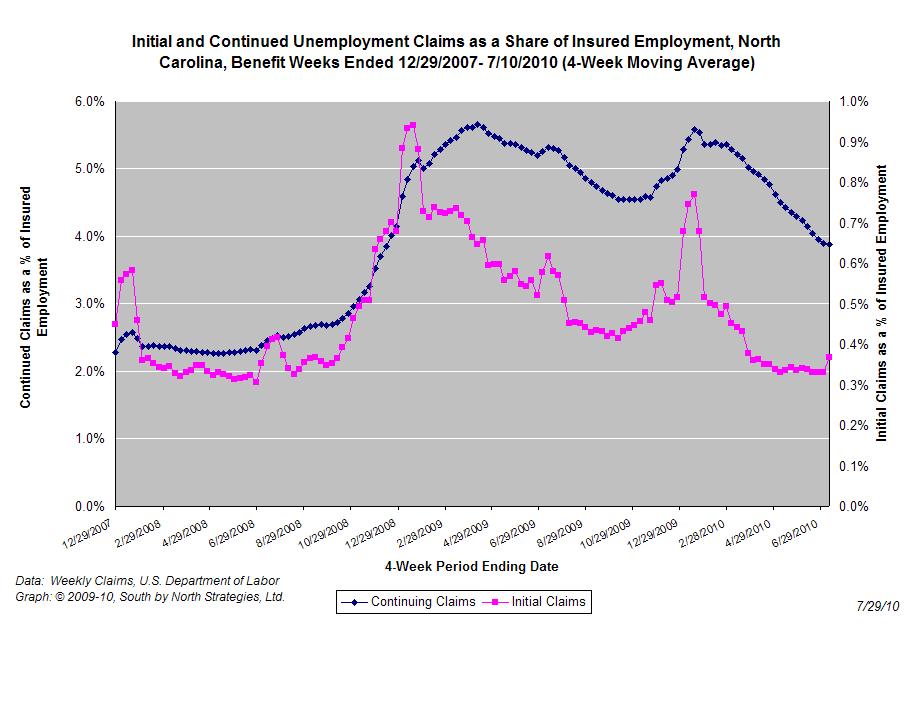
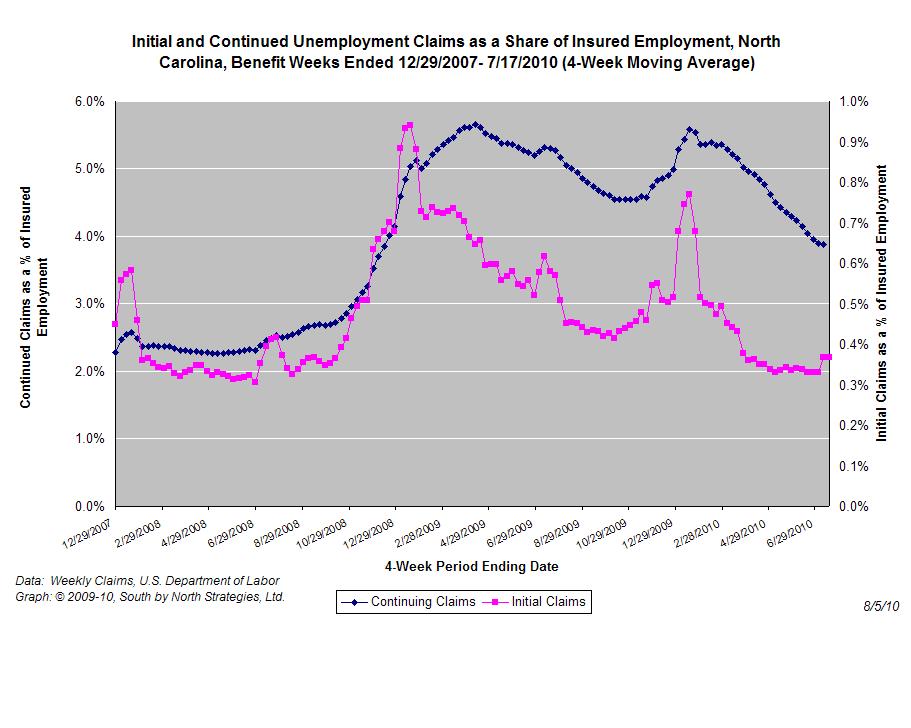
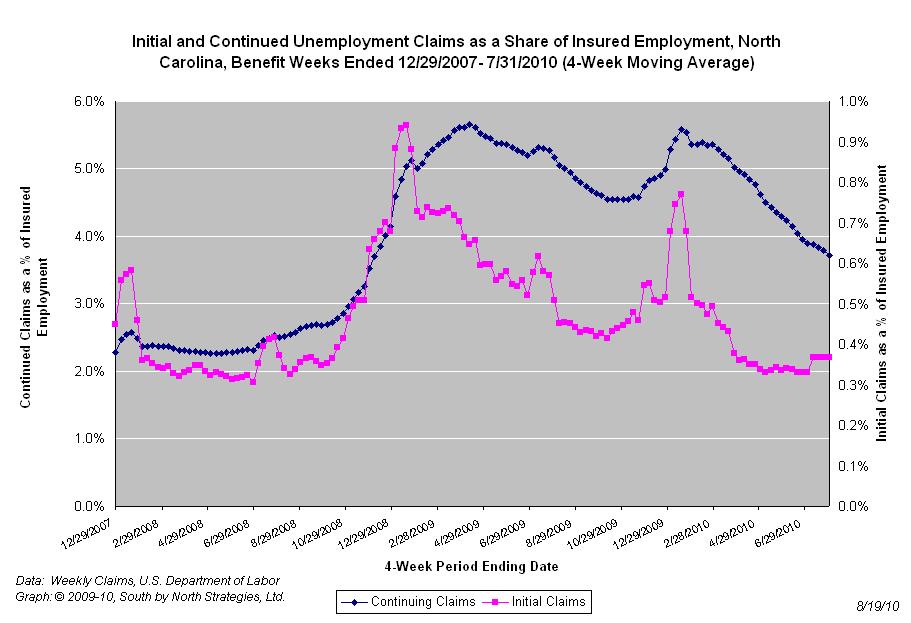
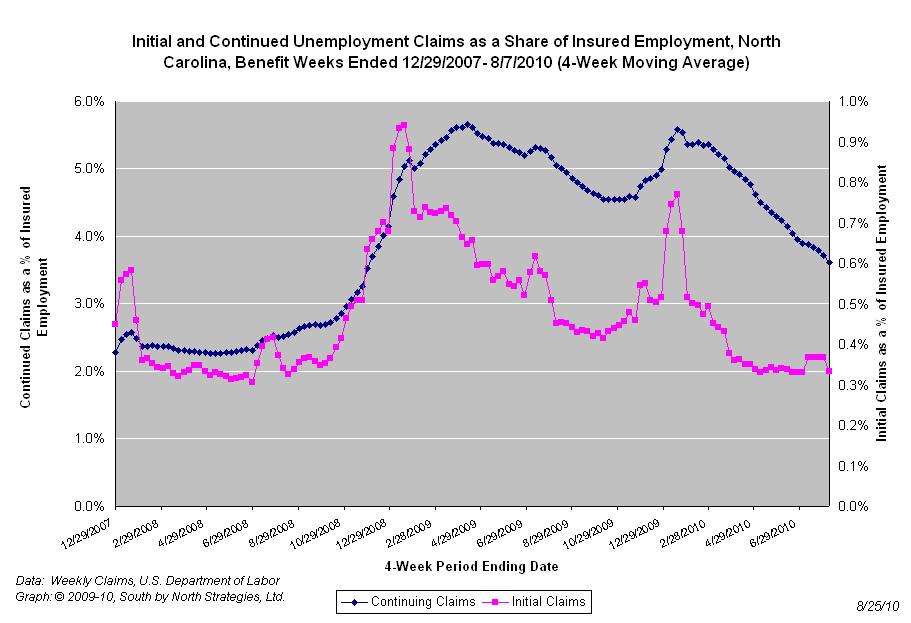
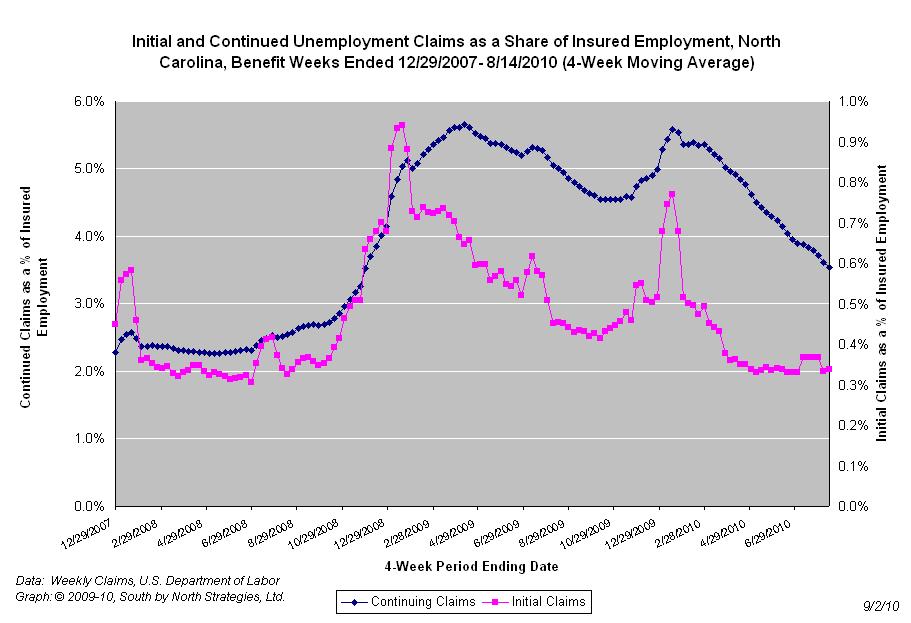
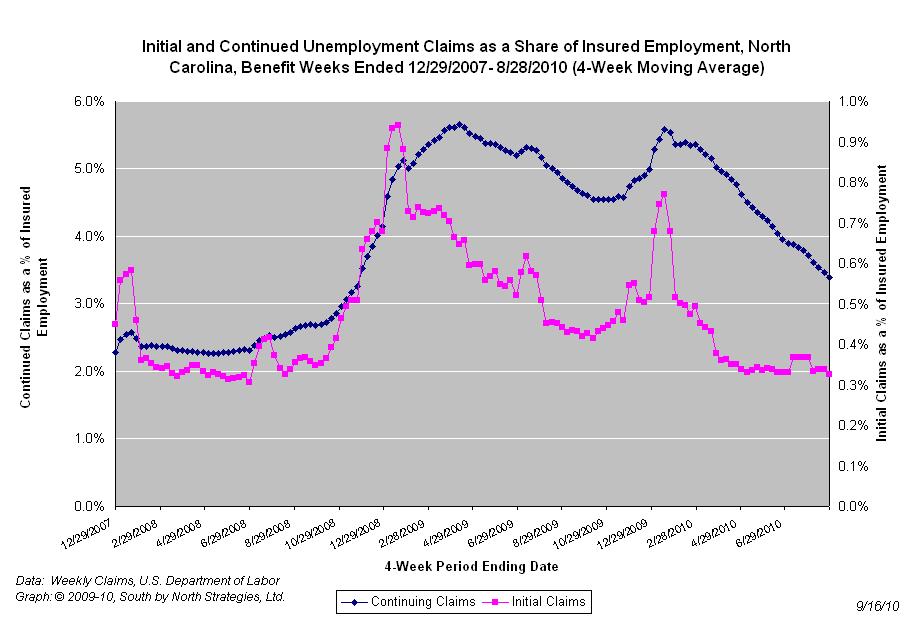
The graph (right) shows the changes in unemployment insurance claims (as a share of covered employment) in North Carolina since the recession’s start in December 2007.
Both new and continuing claims appear to have peaked for this business cycle, and the four-week averages of new and continuing claims have fallen considerably. Yet continuing claims remain at an elevated level, which suggests that unemployed individuals are finding it difficult to find new positions.
Also, little change has occurred within recent months. Since April 2010, the four-week average of initial claims consistently has ranged between 13,987 and 11,800.
Back to 1972
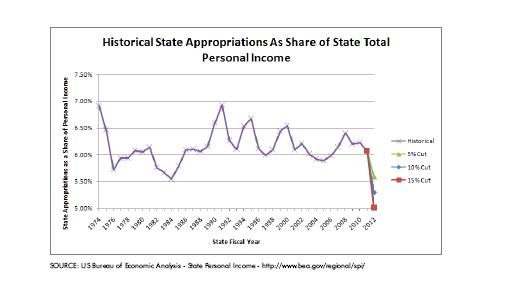
A policy brief from the N.C. Budget & Tax Center finds that North Carolina is facing an estimated $3.3 billion budget shortfall in its General Fund for fiscal year 2011-12.
As the graph below shows, attempts to close that gap solely through budget cuts would drive state spending as a share of total personal income to the lowest level recorded since 1972.
 Email Sign-Up
 RSS Feed