

Understanding The Consequences
In a recent column, economist James Galbraith laid out the consequences of “the conventional wisdom” calling for reductions to Social Security and Medicare benefits and argues instead for expanding these social insurance programs.
Medicare pays doctors’ bills for the old. It pays out at lower rates than does private insurance for working people. Cutting Medicare would mean two things: less health care for the elderly, and therefore more financial stress on their families. And more health care costs overall, as people substitute with private insurance for the public cuts. Both of these are very bad ideas.
—
Social Security pays to keep working people (and their dependents and survivors) out of poverty when they are old. It spreads its benefits to all who have worked, whether they have children who would otherwise support them or not. The payroll tax spreads the burden to all working people, whether they would otherwise be supporting elderly parents or not. Both of these transfers are fair, modest, and sustainable. Cutting Social Security would simply create more poor elderly—those who could not turn to their children—and more stressed working families—those with parents in need. Both of these are very also bad ideas.
Galbraith continues:
In fact, the right response to the crisis is to expand, not cut, both Social Security and Medicare.
—
The reality is, we are never going to make up good new jobs for everyone who has been hit…. So let’s face reality, and make some tough decisions about who we want to be jobless: the relatively old or the very young. Seen this way, it’s an easy choice.
In the end, he argues,the choice comes down to a question of values.
Encouraging early retirements would mean that young people—just out of school, with fresh skills, good health, and high energy—would get the jobs they need now. They would not be stuck waiting, or spinning their wheels in school, for years and years. Meanwhile, the retirees, supported by Social Security and Medicare, would provide a continuing stable support to total demand, creating jobs for others as they get older.
—
This is the way the economy should work. When we have older people, we must care for them, and the best way to do that is to give them the resources to support themselves. There is no “burden problem” as our economy is plenty productive for the working population to support the elderly in modest comfort, particularly if we include some of our truly wealthy in the tax base.
Around The Dial – August 4
Economic policy reports, blog postings, and media stories of interest:
- Paul Krugman graphs changes in government spending.
- The New York Times reports on wage cuts.
- New Deal 2.0 asks how the future will view current economic leaders.
- USA Today analyzes recovery act spending by state.
- CBPP previews the Social Security/Medicare trustees’ report.
The South’s Difficult Decade
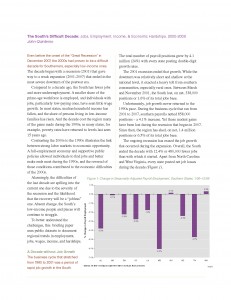 Even before the onset of the “Great Recession” in December 2007, the 2000s had proven to be a difficult decade for working Southerners. Across the region, the 2000s were a period marked by meager job growth, rising joblessness, rapid industrial change, and mounting economic hardships. And the decade’s developments offset many of the gains – most notably against poverty – made by the region during the 1990s.
These findings come from the recent briefing paper, The South’s Difficult Decade, prepared by South by North Strategies, Ltd. for The Mary Reynolds Babcock Foundation in Winston-Salem, NC.
The brief summarizes key economic changes that occurred between 2000 and 2009 in the ten states where the foundation is active: Alabama, Arkansas, Georgia, Kentucky, Louisiana, Mississippi, North Carolina, South Carolina, Tennessee, and West Virginia.
The Long Way to Recovery
A new report by the Center for Economic and Policy Research finds, that absent additional federal action, it could take nearly before the American economy creates the number of payroll jobs that existed in December 2007. From the report’s summary:
Between December 2007 – the official first month of the recession – and December 2009, the U.S. economy lost more than eight million jobs. Even if the economy creates jobs from now on at a pace equal to the fastest four years of the early 2000s expansion, we will not return to the December 2007 level of employment until March 2014. And, by the time we return to the number of jobs we had in December 2007, population growth will have increased the potential labor force by about 6.5 million jobs. If job growth matched the fastest four years in the most recent economic expansion, the economy would not catch up to the expanded labor force until April 2021. Absent policy changes such as a major jobs bill, the Congressional Budget Office’s most recent projections suggest that the economy will not return to December 2007 employment levels until June 2013, and will not cover the intervening growth in the potential labor force until August 2015.
The Wrong Message?
Free Exchange is not impressed by the economic message being advanced by the Obama administration. In response to an op-ed penned by Treasury Secretary Tim Geithner, Exchange notes the following:
The public is unlikely to be fooled. Export growth slowed in the second quarter, and the drag on growth from net exports (net of imports) grew sharply (due largely to a BEA adjustment to petroleum imports, but still). Job growth did return faster than in the previous two recessions, but is proceeding far more slowly than occured in the early 1980s, which was the last time unemployment was this bad. Americans are all too well aware of the extent of joblessness, and forecasts put a return to full employment around mid-decade. Banks and businesses have repaired their balance sheets—and are too concerned about the state of recovery to do much new investment. American saving has risen, but is below long-term averages and indebtedness remains a problem (as does a shortfall in personal consumption). And it’s lovely that the Big Three aren’t in banruptcy anymore and TARP is less expensive than expected, but that means little for the path of recovery.
…
I’m trying and failing to imagine just who might be convinced by this. And the strategy it indicates is a doomed one. The Obama Administration is arguing that the recovery was bound to be a hard slog and is nonetheless proceeding acceptably. And that implies that there’s little more that the White House can or would do to improve economic conditions. Given the choice between a party asking voters to be patient and a party promising action (however ill-defined and ill-advised) there is no choice.
 Email Sign-Up
 RSS Feed