

Falling Homeownership Rates
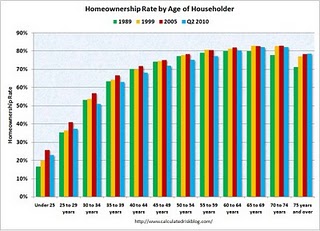
Calculated Risk graphs changes in homeownership rates by age group between 1989 and the second quarter of 2010. The rates are now below the 1989 and 1999 levels for every age cohort between the ages of 30 and 60 with the single hardest-hit group being the 30-35 age bracket.
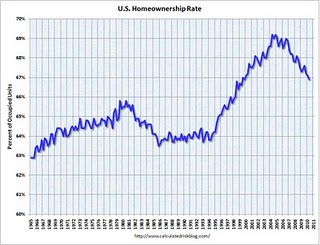
The graph below also traces the changes in the overall homeownership rate that occurred between 1989 and early 2010. Risk predicts that the overall rate will fall to 66 percent, down from a high of 69 percent at the peak of the housing bubble. This level is not much different that what would be expected based on changes in the population that have taken place since 1989.
So much for all that “financial innovation.”
Service Activity In The South Atlantic: July
From the Federal Reserve Bank of Richmond’s latest survey of service-sector activity in the South Atlantic (District of Columbia, Maryland, North Carolina, South Carolina, Virginia and West Virginia):
Service sector revenues picked up in July, fueled by solid gains at non-retail services firms, according to the latest survey by the Federal Reserve Bank of Richmond. Retail sales remained flat, however, while big-ticket sales dropped sharply. Shopper traffic also fell this month. Retail inventories declined, although reductions were somewhat less prevalent than a month ago. Retail merchants and survey respondents at non-retail firms were upbeat about sales prospects for the next six months.
…
Service sector labor markets weakened in July, with a drop in the number of retail employees and no change in hiring at non-retail services firms. In addition, average wages in the service sector flattened.
…
Price growth edged up mildly in July. Compared to their outlook of a month ago, survey respondents looked for slightly slower price growth through the rest of the year.
Around The Dial – July 28
Economic policy reports, blog postings, and media stories of interest:
- Robert Reich discusses the decoupling of jobs from profits.
- Free Exchange debates structural unemployment.
- The New York Times reports on rising corporate profits.
- Paul Krugman worries about persistent unemployment.
Manufacturing In The South Atlantic: July
From the Federal Reserve Bank of Richmond’s latest survey of manufacturing activity in the South Atlantic (District of Columbia, Maryland, North Carolina, South Carolina, Virginia and West Virginia):
Manufacturing activity in the central Atlantic region expanded for the sixth consecutive month but at a more moderate pace in July, according to the Richmond Fed’s latest survey. Looking at our main components of activity, employment continued to grow at a modest rate, while shipments and new orders grew at a rate below June’s pace. Most other indicators also suggested slower growth. Backlogs eased and capacity utilization continued to grow more slowly. Vendor lead-time grew at a considerably slower rate, while inventories grew at a somewhat quicker pace.
…
Looking forward, manufacturers’ optimism about their business prospects continued to wane, compared to a month ago — slowing was most evident in shipments, new orders, capacity utilization, and capital expenditures. In contrast, contacts expected employment and the average workweek to grow more quickly.
Happy Birthday, Minimum Wage
The Economic Policy Institute recently commemorated the July 24th birthday of the minimum wage.
On the wage floor’s history:
The federal minimum wage was first established in the Fair Labor Standards Act of 1938. Since then, Congress has periodically increased the minimum wage as prices in the overall economy increased. In 2006, before the most recent three-part increase, the federal minimum wage was $5.15, the same level it had been for the previous 10 years. Because Congress had ignored the minimum wage for such a long time, inflation eroded much of its purchasing power. Adjusting for inflation, the minimum wage in 2006 was worth less than at any other time in the previous 50 years. Congress finally acted in 2007 to help low-wage workers, and passed a three-step increase to the federal minimum wage. The first increase to $5.85 took place on July 24, 2007, the second increase to $6.55 on July 24, 2008, and the final increase to $7.25 on July 24, 2009. Although this final step restored some of the purchasing power of the minimum wage, it is still well below the peak of close to $9.00 reached in 1968.
On current objections to the minimum wage:
Lately, opponents of the minimum wage have suggested that decreasing it would help to boost employment. This is a terrible idea for a variety of reasons. First, the minimum wage is not high by historical standards – today, the real value of the minimum wage is less than what it was from 1961 to 1981. Second, research on the disemployment effects of the minimum wage give mixed results – many indicate that a small change to the minimum wage would have no impact on employment. Furthermore, even if there is a disemployment effect, it is small and far outweighed by the fact that low-wage workers on average will see a net benefit from most minimum wage increases (Shierholz 2009). Finally, one of the biggest problems during a recession is the decrease in consumer demand – when consumers cut back on spending, employers respond by cutting back on jobs. Reducing the wages of already low-wage workers will only make this problem worse, and will hurt those who are least well off.
 Email Sign-Up
 RSS Feed