Local Labor Markets Move Sideways in April
CHAPEL HILL (May 28, 2010) – Local labor market conditions across North Carolina remained weak in April, according to preliminary data released today by the Employment Security Commission. In April, 63 counties posted double-digit unemployment rates, and 23 counties recorded unemployment rates of at least 12 percent.
“Weak conditions remained the norm in April,” says John Quinterno, a principal with South by North Strategies, Ltd., a research firm specializing in economic and social policy. “While conditions in many places have stabilized during 2010, few meaningful improvements have occurred. Most job markets are moving sideways, and there is little to celebrate.”
Since the recession’s onset in December 2007, North Carolina has shed 6.5 percent of its payroll employment base (-270,000 positions) and has seen its unadjusted unemployment rate climb from 4.7 percent to 10 percent.
Every part of the state experienced weak labor markets in April. Unemployment rates exceeded 10 percent in 63 counties, and in 23 counties, at least 12 percent of the labor force was jobless and actively seeking work. County unemployment rates ranged from 5.8 percent in Currituck County to 15.8 percent in Scotland County.
“The recession continues to batter the state’s non-metropolitan communities,” adds Quinterno. “Last month, 11.1 percent of the non-metro labor force was unemployed, compared to 9.6 percent of the metro labor force. Since December 2007, the number of employed individuals in non-metro areas has fallen by 6.7 percent while the number of unemployed individuals has grown by 98 percent.”
Last month, unemployment rates fell in all 14 of the state’s metropolitan areas, and every metro but Rocky Mount netted jobs. Nevertheless, five metros posted double-digit unemployment rates. The Hickory-Morganton-Lenoir area had the highest unemployment rate (13.3 percent) followed by Rocky Mount (13 percent). The lowest metro unemployment rate was 7.2 percent in Durham-Chapel Hill.
“Because of the lack of seasonal adjustments, monthly fluctuations in local unemployment rates must be interpreted cautiously, especially since unemployment normally rises at the start of the year before dipping in the spring,” cautions Quinterno. “A better comparison is a yearly one.”
Compared to April 2009, unemployment rates were the same or higher in 22 counties and 3 metro areas. And compared to a year ago, 68 counties and 6 metro areas had smaller labor forces. Among metros, Hickory-Morganton-Lenoir posted the largest decline in the size of its labor force (-3.3 percent), followed by Burlington (-2.1 percent). Jacksonville posted the largest gain (+6.8 percent).
“Despite some stabilization in labor market conditions, the long-term employment picture remains the same,” cautions Quinterno. “The sustained job growth needed to absorb displaced individuals and new workers simply isn’t occurring.”
In the long term, any meaningful recovery will be driven by growth in the state’s three major metro regions: Charlotte, the Research Triangle, and Piedmont Triad. Yet job growth in 2010 has been sluggish. Collectively, employment in these three major metro regions has fallen by 3.9 percent since the start of the recession. The overall April unemployment rate in the major metros equaled 9.5 percent. Of the three areas, the Research Triangle had the lowest April unemployment rate (8.1 percent), followed by the Piedmont Triad (10.5 percent) and Charlotte (11.6 percent).
“One piece of good news contained in the April report is evidence of the powerful role that unemployment insurance has played in blunting the recession,” observes Quinterno. “Over the last 12 months, the Employment Security Commission paid out $5.4 billion in regular state payments, emergency federal benefits, and additional federal compensation. These payments not only helped households coping with a job loss, but they also generated an estimated $8.9 billion in statewide economic activity.”
Unemployment Insurance Solvency
The U.S. Department of Labor estimates that outstanding loans to state unemployment insurance system will reach $90 billion by fiscal year 2013. The unprecedented demand for unemployment insurance partly is a consequence of the severe recession, but it also is the result of poor financing decisions made by many states during the 1990s.
In a recent paper, the National Employment Law Project analyzed the health of state unemployment insurance systems and offered the following state-level recommendations for restoring fund solvency:
State policy makers should resist reverting to the “equality of sacrifice” model in which roughly equivalent benefit cuts and tax increases are used to restore solvency. Overly generous benefits did not cause today’s crisis, and taking money out of the hands of jobless workers in today’s slowly recovering economy would do more harm than good.
…
Employers in states that have adopted a “pay-as-you-go” approach to UI financing are now facing major costs that are a direct consequence of this philosophy. As they move out of the current solvency crisis, these states need to turn the corner and adopt forward-financing principles.
Around The Dial – May 27
Economic policy reports, blog postings, and media stories of interest:
- The N.C. Budget and Tax Center proposes job creation subsidies.
- The Kaiser Family Foundation estimates changes in Medicaid spending.
- The CBO reports on the recovery act’s impacts through March.
NC Unemployment Claims: Week of 5/8
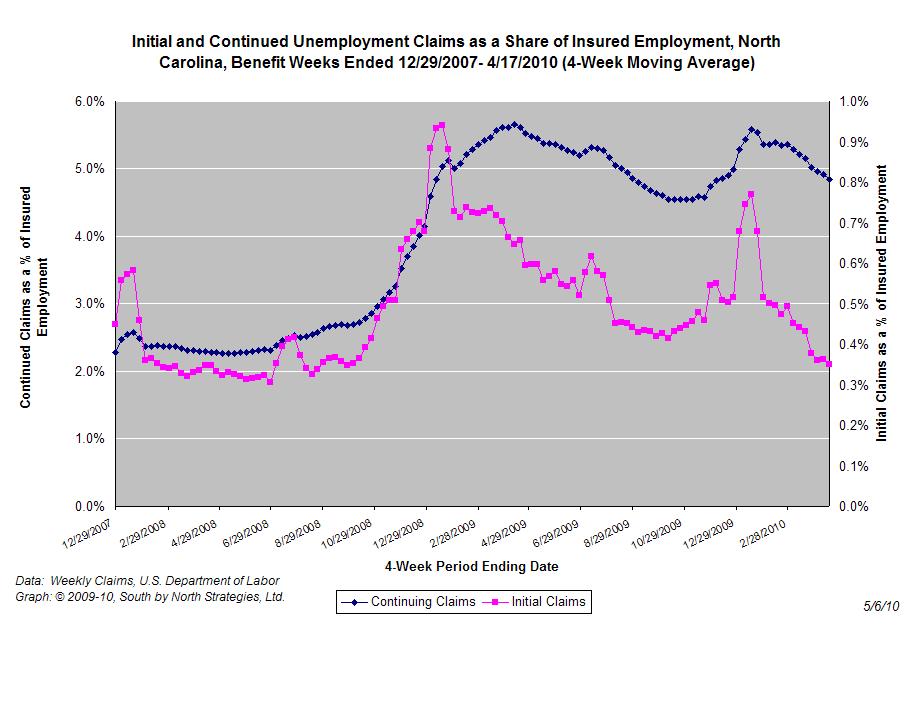
For the benefit week ending on May 8th, 13,476 North Carolinians filed initial claims for state unemployment insurance benefits, and 167,121 individuals applied for state-funded continuing benefits. Compared to the prior week, there were more initial and fewer continuing claims. These figures come from data released today by the U.S. Department of Labor.
Averaging new and continuing claims over a four-week period — a process that helps adjust for seasonal fluctuations and better illustrates trends — shows that an average of 12,595 initial claims were filed over the last four weeks, along with an average of 171,981 claims. Compared to the previous four-week period, both initial and continuing claims were lower.
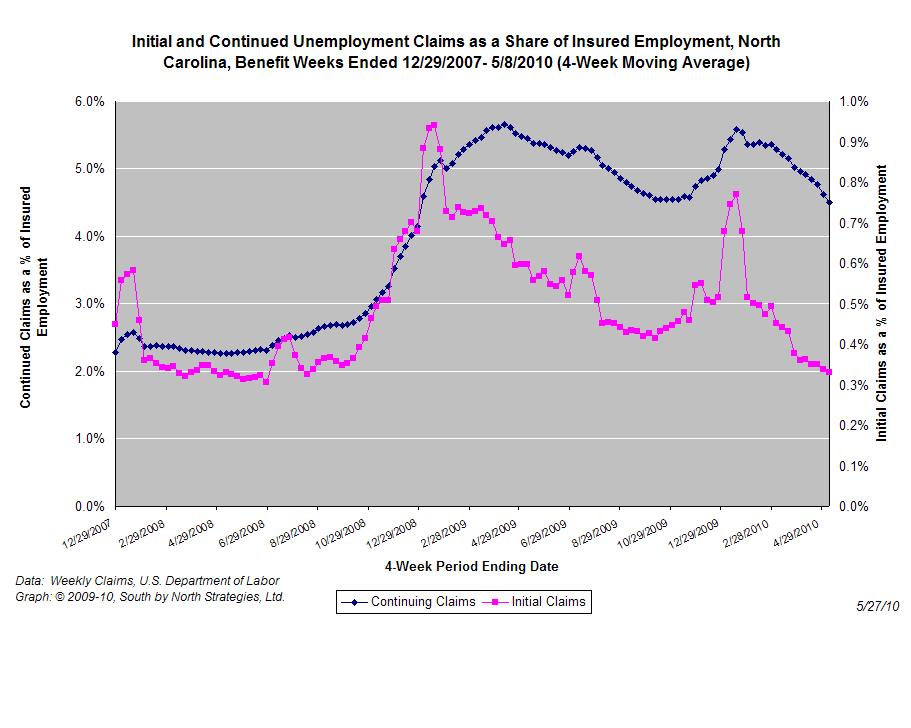 One year ago, the four-week average for initial claims stood at 24,050 and the four-week average of continuing claims equaled 219,164.
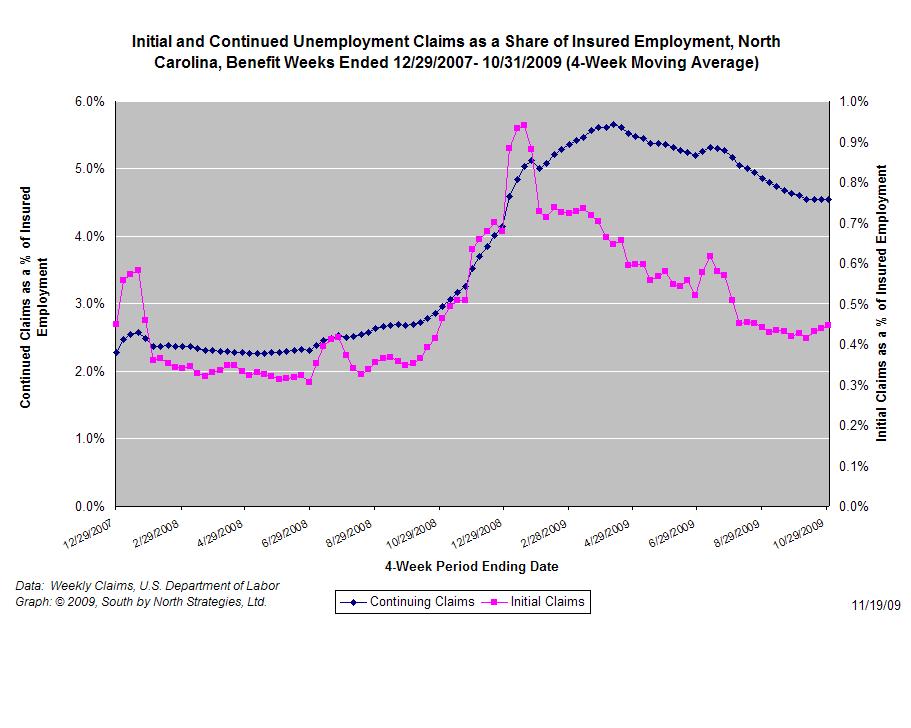
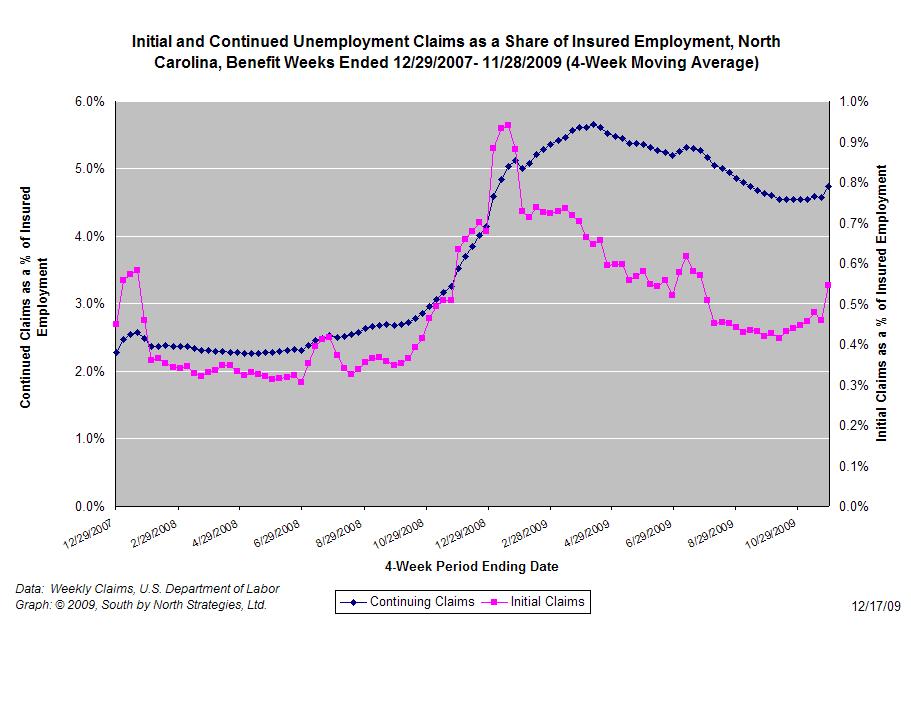
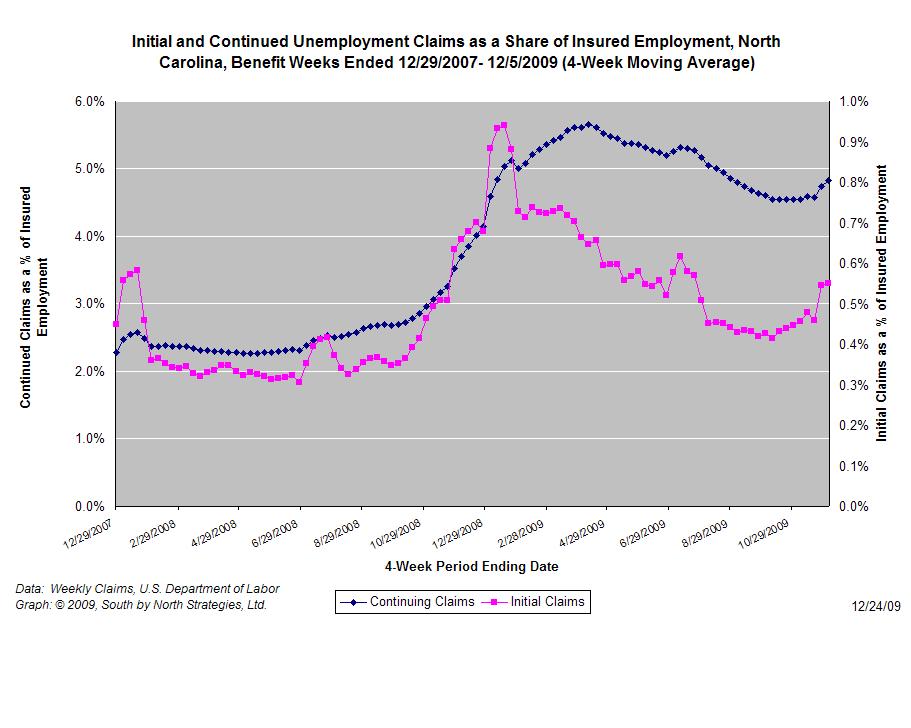
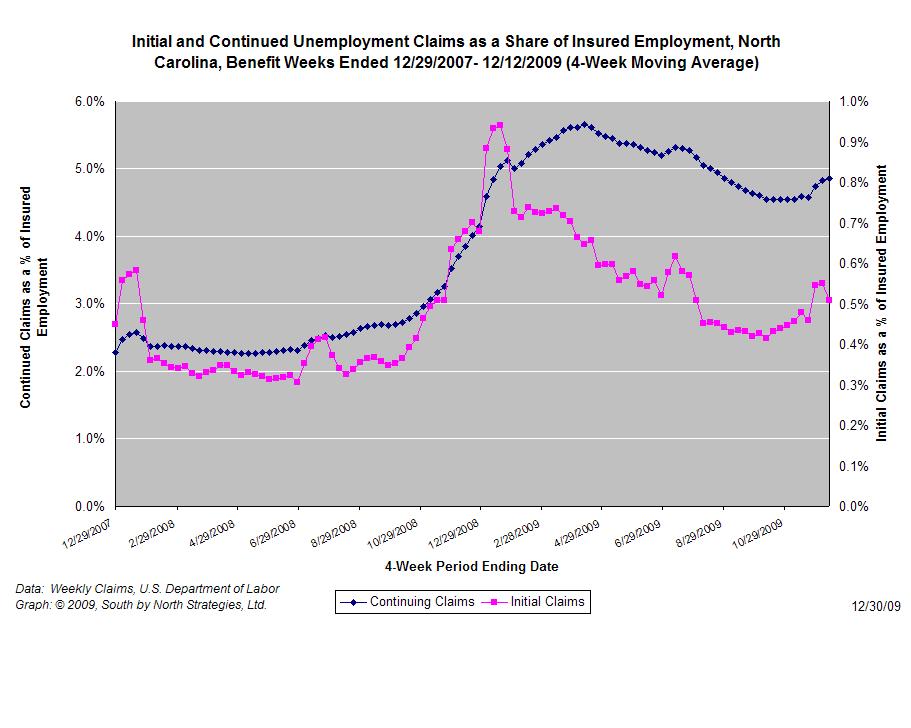
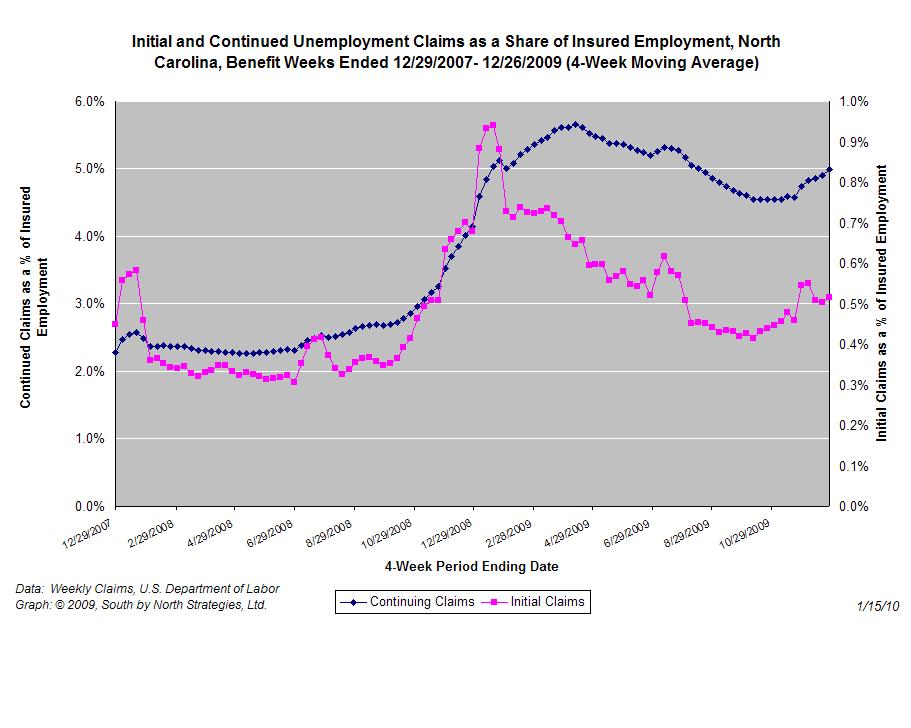
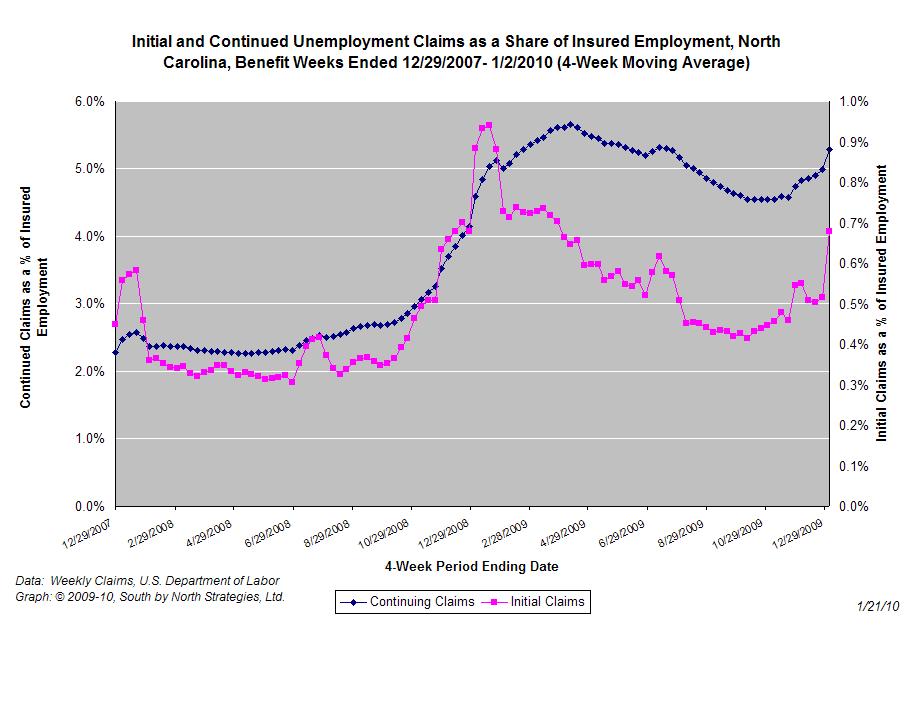
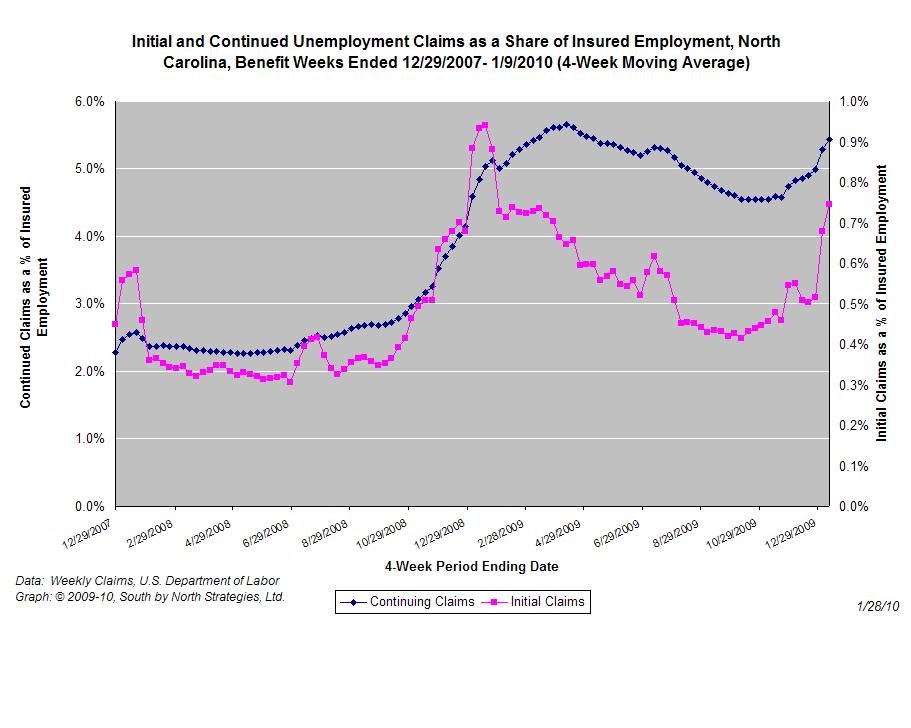
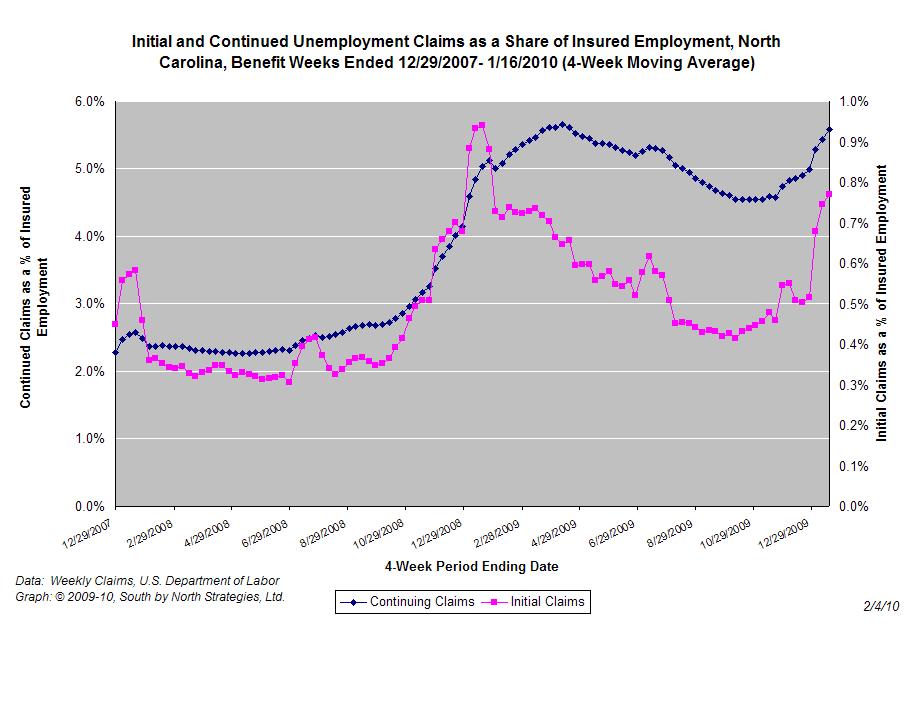
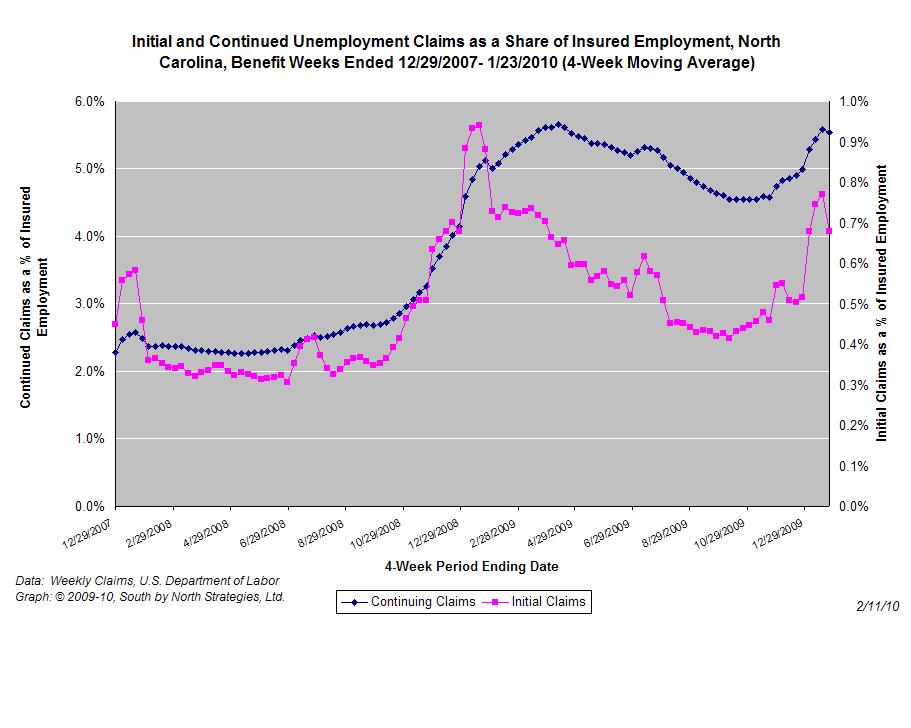
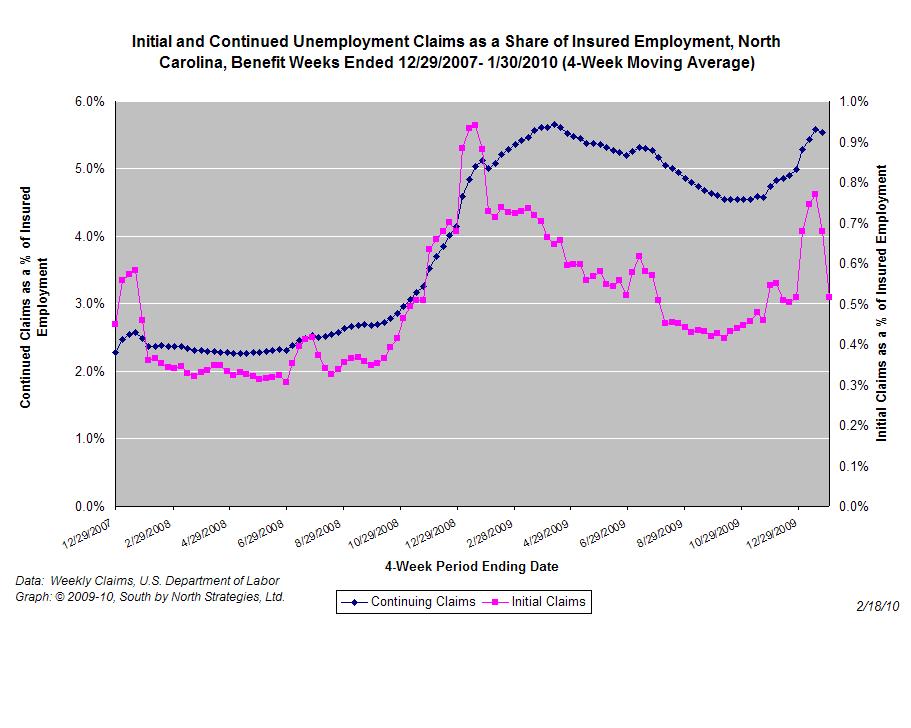
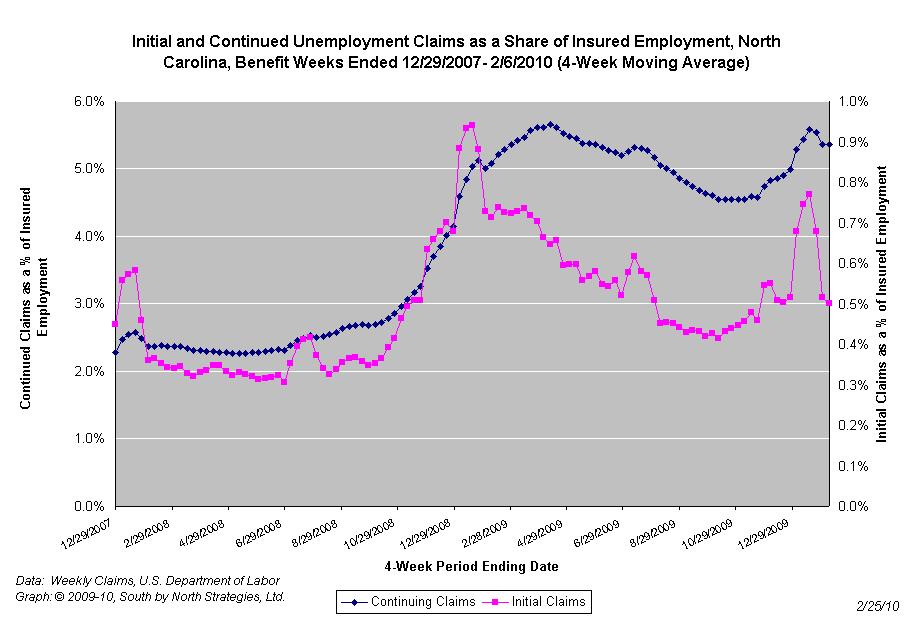
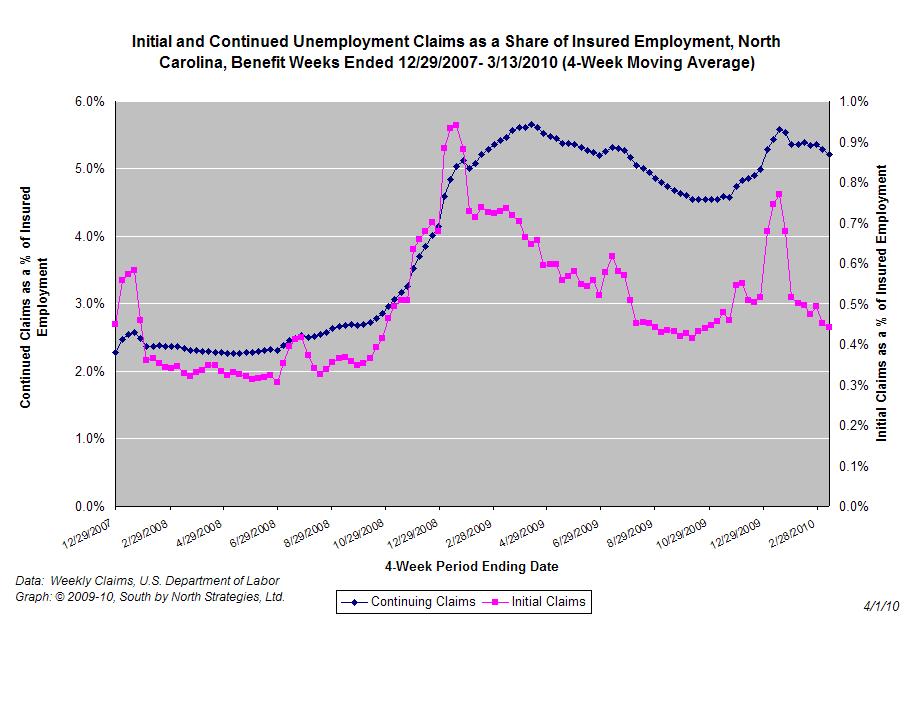
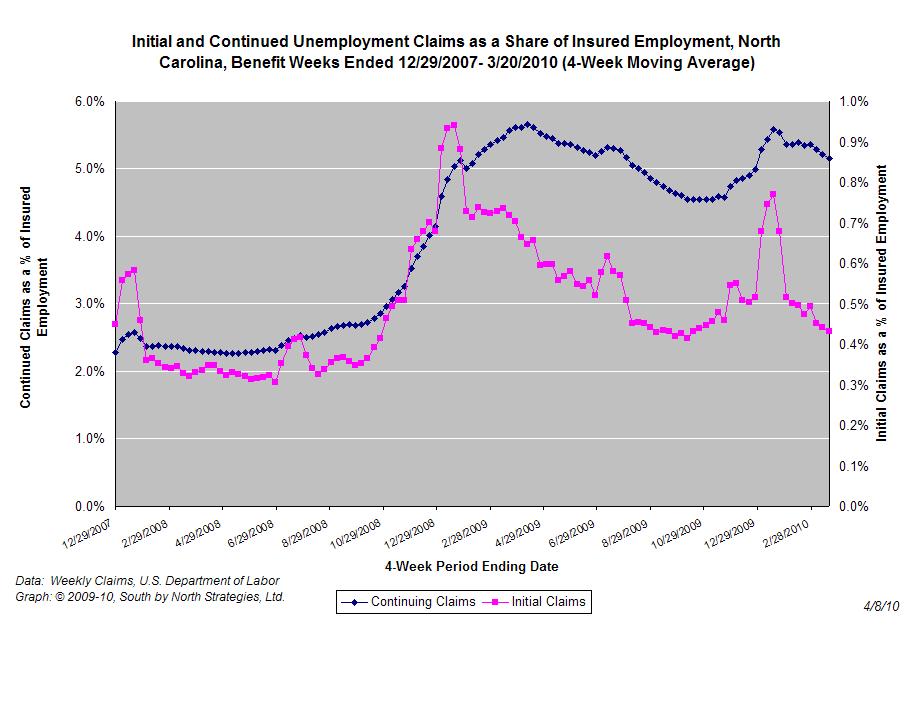
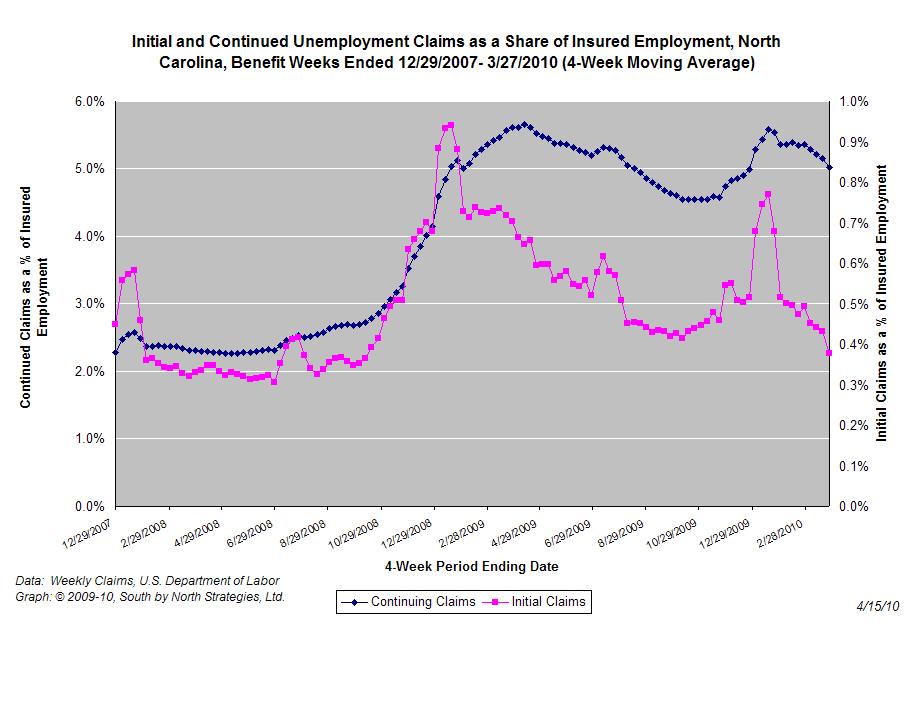
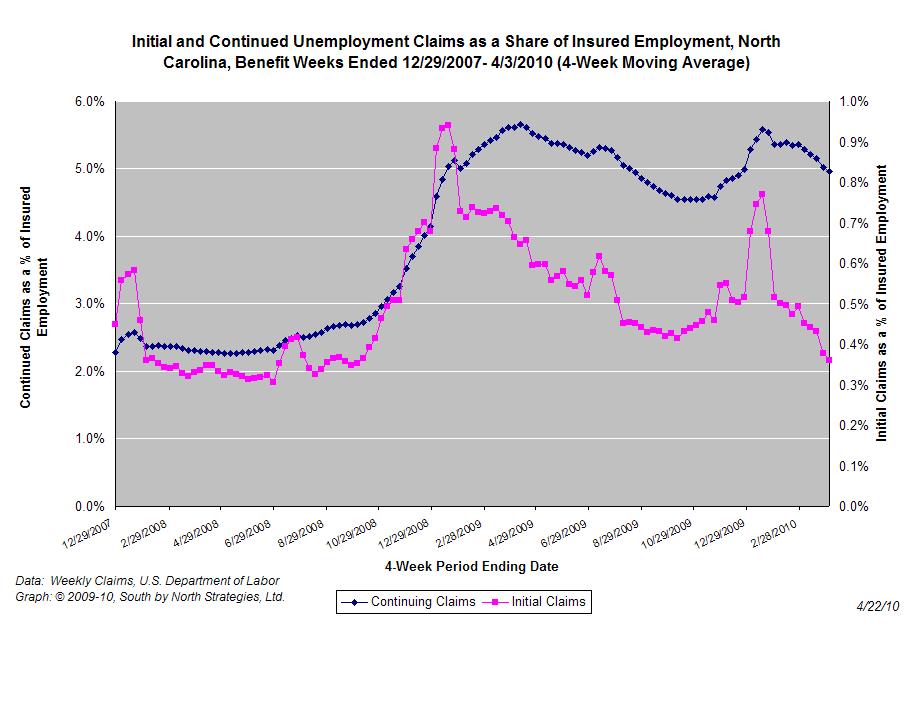
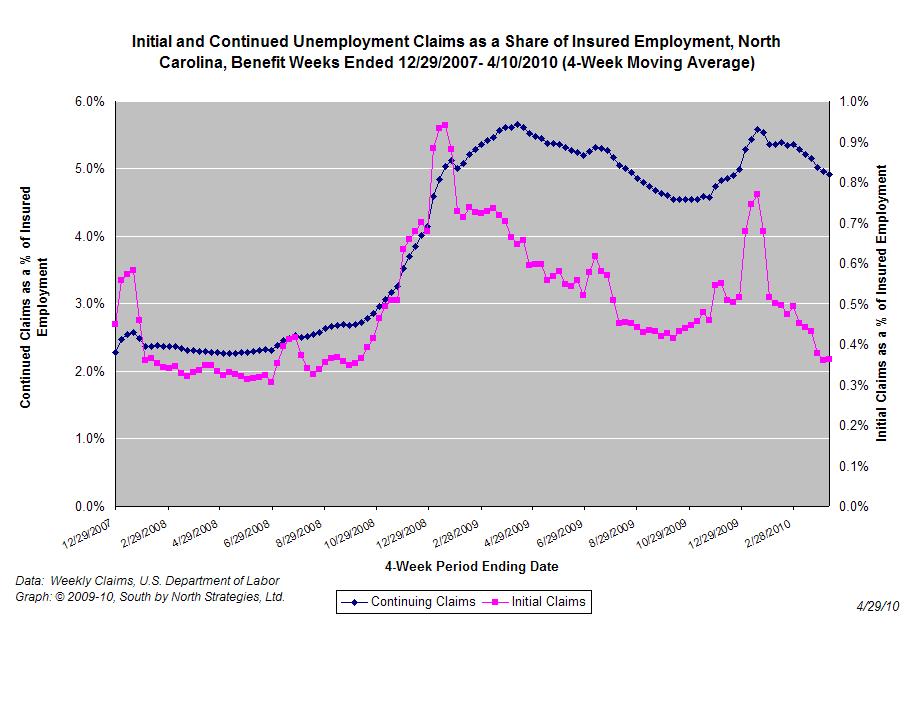
The graph (right) shows the changes in unemployment insurance claims (as a share of covered employment) in North Carolina since the recession’s start in December 2007.
Both new and continuing claims appear to have peaked for this business cycle, and the four-week average of new claims has fallen to a level last seen in June 2008. Yet continuing claims remain at an elevated level, which suggests that unemployed individuals are finding it extremely difficult to find new positions.
What Happened To The Recession?
Washington Post columnist Harold Meyerson wonders why jobs issues have disappeared from the public debate. Writes Meyerson:
Of all the gaps between elite and mass opinion in America today, perhaps the greatest is this: The elites don’t really believe we’re still in recession. Or maybe, they just don’t care.
…
How else to explain the continual harping on the deficit by editorialists, centrist think tanks and the like when the nation is still enmeshed in the most serious economic downturn since the 1930s? How else to understand the growing opposition to the jobs bills Congress is set to vote on this week, particularly when nobody has identified any future engine of American economic growth save countercyclical public investment?
 Email Sign-Up
 RSS Feed