April Employment Report: North Carolina
The April employment report released today by the Employment Security Commission points to a state labor market in fragile condition. Job growth is insufficient to accommodate all those who wish to work; unemployment remains elevated; and uncertainty clouds future prospects.
Last month, North Carolina employers added 7,500 more positions than they eliminated. The public sector generated 80 percent of those jobs with federal hiring – mainly for temporary census positions – accounting for 51.6 percent of net public-sector payroll growth. Since December 2007, North Carolina has lost, on net, 270,000 positions or 6.5 percent of its payroll employment base.
Stabilizing labor market conditions are reflected in April’s household data. Last month, the labor force expanded by 0.1 percent as 6,220 additional people sought work. The number of employed individuals rose, and the number of unemployed individuals declined. The unemployment rate therefore dipped from 11.1 percent to 10.8 percent. Nevertheless, since the start of the recession, the number of unemployed Tar Heels has grown by 131.3 percent, and the unemployment rate has jumped from 4.7 percent to 10.8 percent.
The next few months could be quite difficult for North Carolinians seeking work. Job growth is weak, and much of the recent growth has resulted from such government actions as temporary census hiring, housing tax credits, emergency unemployment insurance payments, and recovery act funding. Many of these supports are phasing out, and it is unclear if enough private-sector demand exists to take their place.
Click here to read South by North Strategies’ full analysis of the April report.
Hold Off On The Celebration
CHAPEL HILL (May 21, 2010) – The April employment report released today by the Employment Security Commission points to a state labor market in fragile condition. Job growth is insufficient to accommodate all those who wish to work; unemployment remains elevated; and uncertainty clouds future prospects.
Last month, North Carolina employers added 7,500 more positions than they eliminated. The public sector generated 80 percent of those jobs with federal hiring – mainly for temporary census positions – accounting for 51.6 percent of net public-sector payroll growth. Since December 2007, North Carolina has lost, on net, 270,000 positions or 6.5 percent of its payroll employment base.
“Few positive changes have occurred within North Carolina’s labor market so far in 2010,” says John Quinterno, a principal at South by North Strategies, Ltd., a research firm specializing in economic and social policy. “Perhaps the best that can be said is that conditions have held steady. However, job growth remains insufficient to absorb new workers, let alone those displaced earlier in the recession.”
In April, North Carolina employers added 7,500 more positions than they cut. The public sector gained, on net, 6,000 positions while the private sector netted 1,500 positions. Among private industries, professional and business services gained the most positions (+6,300), followed by education and health services (+1,900). These gains were offset by losses in trade, transportation, and utilities (-3,100); leisure and hospitality services (-3,100); and construction (-1,800). Additionally, an upward revision to the March data raised net payroll growth for that month from 3,300 to 6,000.
“So far in 2010, North Carolina employers have added 15,700 more positions than they have eliminated,” notes Quinterno. “The average monthly gain of 3,925 is insufficient to meet the natural growth of the labor force, to say nothing of generating jobs for those displaced earlier in the recession. We are not on the road to a swift recovery.”
Despite a recent moderation in job losses, conditions deteriorated over the past year. Compared to April 2009, the state had 33,600 fewer jobs (-0.9 percent). In terms of individual industries, manufacturing (-26,100) and construction (-25,600) lost the greatest number of positions over the past year, while construction also declined the most in relative terms (-13 percent). Government employment grew the most in numerical (+20,400 positions) and relative (+2.9 percent) terms.
Stabilizing labor market conditions are reflected in April’s household data. Last month, the labor force expanded by 0.1 percent as 6,220 additional people sought work. The number of employed individuals rose, and the number of unemployed individuals declined. The unemployment rate therefore dipped from 11.1 percent to 10.8 percent. Nevertheless, since the start of the recession, the number of unemployed Tar Heels has grown by 131.3 percent, and the unemployment rate has jumped from 4.7 percent to 10.8 percent.
“The next few months could be quite difficult for North Carolinians seeking work,” cautions Quinterno. “Job growth is weak, and much of the recent growth has resulted from such government actions as temporary census hiring, housing tax credits, emergency unemployment insurance payments, and recovery act funding. Many of these supports are phasing out, and it is unclear if enough private-sector demand exists to take their place.”
Warned Quinterno, “Conditions could start deteriorating again.”
The Jobs Crisis
From a recent opinion piece by Ross Eisenbrey of the Economic Policy Institute …
Senate Democrats are struggling to put together a $200 billion package of tax extenders, extenders for the Recovery Act’s expansion of Medicaid assistance to the states, unemployment insurance, COBRA subsidies and food stamps, and emergency funding for the 275,000 education jobs that could be lost in the coming school year. Geithner has proposed a $90 billion tax on the liabilities of the largest banks – a sensible way to rein in leverage and raise revenue at the same time. But he has told the Senators he doesn’t want the bank tax used to offset new spending for jobs; he wants it devoted to deficit reduction!
…
It’s one thing for Republicans to take that position; they would just as soon see the economy stall before the November elections. But the Obama cabinet should be doing everything possible to create more jobs, both for economic reasons and for their party’s survival. The biggest current contributors to the budget deficit are the recession and the unemployment it is still causing. Getting people back to work in paying jobs would increase consumer demand and help the virtuous cycle of spending and business investment we need – and the Democrats need – to ensure a robust recovery and begin reducing the deficit.
Around The Dial – May 20
Economic policy reports, blog postings, and media stories of interest:
- The Congressional Budget Office reports on the economic outlook.
- EPI asks about the employment prospects of the class of 2010.
- James Surowiecki says welcome to “the age of political risk.”
- The Wall Street Journal reports on stay-at-home dads.
NC Unemployment Claims: Week of 5/1
For the benefit week ending on May 1st, 12,698 North Carolinians filed initial claims for state unemployment insurance benefits, and 168,979 individuals applied for state-funded continuing benefits. Compared to the prior week, there were fewer initial and continuing claims. These figures come from data released today by the U.S. Department of Labor.
Averaging new and continuing claims over a four-week period — a process that helps adjust for seasonal fluctuations and better illustrates trends — shows that an average of 12,905 initial claims were filed over the last four weeks, along with an average of 176,639 claims. Compared to the previous four-week period, both initial and continuing claims were lower.
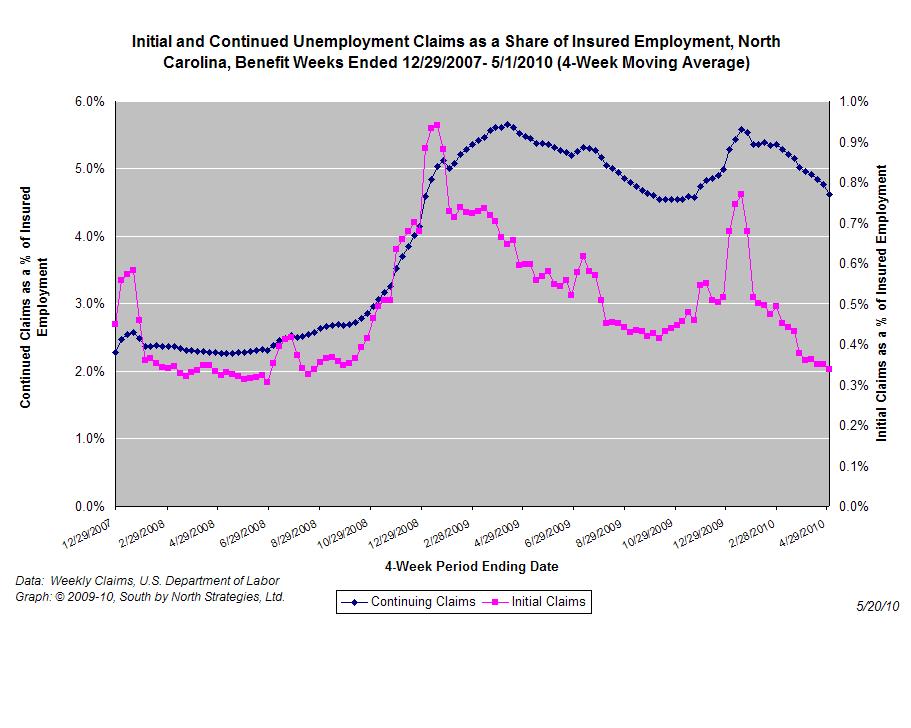 One year ago, the four-week average for initial claims stood at 24,041 and the four-week average of continuing claims equaled 220,824.
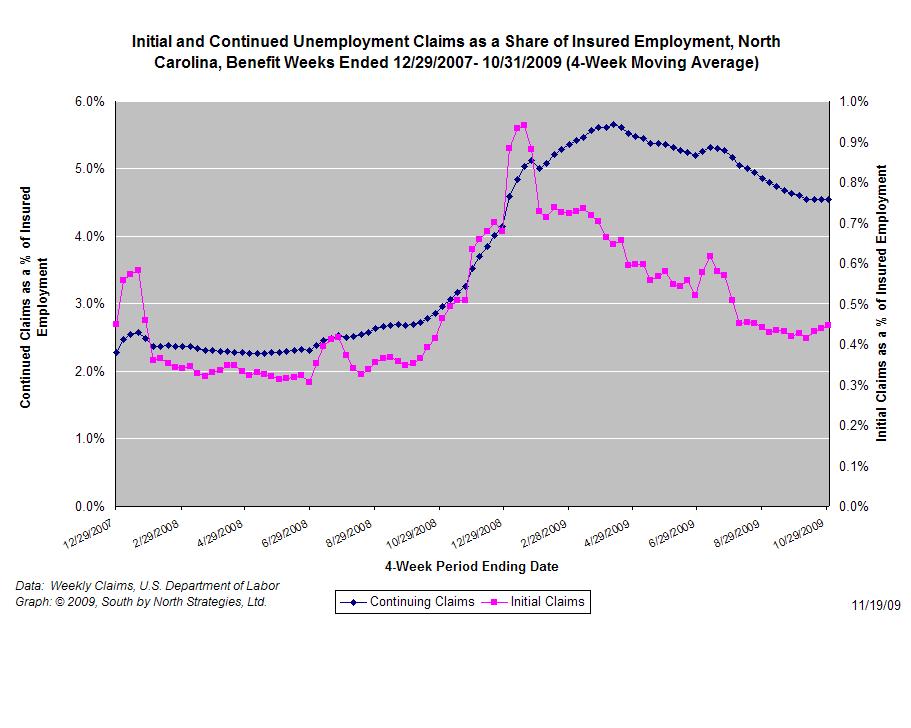
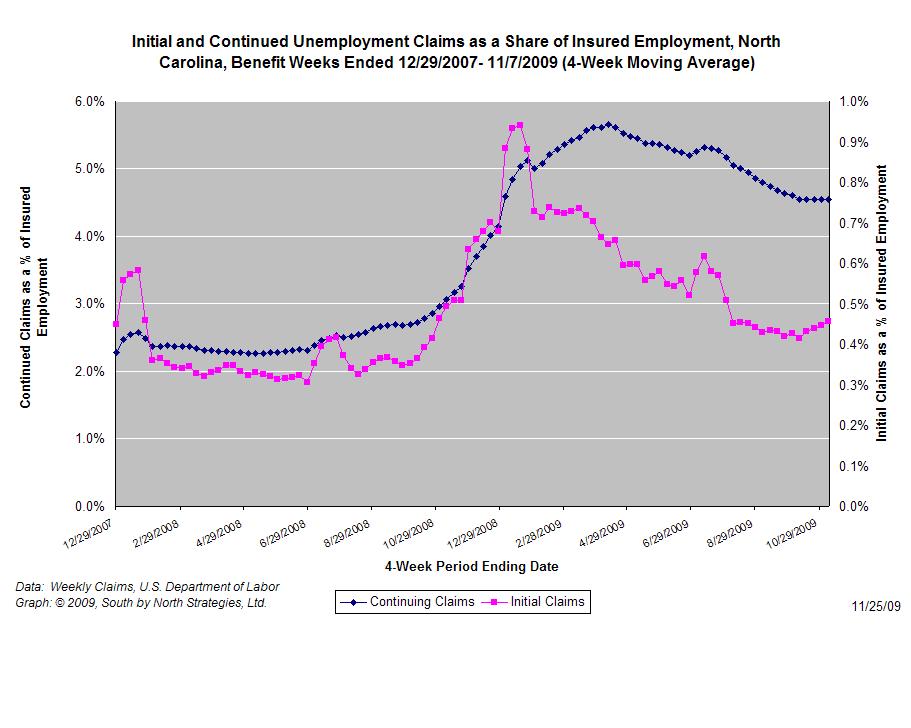
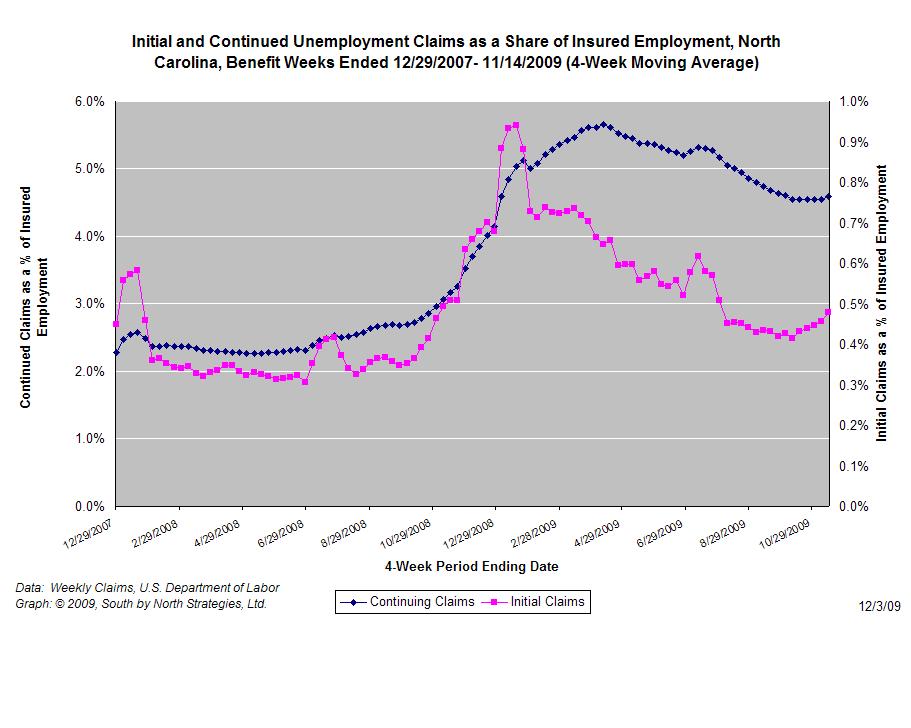
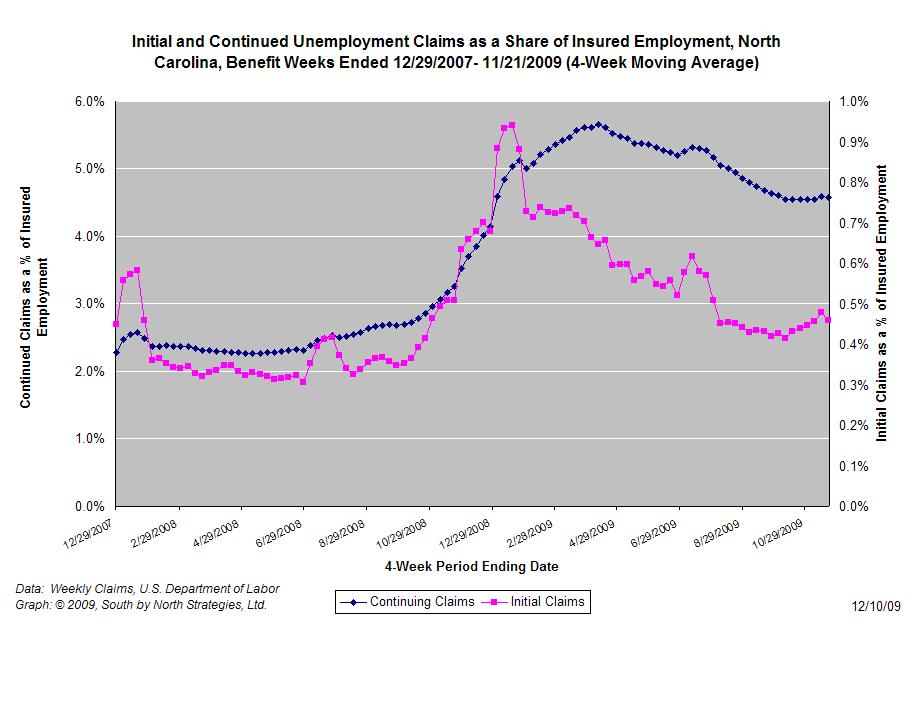
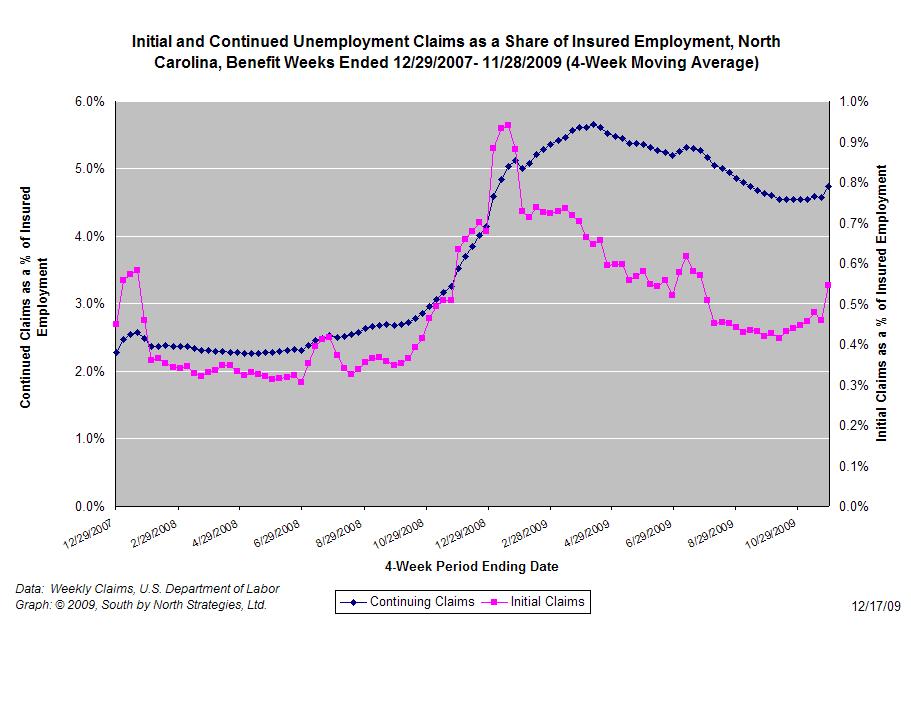
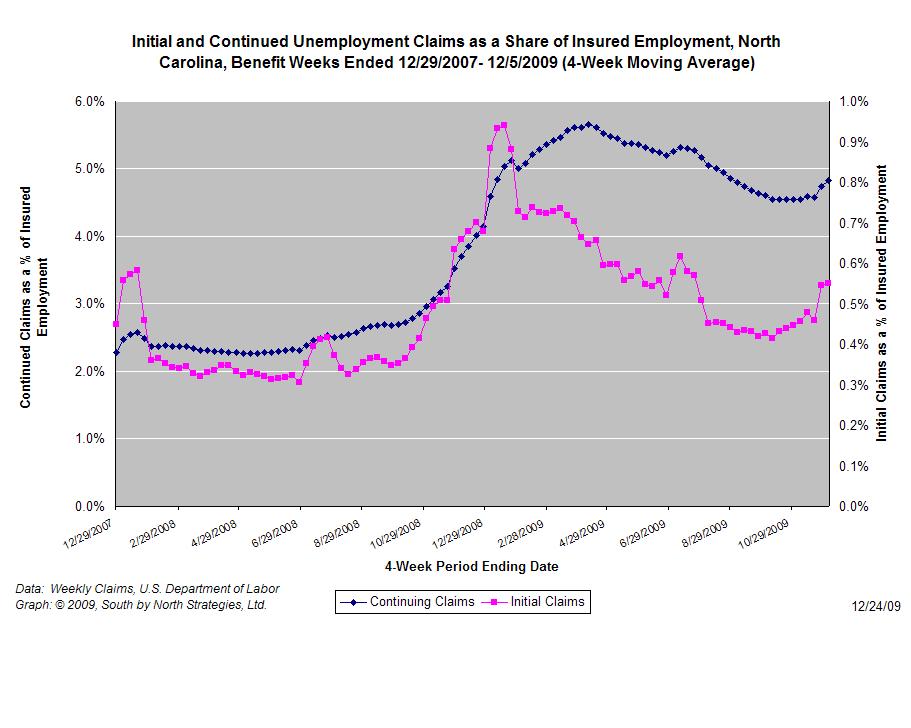
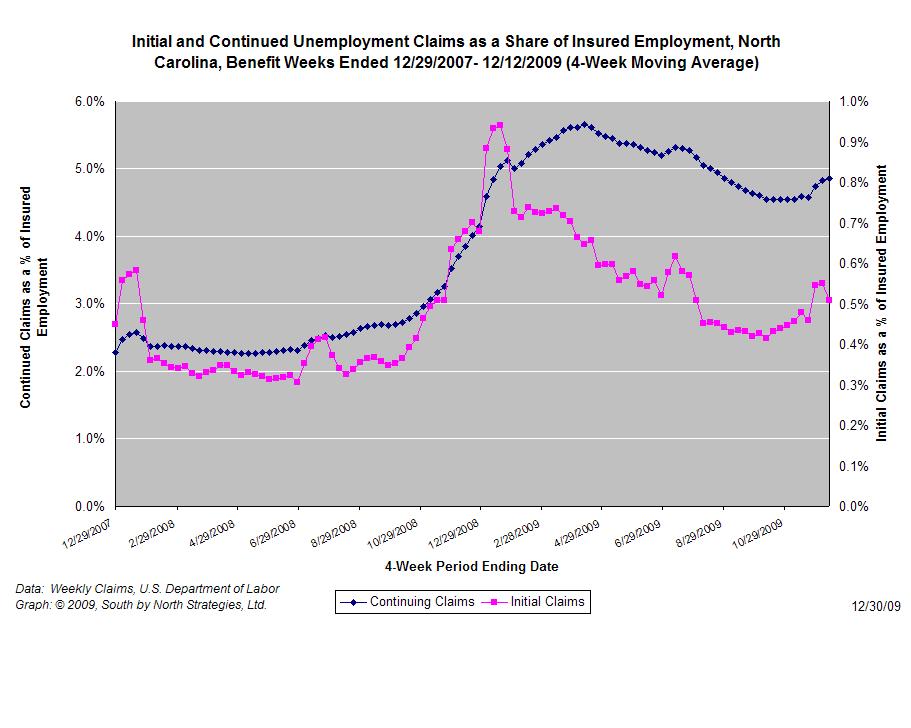
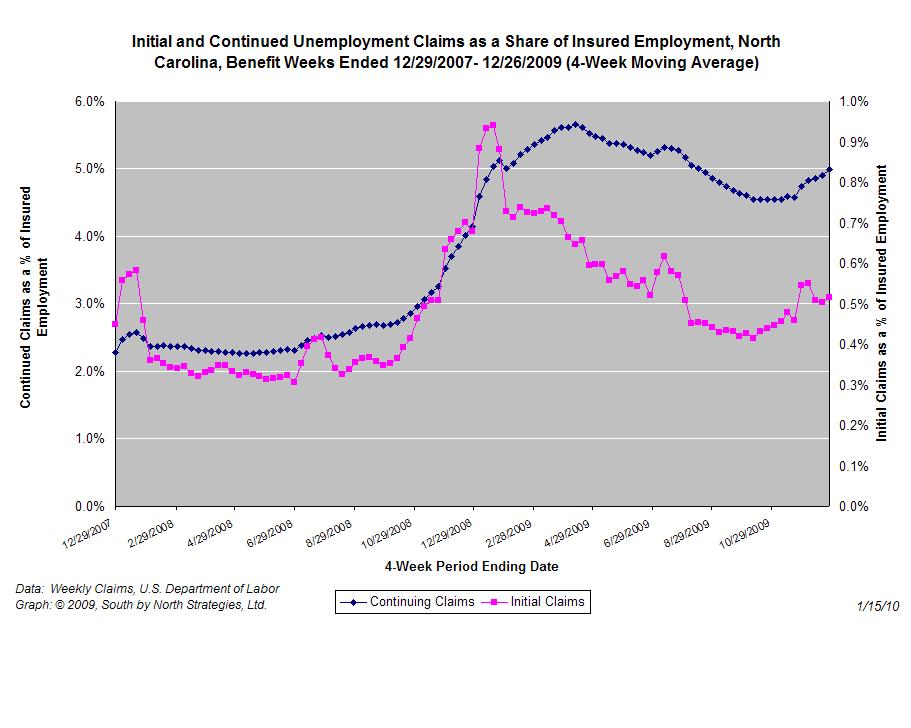
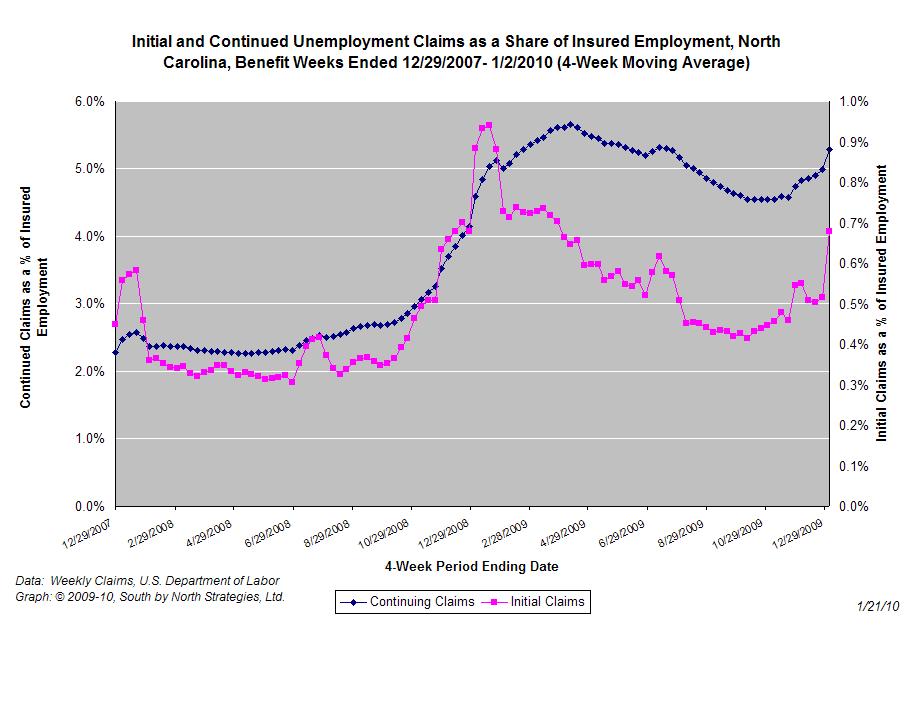
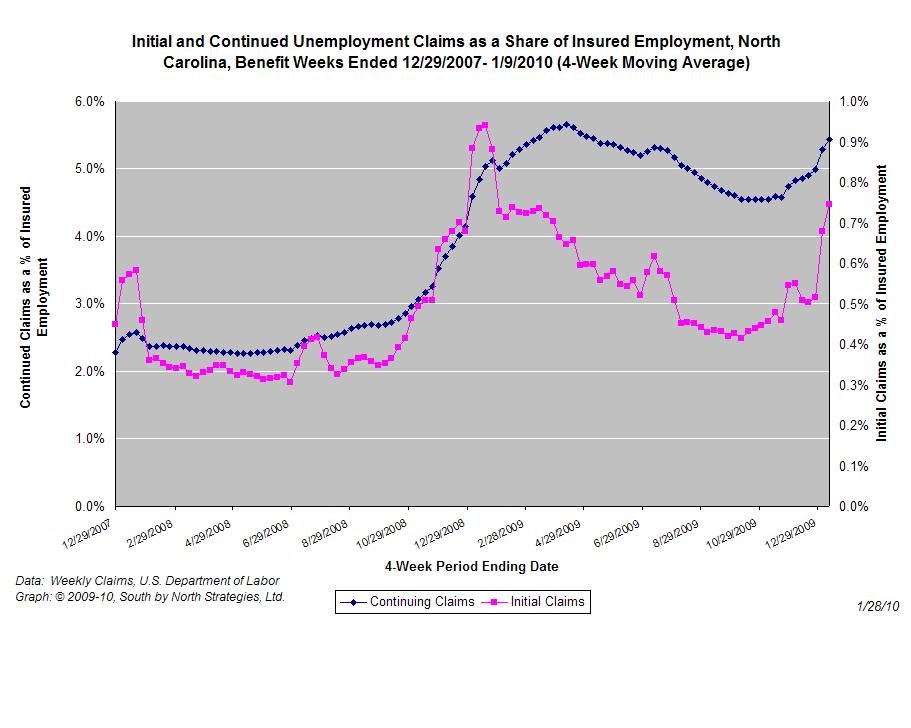
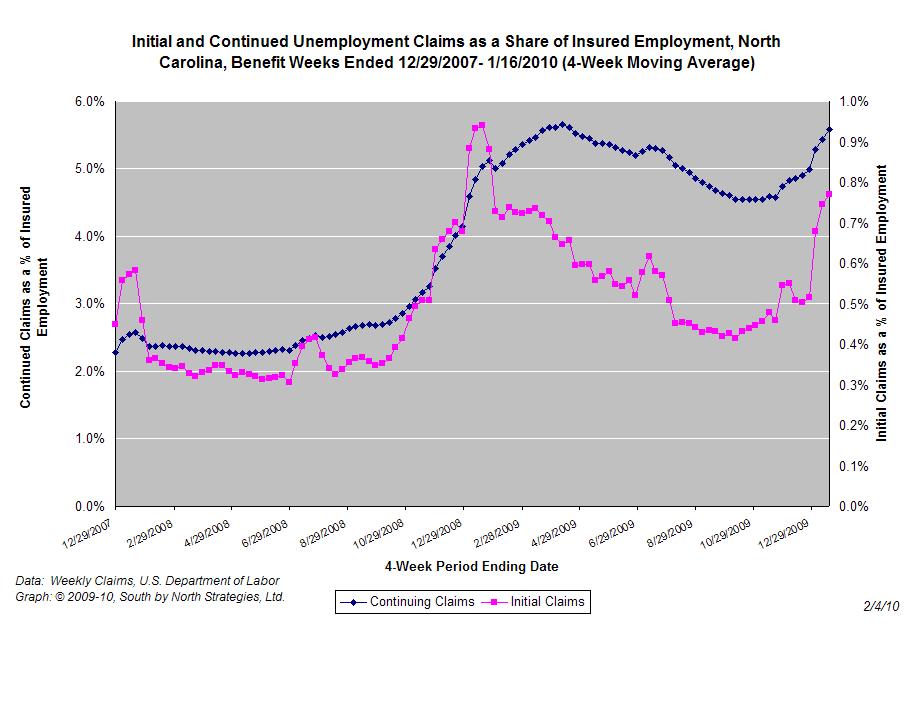
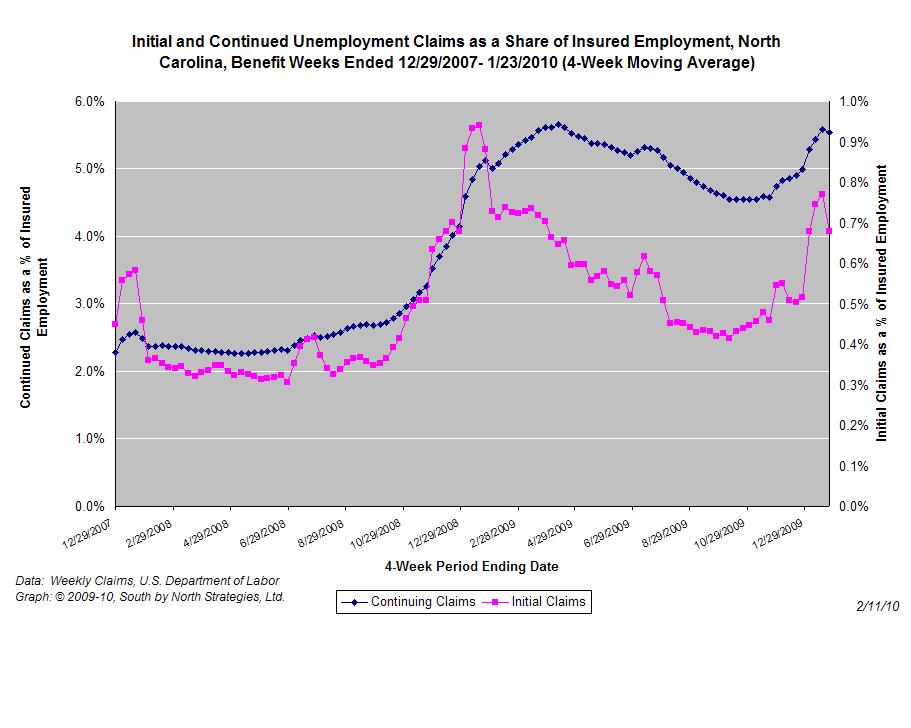
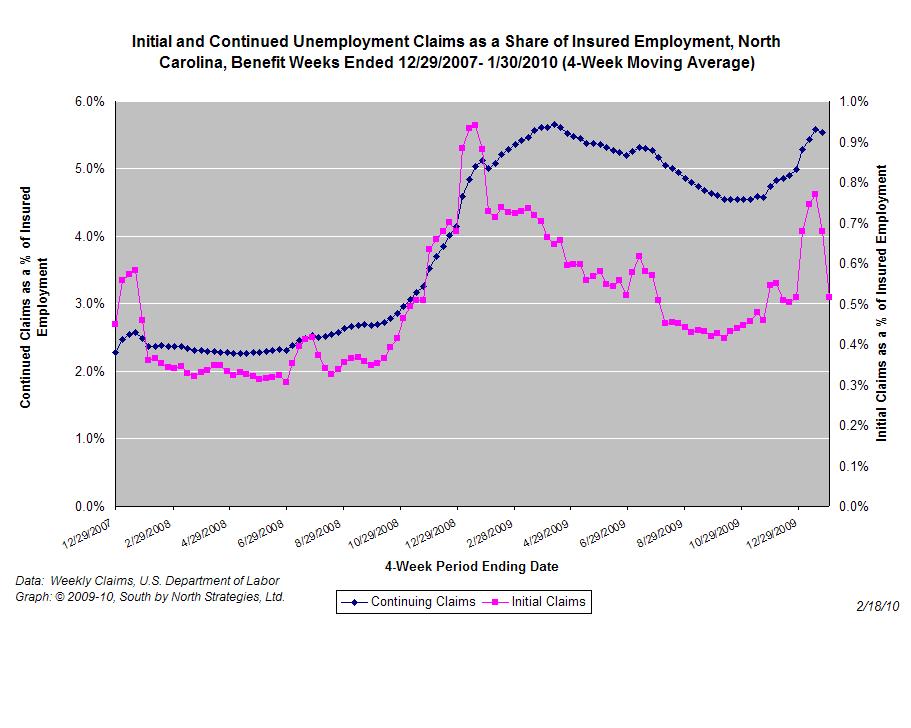
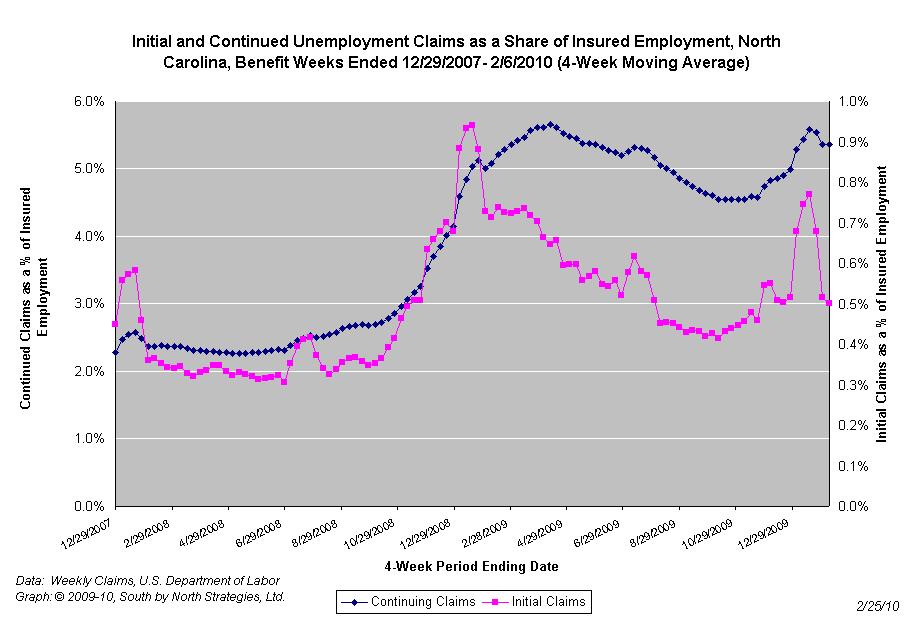
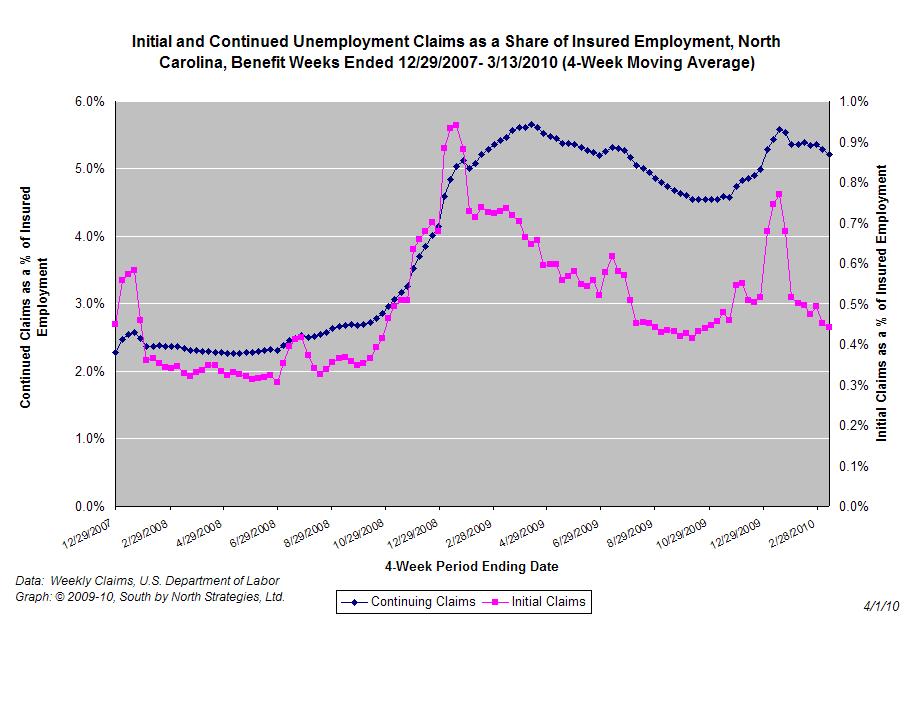
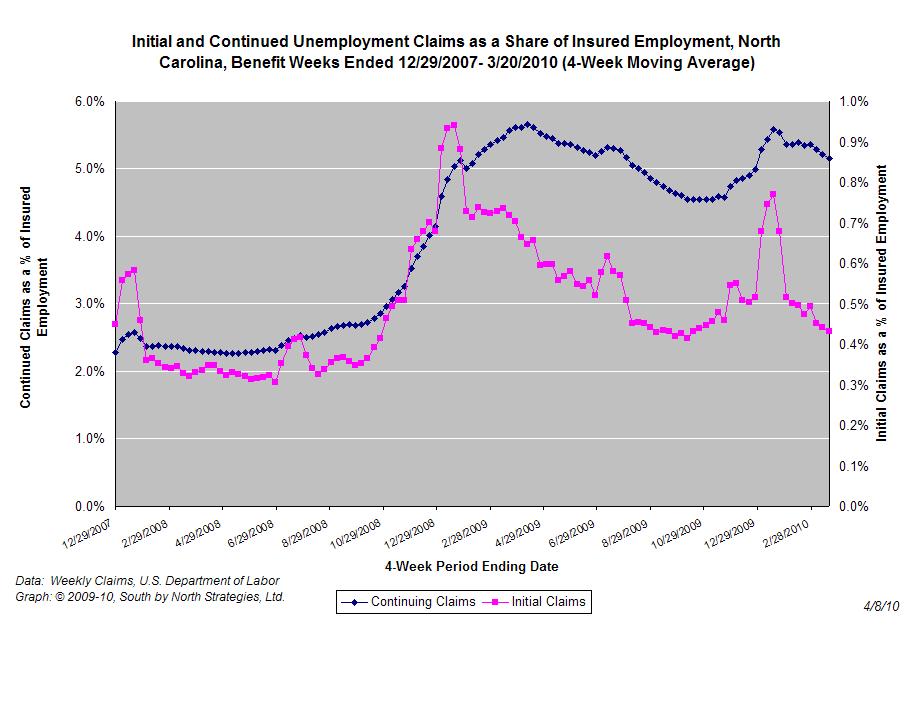
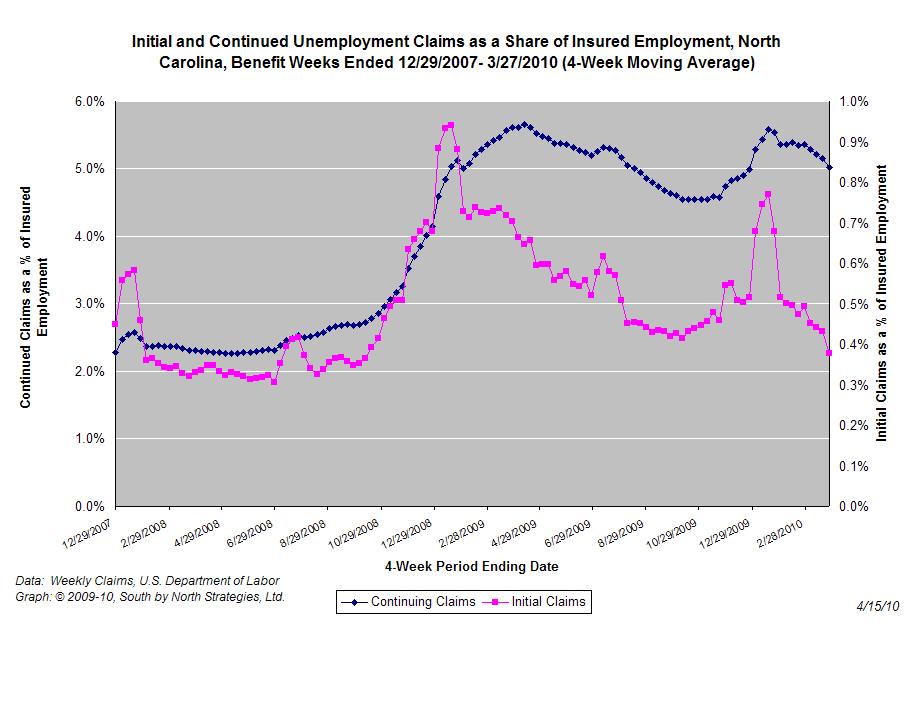
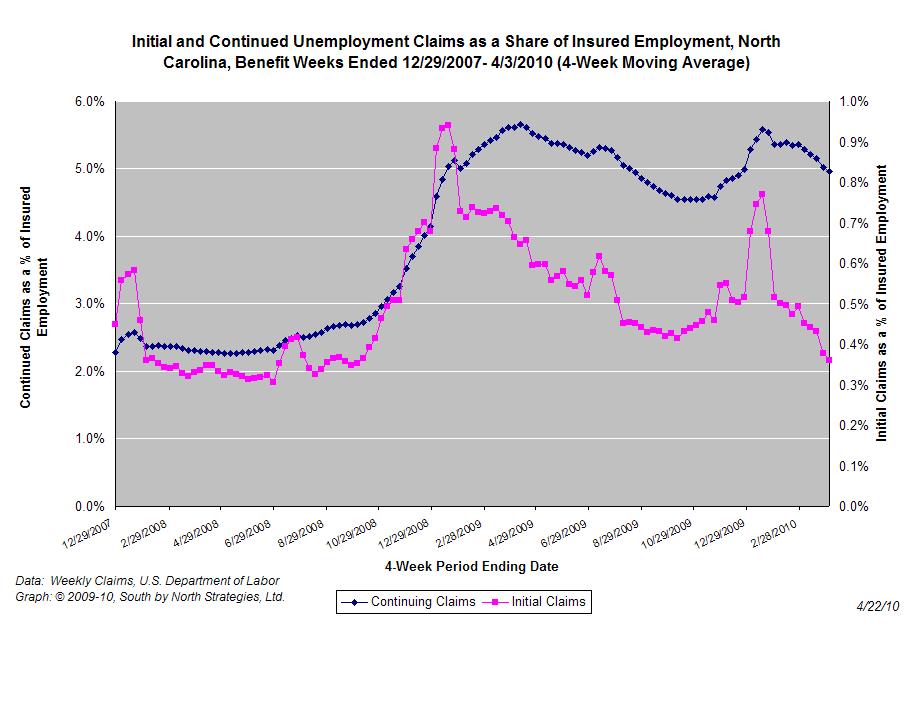
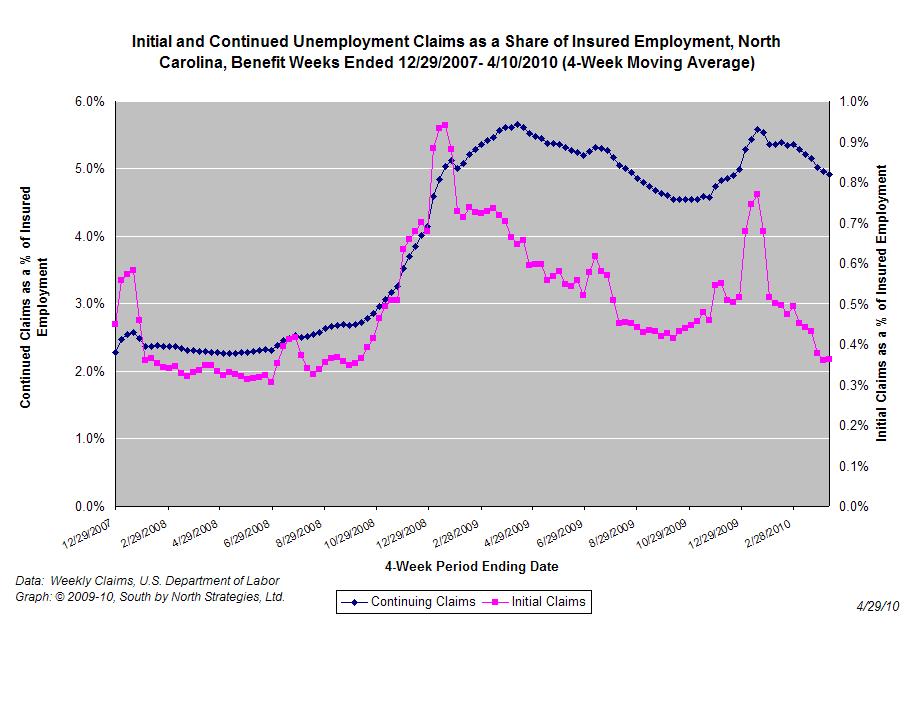
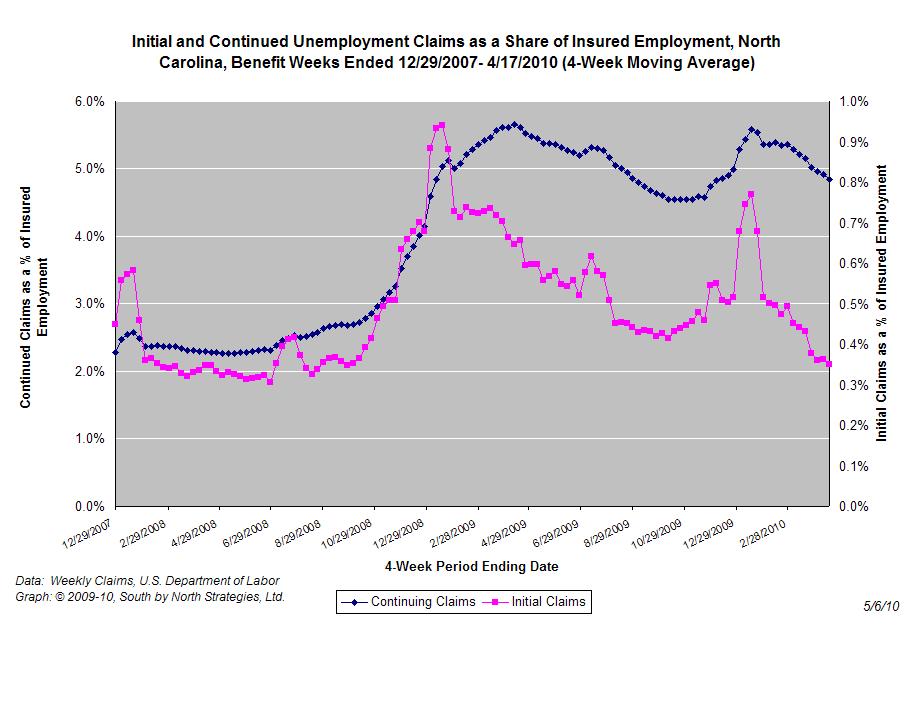
The graph (right) shows the changes in unemployment insurance claims (as a share of covered employment) in North Carolina since the recession’s start in December 2007.
Both new and continuing claims appear to have peaked for this business cycle, and the four-week average of new claims has fallen to a level last seen in the Summer of 2008. Yet continuing claims remain at an elevated level, which suggests that unemployed individuals are finding it extremely difficult to find new positions.
 Email Sign-Up
 RSS Feed