

A Changing Workforce
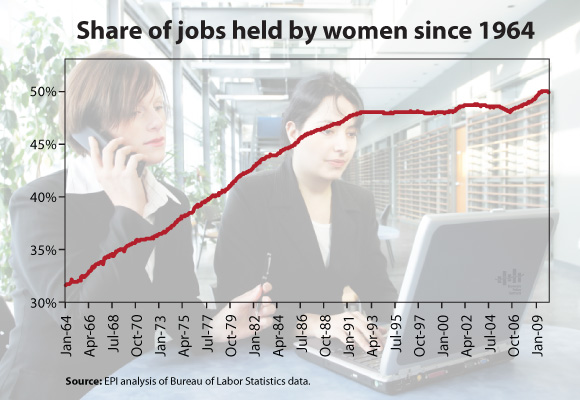
A research brief from the Economic Policy Institute notes that women now hold close to half of all jobs in the United States, up from 40 percent in 1978.
Around The Dial – May 12
Economic policy reports, blog postings, and media stories of interest:
- Dean Baker says that “banks failing to lend” isn’t the problem.
- Free Exchange looks at income trends in “ideopolises” like Raleigh-Durham.
- The American Prospect profiles the new president of the SEIU.
Service Activity in The South Atlantic: April
From the Federal Reserve Bank of Richmond’s latest survey of service-sector activity in the South Atlantic (District of Columbia, Maryland, North Carolina, South Carolina, Virginia and West Virginia):
Fifth District service sector activity improved in April, according to the latest survey by the Federal Reserve Bank of Richmond. Growth in retail sales picked up while retail inventories continued to decline. Although big-ticket sales slumped, shopper traffic rose this month. Revenue growth also returned at non-retail services firms. Price change in the broad service sector ticked up slightly.
…
In service sector labor markets, non-retail firms were hiring again while retail job cuts continued. Average wages grew moderately across the sector.
Unemployment Insurance Solvency
A new report from the National Employment Law Project analyzes the severe solvency problems facing state unemployment insurance systems across the nation. Notes the report:
The financing system for unemployment bene-fits is under unprecedented distress, but the situation is not simply the result of the deep recession. The system failure is a result of years of poor financing policy decisions, and the cur-rent crisis should compel policy makers to forge a new path to forward financing of the unemployment insurance program.
The table below summarizes the financial conditions of state trust funds. (Click to enlarge.)

Demand-Driven Development in Rural North Carolina
In late 2009 and early 2010, South by North Strategies, Ltd. conducted a review of “demand-driven” workforce development models for the N.C. Rural Economic Development Center. This research was part of the Rural Center’s “Rural Community Mobilization Project,” which is funded by federal recovery funds provided through the state Department of Commerce.
The project’s purpose was to help selected rural communities use demand-driven workforce development practices to respond to the recession. To that end, the Rural Center asked South by North Strategies to review existing demand-driven development practices in North Carolina and consult with key practitioners. Specifically, South by North Strategies considered the current economic context, critiqued the demand-driven workforce development model, profiled several promising strategies, and identified key lessons.
 Email Sign-Up
 RSS Feed