

In The Eye of The Beholder
The graph (below), which was prepared by the office of the Speaker of the U.S. House of Representatives, has been making its way through the blogosphere. The intended point is that economic conditions, as measured by rates of GDP growth, have been improving under the current administration and congress.
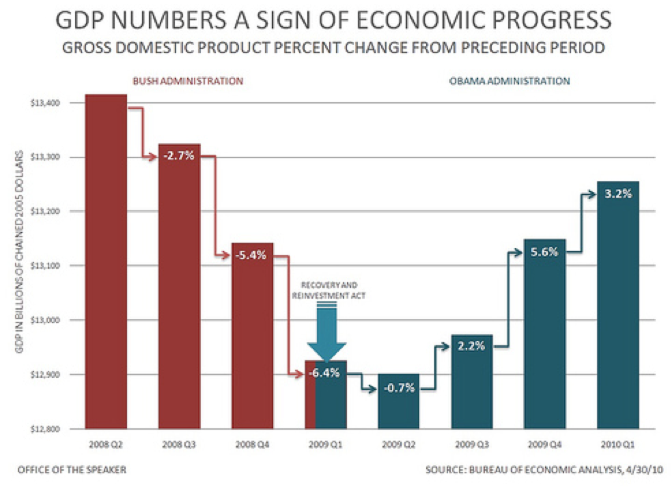
The graph is right to note that the direction of changes in GDP growth has been positive and that the country has experienced three consecutive quarters of growth. Yet more important than the direction is the rate of growth. And the recent growth rates are insufficient to close the gap between actual output and potential output. As a result, the recovery is a tepid one that is proving insufficient to put much of a dent on the overall high levels of joblessness.
Rather than signaling “mission accomplished,” the graph suggests that more needs to be done and that the policies pursued since early 2009 have made a difference. The challenge is make them more effective.
Around The Dial – May 7
Economic policy reports, blog postings, and media stories of interest:
- CBPP calls for an extended moratorium on UI interest repayment.
- Harold Meyerson says that “deficit hawkery” is harming education.
- Naked Capitalism analyzes yesterday’s “market freakout.”
- Ed Glaeser notes the perverse effects of the mortgage interest deduction.
National Labor Market Improves in April
The national employment report for April points to an improving labor market. Last month, employers added 290,000 more payroll jobs than they eliminated with gains occurring across a broad range of industries. Stabilizing conditions also drew many jobless individuals back into the labor force in attempts to find work.
In April, the nation’s employers added 290,000 more payroll positions than they eliminated. Gains occurred in both the public (+59,000) and private sectors (+231,000), as well as in most major industry groups. The largest gains occurred in professional and business services (+80,000), government (+59,000), leisure and hospitality services (+45,000), and manufacturing (+44,000). Losses occurred in the trade/transportation/utilities (-3,000) and information (-3,000) sectors.
The job growth experienced in April encouraged individuals who had stopped looking for work to resume their searches, a development that pushed up the unemployment rate. In April, 15.3 million Americans – 9.9 percent of the labor force – were jobless and actively seeking work. Proportionally more adult male workers were unemployed than female ones (10.1 percent vs. 8.2 percent). Similarly, unemployment rates were higher among Black (16.5 percent) and Hispanic workers (12.5 percent) than among White ones (9.0 percent). The unemployment rate among teenagers was 25.4 percent.Furthermore, newly available data show that 9.1 percent of all veterans were unemployed in April; the rate among veterans who had served since September 2001 was 13.1 percent.
Click here for South by North Strategies’ full analysis of the employment report.
National Job Market Improves in April
CHAPEL HILL (May 7, 2010) – The national employment report for April points to an improving labor market. Last month, employers added 290,000 more payroll jobs than they eliminated with gains occurring across a broad range of industries. Stabilizing conditions also drew many jobless individuals back into the labor force in attempts to find work.
“The payroll growth that occurred in April is good news, and overall conditions have improved throughout 2010,” said John Quinterno, a principal at South by North Strategies, Ltd., a research firm specializing in economic and social policy. “The problem is that growth still is not occurring at a pace needed to reverse the severe job losses that occurred during the recession. The employment landscape remains a difficult one to navigate.”
In April, the nation’s employers added 290,000 more payroll positions than they eliminated. Gains occurred in both the public (+59,000) and private sectors (+231,000), as well as in most major industry groups. The largest gains occurred in professional and business services (+80,000), government (+59,000), leisure and hospitality services (+45,000), and manufacturing (+44,000). Losses occurred in the trade/transportation/utilities (-3,000) and information (-3,000) sectors.
“Nearly one-third of the payroll positions added in April were temporary ones connected to the private sector or the Census Bureau,” noted Quinterno. “When those positions end, the individuals holding those jobs likely will find themselves jobless again.”
The job growth experienced in April encouraged individuals who had stopped looking for work to resume their searches, a development that pushed up the unemployment rate. In April, 15.3 million Americans – 9.9 percent of the labor force – were jobless and actively seeking work. Proportionally more adult male workers were unemployed than female ones (10.1 percent vs. 8.2 percent). Similarly, unemployment rates were higher among Black (16.5 percent) and Hispanic workers (12.5 percent) than among White ones (9.0 percent). The unemployment rate among teenagers was 25.4 percent.
Furthermore, newly available data show that 9.1 percent of all veterans were unemployed in April; the rate among veterans who had served since September 2001 was 13.1 percent.
“Improved labor market conditions led 805,000 individuals to enter the labor force last month, and one-quarter of unemployed individuals said they were re-entrants to the labor market,” added Quinterno. “Nevertheless, jobs remain difficult to find. In April, 45.9 percent of all unemployed workers had been jobless for at least six months. Many other individuals simply stopped looking, and counting those individuals and those working part-time on an involuntary basis brings the underemployment rate to 17.1 percent.”
“The April employment report contains much positive news, but the bottom line is that conditions remain weak,” observed Quinterno. “Given the magnitude of the recession, improvements are not occurring at the levels needed to reverse past job losses anytime soon. We don’t just need positive growth, we need faster growth. Absent that, the recovery will unfold slowly.”
Bourgeoisie Bearing Pitchforks
James Kwak of The Baseline Scenario asks just who is driving the so-called “populist” backlash.
Michael Lewis, in an interview with Christopher Lydon, said that in his book tour, a lot of his audiences are well-off and moderate well-off professionals — doctors, dentists, lawyers, small business owners, etc. These are people who (at least according to them) followed the rules, worked hard, paid their taxes, made a fair amount of money, etc. — and just saw the economy almost collapse because of what they see as the shenanigans of a tiny, tiny elite that plays by a different set of rules. Lewis or Lydon (I can’t recall which) called it a “revolt of the petty bourgeoisie.” And it is true that one of the societal forces behind the French Revolution was a traditional official class that saw its status threatened by the new capitalist class. (Yes, this is the opposite of what Marx and Engels thought.)
…
I don’t want to make too much of this. But I think it is true that the pitchfork-wielders of today are not rock-throwing Trotskyites; they are, largely, politically moderate (or conservative) people who believe in capitalism and in making money. And I also think that there has been a relative shift in economic fortunes away from the small business owning class that we like to think of as the bedrock of American society (the modern version of the yeoman farmer of the eighteenth century), and toward a new elite made up of corporate CEOs, investment bankers, and hedge fund managers. Where this will end up I do not know.
 Email Sign-Up
 RSS Feed