

Service Activity in the South Atlantic: March
From the Federal Reserve Bank of Richmond’s January survey of service-sector activity in the South Atlantic (District of Columbia, Maryland, North Carolina, South Carolina, Virginia and West Virginia):
Fifth District service sector activity strengthened in March, according to the latest survey by the Federal Reserve Bank of Richmond. Retail sales expanded and inventories decreased. In addition, the drop in big-ticket sales abated this month. Shopper traffic continued to slump, however. At non-retail services firms, revenues fell, but the decline was less pervasive than in recent months. Price change in the broad service sector was nearly the same as a month ago.
…
In labor markets, job cuts subsided at retail businesses and the number of employees was unchanged at services firms. Average wages in the overall service sector ticked higher in March.
Bad Economists
In this video, Yves Smith of Naked Capitalism discusses the recent failures of the economics profession.
Around the Dial – April 20
Economic policy reports, blog postings, and media stories of interest:
- Economix offers a primer on value-added taxes.
- TaxVox asks whether subsidies or tax credits better aid low-income families.
- Marshall Auerback wonders what the Eurozone’s problems mean for the U.S.
Rising Social Inequality
From a report in The Economist on social mobility and inequality in America …
But the reality for most Americans is becoming more complicated. The recession came at the end of a period marked by record levels of inequality. Many Americans, lacking true upward mobility, bought its trappings, such as a bigger house or better car. Disaster duly followed. As a result, American optimism has been pierced by doubt. In a new poll for The Economist, 36% of respondents said they had less opportunity than their parents did, compared with 39% who thought they had more. Half thought the next generation would have a lower standard of living, double the share that thought living standards would rise. As the country recovers, two problems cloud its future. Rates of social mobility are unlikely to grow. Inequality, however, may widen even further.
—-
The recession, meanwhile, may have exacerbated trends in inequality. The capital markets, points out Timothy Smeeding of the University of Wisconsin, have recovered more quickly than the housing or labour markets. This is troubling for the poor and the middle class, since homes represent a greater share of their wealth. Unemployment has been concentrated in America’s lower ranks. As the rich recover, poor and middle-class people may lag behind. Young workers may fare badly, too. Those who graduate in recessions have lower incomes in the long term, according to Lisa Kahn of Yale University.
State Level ARRA Estimates
From the Council of Economic Advisers’ latest report on the American Recovery and Reinvestment Act …
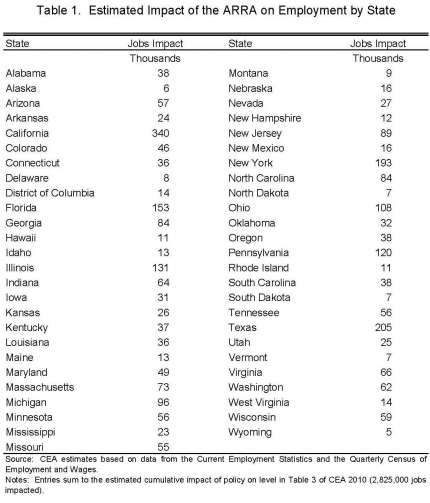
The CEA’s third quarterly report on the impact of the American Recovery and Reinvestment Act (ARRA), released on April 14, 2010 (CEA 2010), found that the ARRA raised employment as of the first quarter of 2010 by between 2.2 million and 2.8 million jobs over what it would otherwise have been.
The following table estimates the number of jobs created or saved by state. Note that the estimate for North Carolina is 84,000 jobs.
 Email Sign-Up
 RSS Feed