NC Unemployment Claims: Week of 3/13
For the benefit week ending on March 13th, 14,385 North Carolinians filed initial claims for state unemployment insurance benefits, and 196,113 individuals applied for state-funded continuing benefits. Compared to the prior week, there were fewer initial and continuing claims. These figures come from data released today by the U.S. Department of Labor.
Averaging new and continuing claims over a four-week period — a process that helps adjust for seasonal fluctuations and better illustrates trends — shows that an average of 17,189 initial claims were filed over the last four weeks, along with an average of 202,207 claims. Compared to the previous four-week period, both initial and continuing claims were lower.
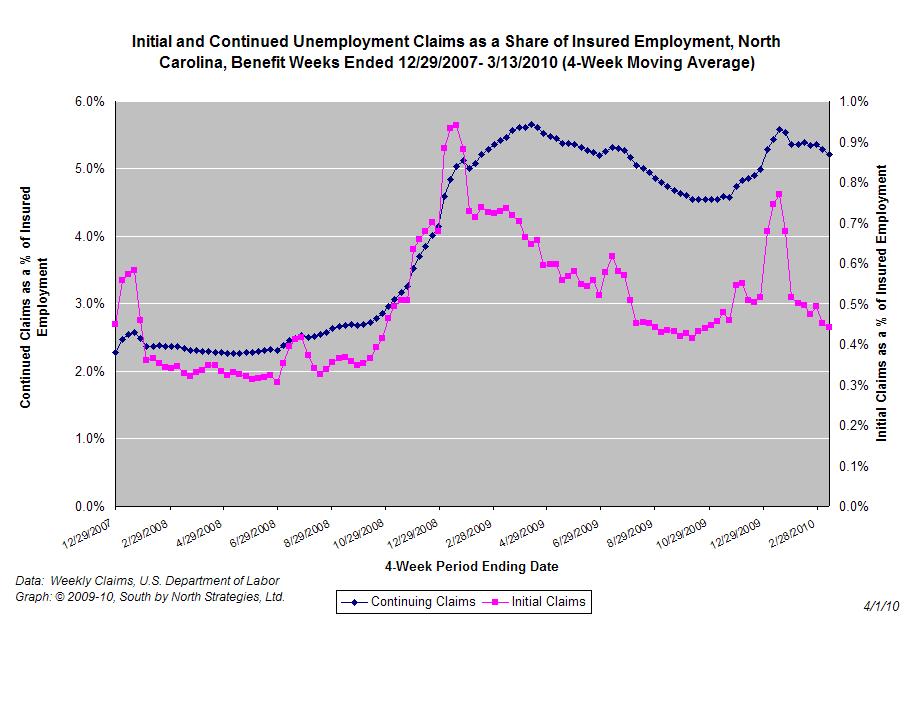 One year ago, the four-week average for initial claims stood at 29,563 and the four-week average of continuing claims equaled 220,813.
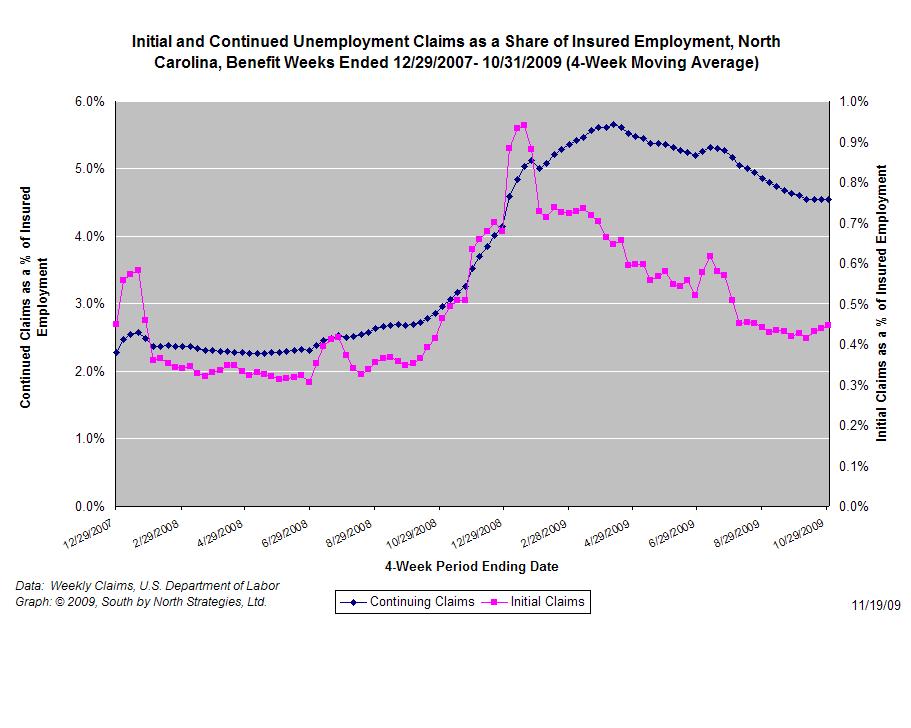
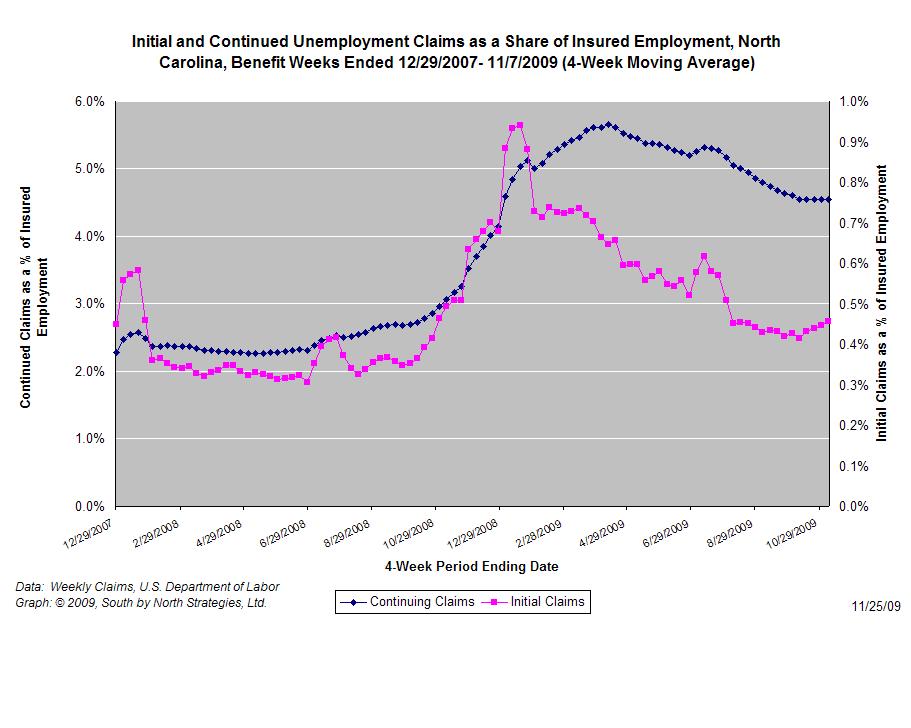
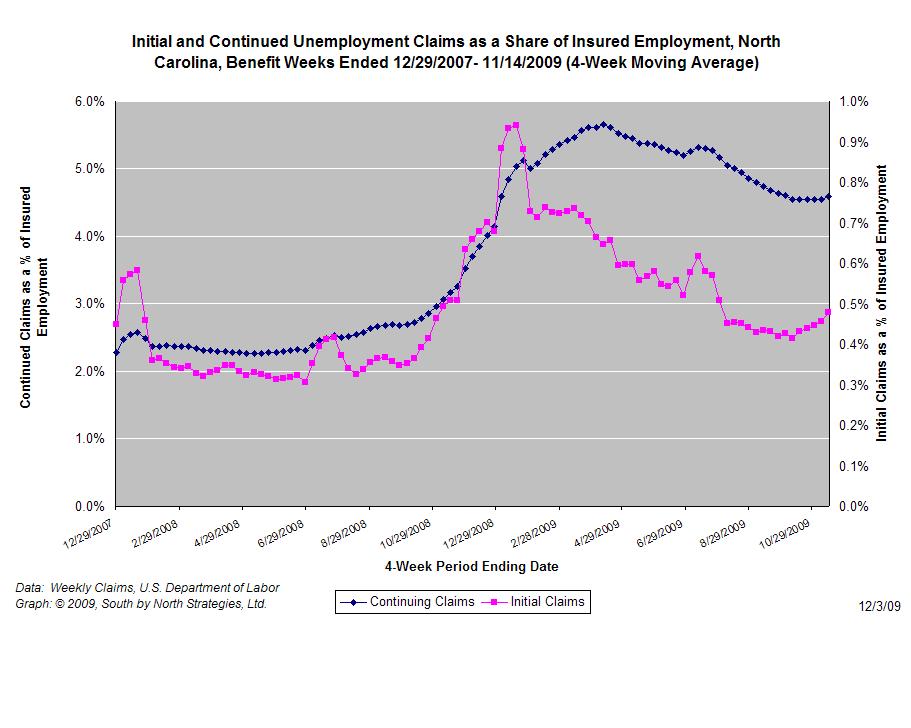
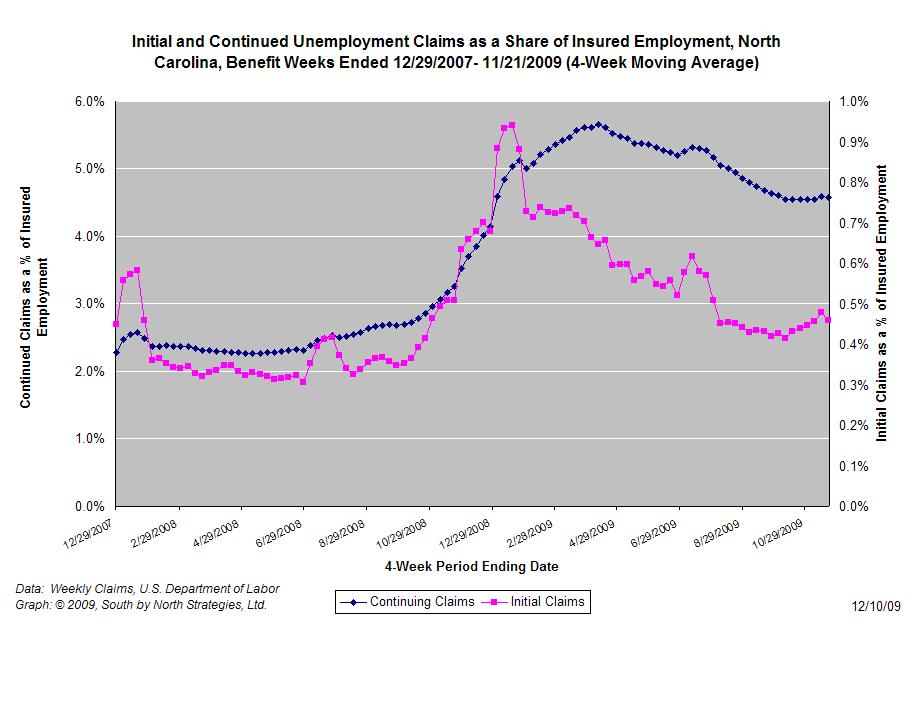
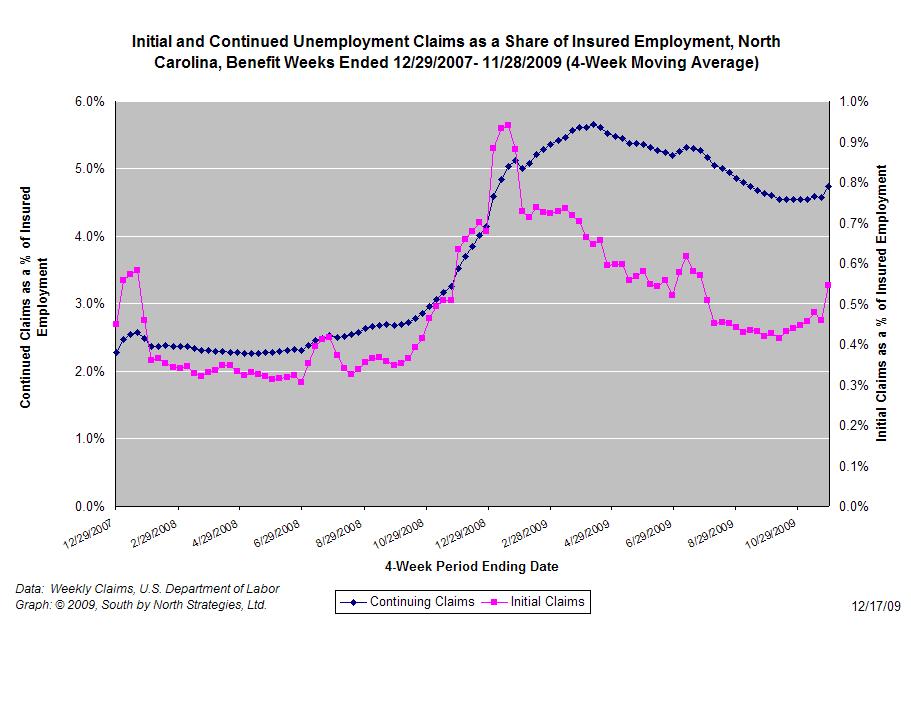
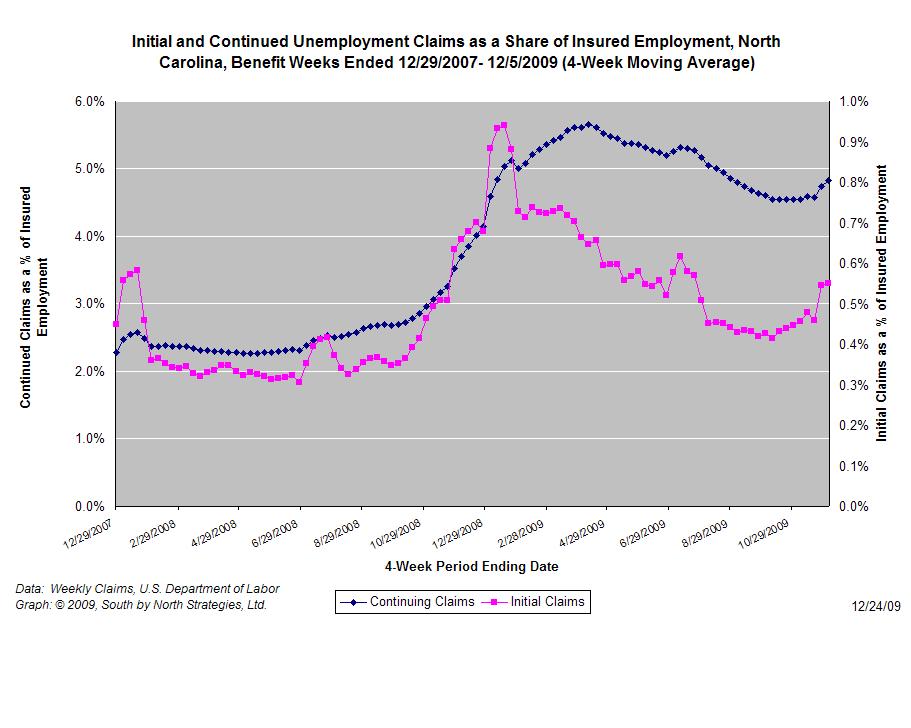
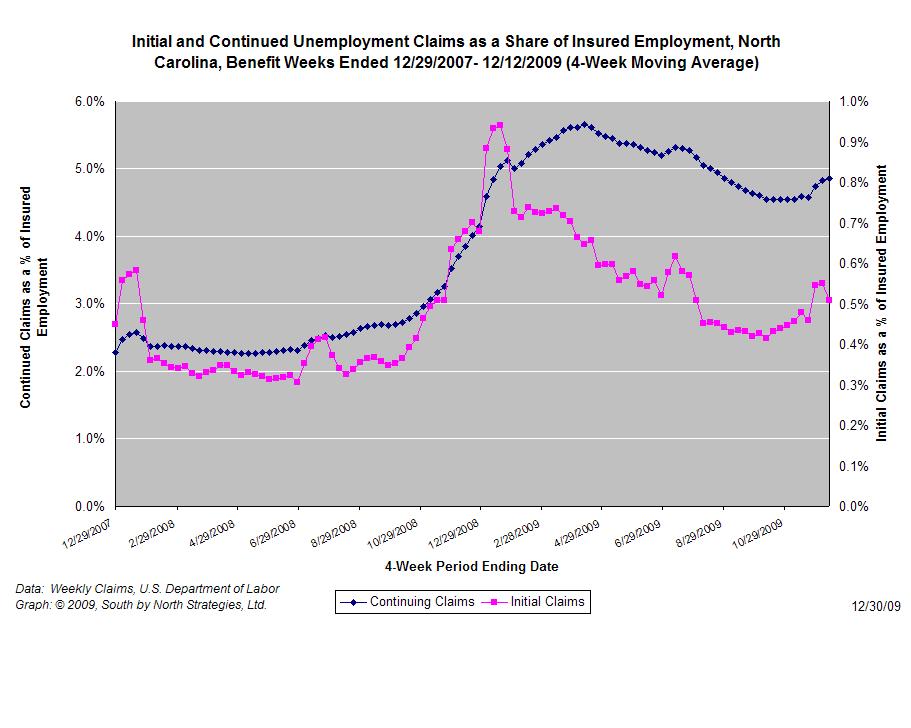
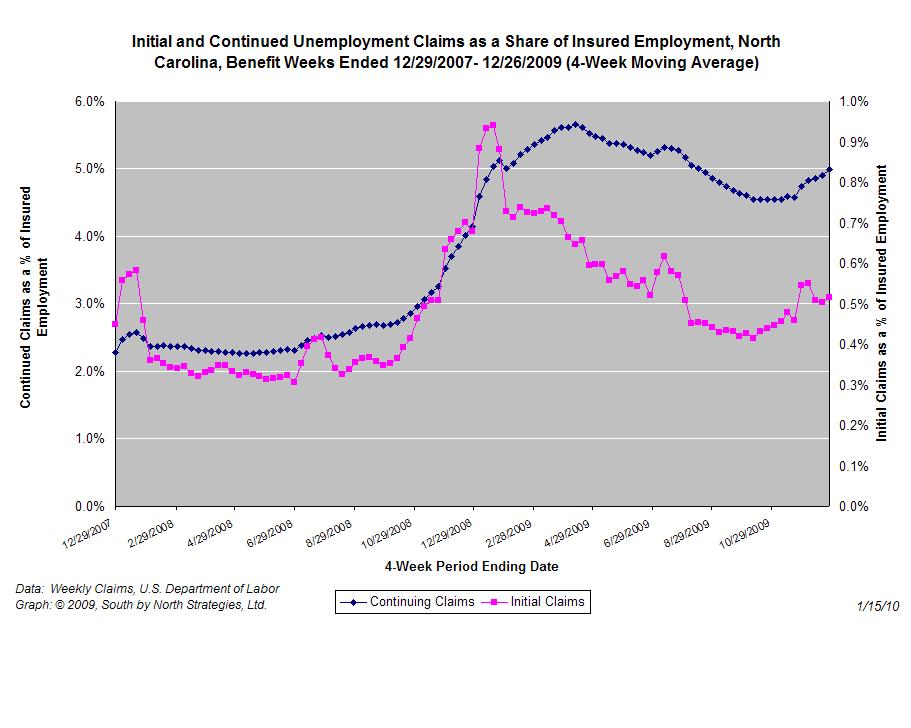
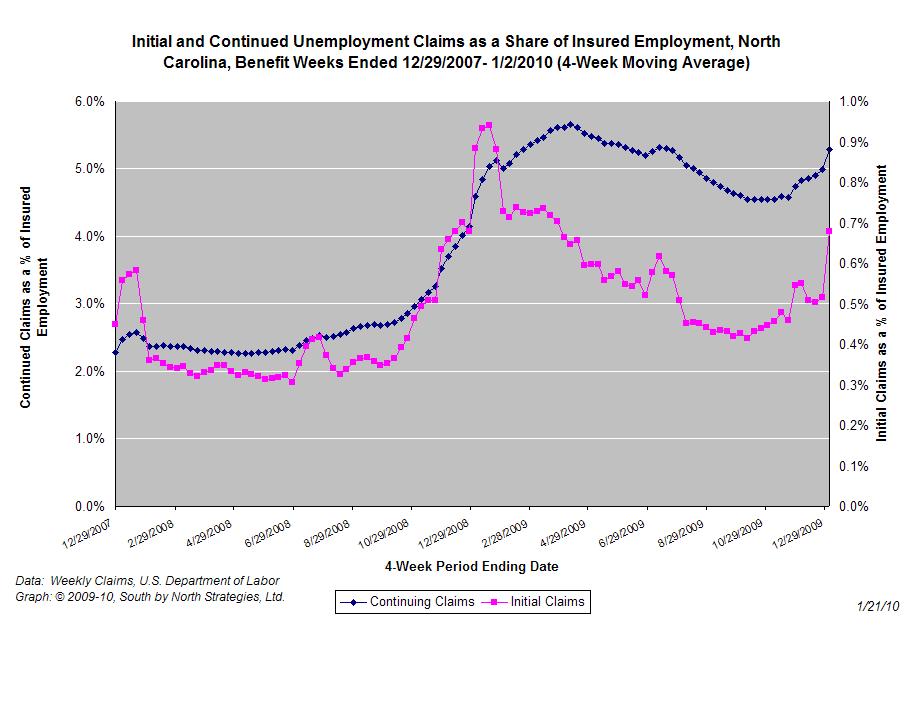
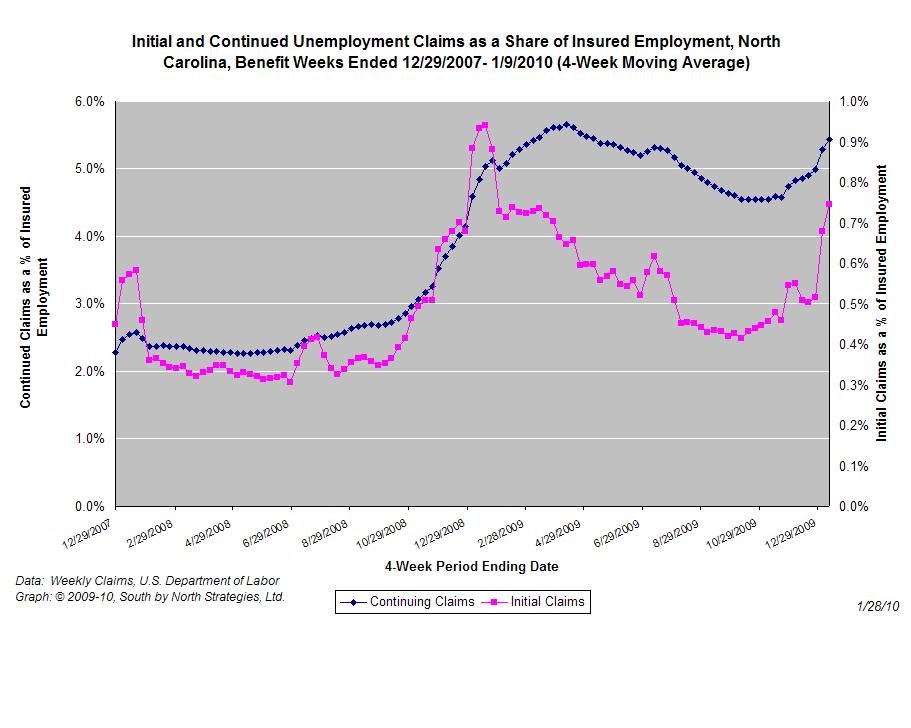
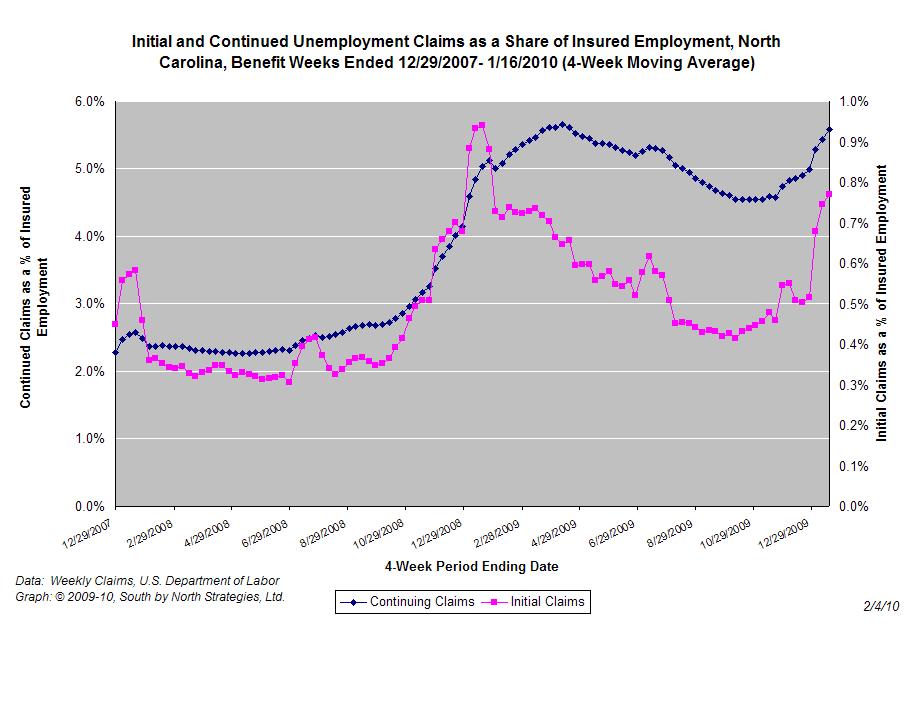
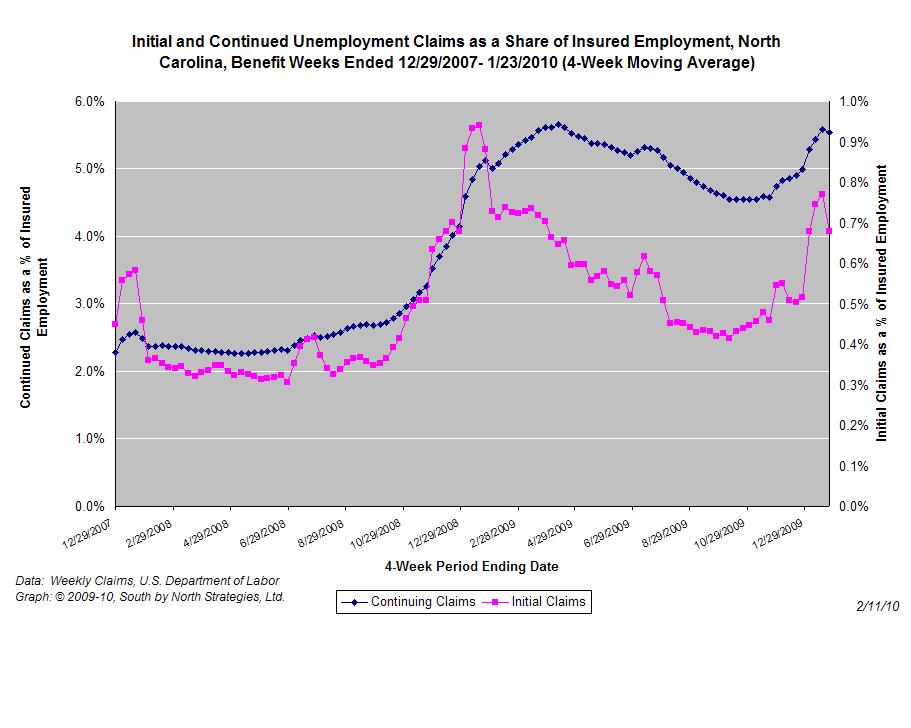
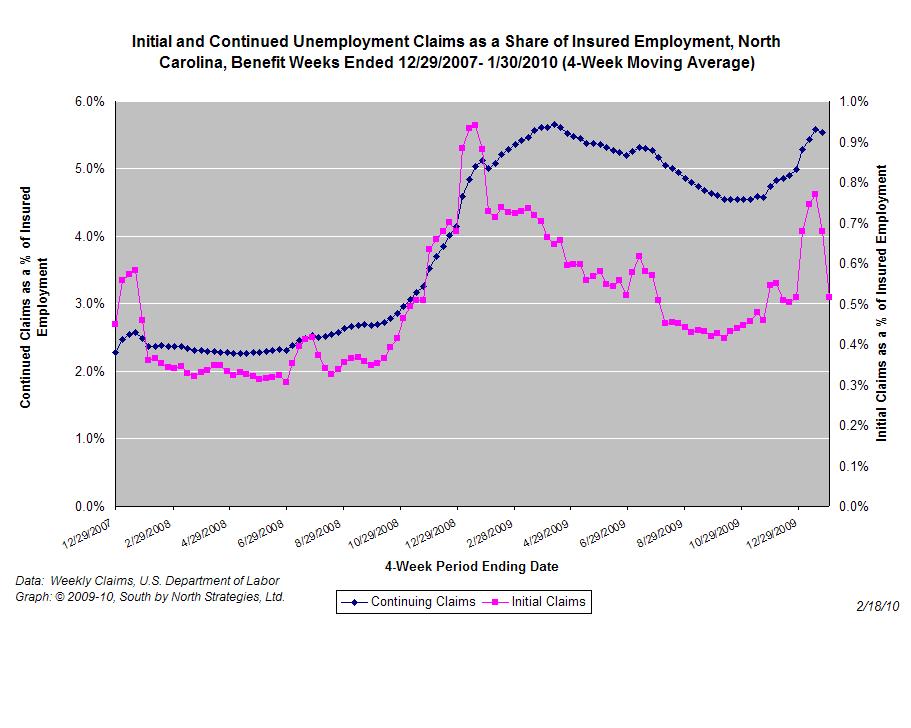
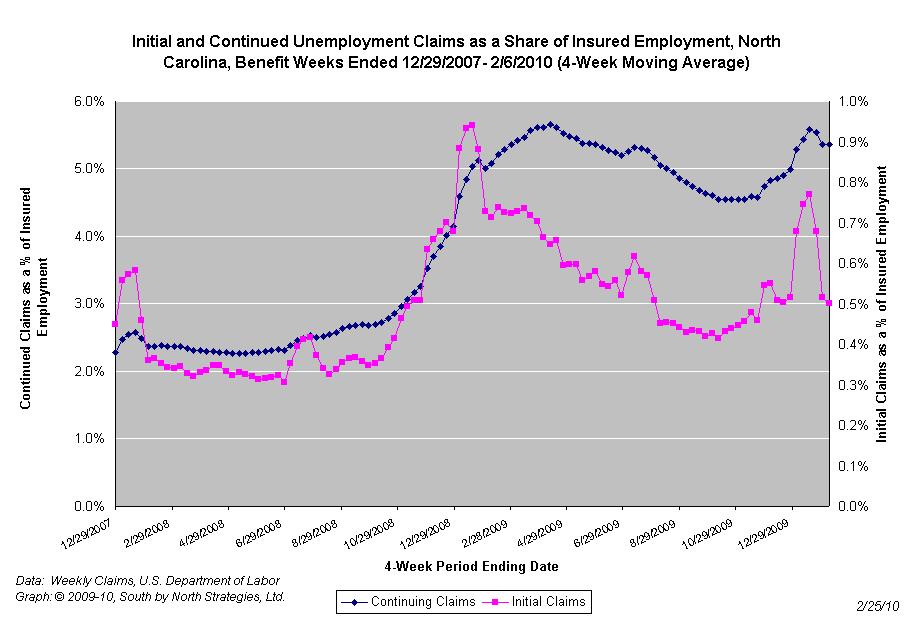
The graph (right) shows the changes in unemployment insurance claims (as a share of covered employment) in North Carolina since the recession’s start in December 2007.
Although new and continuing claims appear to have peaked for this business cycle, the claims levels remain elevated and point to a labor market that remains extremely weak. Especially troubling is the high level of continuing claims, which suggests that unemployed individuals are finding it extremely difficult to find new positions.
Editor’s Note
Policy Points will not be published on March 29, 2010. The regular posting schedule will resume on March 30, 2010. Thank you for your interest.
When Down Is Up
Brad DeLong asks how “RomneyCare” became the law of the land. The answer: politics.
The conservative DNA of ObamaCare is hardly a secret. “The Obama plan has a broad family resemblance to Mitt Romney’s Massachusetts plan,”[David] Frum wrote. “It builds on ideas developed at the Heritage Foundation in the early 1990s that formed the basis for Republican counter-proposals to Clintoncare in 1993-1994.”
…
So why are none of the talking heads on your TV screen and none of the op-ed writers in your newspaper talking about how this health plan is a big victory for Mitt Romney and Republican policy analysts? Because there has been a conspiracy of silence among those working for the bill and those working against it.
…
Republicans working against the bill have been unwilling to say “It’s RomneyCare!” because they would then face the awkward question of why they did not support it. And they were never, never, never going to vote for it. The point for the Republican legislators, you see, was to follow the Gingrich strategy: work as hard as you can to block the Democratic president’s initiatives so that the press then portrays him as a wimp. Then, Republicans could pick up seats and regain their congressional majorities — for Americans do not like wimps and the politicians who support them. This political gambit overwhelmed all policy considerations. The Son of Man himself, coming unto the Ancient of Days and stating that this was his favorite health care financing mechanism, could not have called forth Republican votes for it in Congress.
…
And the Democrats? Well, the critical votes — numbers 200-240 in the House and numbers 55-60 in the Senate–would vote for RomneyCare but not for anything more liberal and interventionist. These Democrats would not support any form of government-provided health care — not even Medicare-for-All or Federal-Employees-Heath-Benefit-Plan-for-All. They were not on board for any plan that required businesses to pool the costs of their workers and bargain in their behalf for affordable health care. They were not even on board for a plan that allowed people to vote-with-their-feet and sign up for Medicare if they thought it was a better deal than their private insurance.
…
So for the Democrats, it was RomneyCare or nothing. Thus the task for Harry Reid, Nancy Pelosi, and Barack Obama was to hold the Democratic right to RomneyCare while not losing the Democratic left. As long as they could say to the left, “Look, this is what we can pass: it’s a lot better than a poke in the eye with a sharp stick (and a poke in the eye with a sharp stick is a lot better than our current health care financing system),” they had a chance of holding the left, especially if they could sweeten it with progressive tax and subsidy policies. But if they pointed out the intellectual origins of the plan — oh, and by the way the guts of the plan came out of the conservative uber-think tank, the Heritage Foundation, and it was what Mitt Romney thought was good policy back in 2004 — then the left-wing Democrats’ heads would have exploded and their votes would have vanished.
Does Greece Matter?
The president of the Federal Reserve Bank of Atlanta, Dennis Lockhart, outlines three ways in which the Greek financial crisis may affect the United States.
I see three ways the Greek crisis might directly affect the U.S. economy. First, adjustment across the EU to fiscal problems could dampen euro area growth and constrain U.S. exports to that region. The European Union as a whole is this nation’s largest export market. Second, related to this, safe haven currency flows from the euro into dollar assets could cause appreciation of the dollar and hurt U.S. export competitiveness. Third is the possibility that the Greek fiscal crisis could lead to a broad shock to financial markets. This could play out in the banking system or in the form of a general retreat from sovereign debt.
Avoiding the Irish Way
Simon Johnson of The Baseline Scenario argues that the Irish response to the recession is one the United States should avoid, not replicate.
Ireland, until 2009, seemed like a fiscally prudent nation. Successive governments had paid down the national debt to such an extent that total debt to GDP was only 25% at end 2008 – among industrialized countries, this was one of the lowest.
…
But the Irish state was also carrying a large off-balance sheet liability, in the form of three huge banks that were seriously out of control. When the crash came, the scale and nature of the bank bailouts meant that all this changed. Even with their now famous public wage cuts, the government budget deficit will be an eye-popping 12.5% of GDP in 2010.
—
Ireland had more prudent choices. They could have avoided taking on private bank debts by forcing the creditors of these banks to share the burden – and this is now what some sensible voices within the main opposition party have called for. However, a strong lobby of real estate developers, the investors who bought the bank bonds, and politicians with links to the failed developments (and their bankers), have managed to ensure that taxpayers rather than creditors will pay. The government plan is – with good reason – highly unpopular, but the coalition of interests in its favor it strong enough to ensure that it will proceed.
—
When Irish-type banks fail, you have a dramatic and unpleasant choice. Either takeover the banks’ debts – and create a very real burden on taxpayers and a drag on growth. Or restructure these debts – forcing creditors to take a hit. If the banks are bigger, more powerful politically, and better connected in the corridors of power, you will find the creditors’ potential losses more fully shifted onto the shoulders of taxpayers.
 Email Sign-Up
 RSS Feed