

Around the Dial – April 2
Economic policy reports, blog postings, and media stories of interest:
- Paul Krugman teaches “financial reform 101.”
- FiveThirtyEight.com debunks bad recovery math.
- Justin Fox asks how to take economics debates back from economists.
- Dennis Lockhart of the Atlanta Fed discusses recovery prospects.
National Employment in March
The national employment report for March points to a labor market that is adding some jobs but few permanent positions. Last month, employers added 162,000 more payroll jobs than they eliminated. Many of these positions, however, were temporary ones, either in the private sector or with the U.S. Census Bureau.
In March, the nation’s employers added 162,000 more payroll positions than they eliminated. Gains were concentrated in professional and business services, primarily temporary help services (+40,000), health care (+27,000), and government (+39,000). Losses occurred within the financial activities (-21,000) and information (-12,000) industries.
The job growth experienced in March was too modest to reduce the country’s supply of idle labor, as reflected in the household data released today. In March, 15 million Americans – 9.7 percent of the labor force – were jobless and actively seeking work. Proportionally more adult male workers were unemployed than female ones (10 percent vs. 8 percent). Similarly, unemployment rates were higher among Black (16.5 percent) and Hispanic workers (12.6 percent) than among White ones (8.7 percent). The unemployment rate among teenagers was 26.1 percent.
Click here to read South by North Strategies’ analysis of the March employment report.
National Job Market Makes A Kind of Progress
CHAPEL HILL (April 2, 2010) – The national employment report for March points to a labor market that is adding some jobs but few permanent positions. Last month, employers added 162,000 more payroll jobs than they eliminated. Many of these positions, however, were temporary ones, either in the private sector or with the U.S. Census Bureau.
“Payroll employment growth is good news, but the March report needs to be interpreted cautiously,” said John Quinterno, a principal at South by North Strategies, Ltd., a research firm specializing in economic and social policy. “A variety of peculiar factors were at work last month. The bottom line is that employment growth is not occurring at a level needed to absorb new workers or re-absorb jobless ones.”
In March, the nation’s employers added 162,000 more payroll positions than they eliminated. Gains were concentrated in professional and business services, primarily temporary help services (+40,000), health care (+27,000), and government (+39,000). Losses occurred within the financial activities (-21,000) and information (-12,000) industries.
“Nearly half of the payroll positions added in March were temporary ones connected to the private sector or the Census Bureau” noted Quinterno. “When these positions end, the individuals holding those jobs likely will find themselves jobless and competing for a relatively small number of openings.”
The job growth experienced in March was too modest to reduce the country’s supply of idle labor, as reflected in the household data released today. In March, 15 million Americans – 9.7 percent of the labor force – were jobless and actively seeking work. Proportionally more adult male workers were unemployed than female ones (10 percent vs. 8 percent). Similarly, unemployment rates were higher among Black (16.5 percent) and Hispanic workers (12.6 percent) than among White ones (8.7 percent). The unemployment rate among teenagers was 26.1 percent.
Furthermore, newly available data show that 9.8 percent of all veterans were unemployed in March; the rate among veterans who had served since Sep. 2001 was 14.7 percent.
“In March, perceived improvements in labor market conditions led 400,000 individuals to resume their job searches,” added Quinterno. “Nevertheless, jobs – particularly permanent ones – are difficult to find. Last month, 44 percent of all unemployed workers had been jobless for at least six months. Because the number of job seekers far exceeds the number of openings, many more individuals have given up on finding work. Counting those individuals and those working part-time on an involuntary basis brings the underemployment rate to 16.9 percent.”
“While labor market conditions have stabilized in recent months, unemployment has settled at an extremely high level,” observed Quinterno. “Fewer people are losing jobs compared to a year ago, but those who are jobless are finding themselves out of work for increasingly long periods. Such high levels of unemployment and long-term unemployment are limiting the speed and strength of the recovery.”
Strengthening State Economic Development Systems
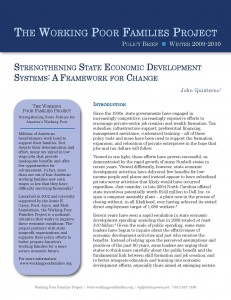 Recent years have seen a rapid escalation in state economic development spending: spending that in 2008 totaled at least $10 billion. Given the scale of public spending, some state leaders have begun to inquire about the effectiveness of economic development activities and just who receives the benefits. Instead of relying upon old assumptions, some leaders are urging their states to think more carefully about the public benefit and the fundamental link between skill formation and job creation.
To encourage this transition, The Working Poor Families Project, a national initiative to strengthen state policies and programs, asked South by North Strategies, Ltd to identify promising ways of better orienting state economic development systems around an education and skills agenda that reflects the economic needs of low income families. The report, entitled Strengthening State Economic Development Systems: A Framework for Change is available through the project’s web site.
Around the Dial – April 1
Economic policy reports, blog postings, and media stories of interest:
- The New York Times looks at the newly-staffed National Labor Relations Board.
- Economix argues that improving bank capital requirements isn’t enough.
- The American Prospect asks about changes in the legislative mentality.
- Paul Krugman looks at the fight between “punks vs. plutocrats.”
 Email Sign-Up
 RSS Feed