

Proposed Federal Workforce Funding – FY’11
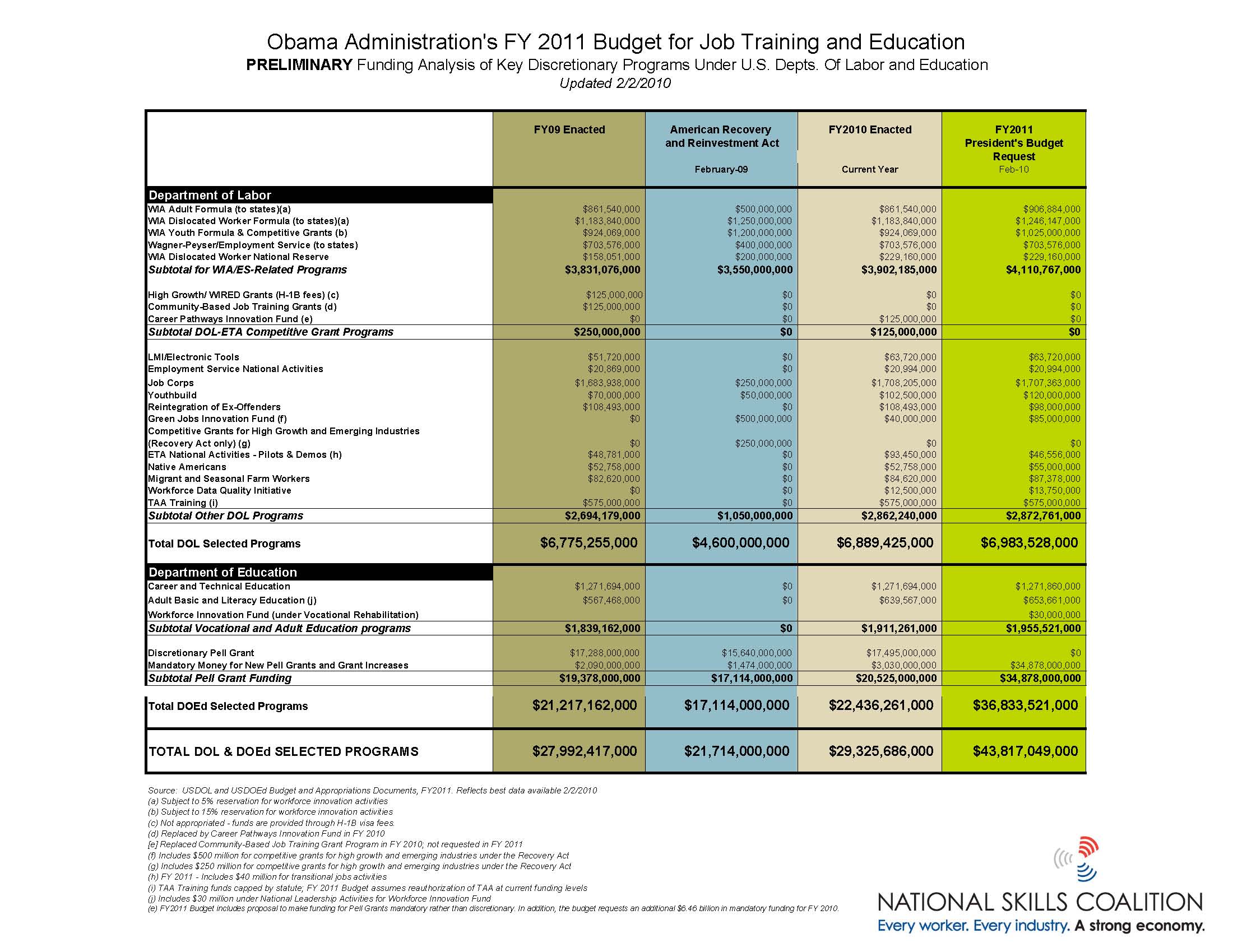
The National Skills Coalition has released a preliminary analysis of proposed federal funding for workforce development programs during Fiscal Year 2011. The following chart (click to enlarge) summarizes proposed funding for key programs operated through the Departments of Labor and Education.
Around the Dial – Feb. 3
Economic policy reports, blog postings, and media stories of interest:
- Simon Johnson proposes Tom Hoenig of the Kansas City Fed for Treasury Secretary.
- Jonathan Cohn says that health reform is on the two-yard line.
- Economix notes that the homeownership rate is back to its 2000 level.
- The Financial Times warns Washington to avoid budget distractions.
Tax Reform In North Carolina
An article in The American Prospect profiles North Carolina as one of seven states that have made reforms to their state revenue systems despite the challenges poses by the recession.
Says the article about the Tar Heel State:
… Gov. Bev Perdue, a Democrat, and the two Democrat–controlled chambers of the state Legislature jousted for more than a month beyond the July 1 fiscal year deadline to settle on a budget that received no Republican votes. Their agreement added a tax surcharge of 2 percent for married couples with incomes between $100,000 and $250,000 and single filers with incomes between $60,000 and $150,000. The additional rate is 3 percent above those thresholds, with the surcharges applying only for 2009 and 2010. A 1-cent increase in the sales tax was also approved. The main sticking points between Perdue and the Legislature related to her preference for higher taxes in exchange for more support for education and other public services.
According to the article, the experiences of states like North Carolina hold important lessons for other states coping with revenue shortfalls.
Although the worst of the recession is winding down, populous states are expected to confront an ongoing budget squeeze for years to come. State and local tax revenues are likely to remain meager, the share of the population relying on state and local services will be high, health-care and educational costs will continue to soar, state pension plans will remain badly underfunded, and the federal stimulus money that staved off disaster will run out unless Congress passes bolder emergency aid. In that climate, governors and state legislatures can’t on their own fix a system of federalism that is rapidly breaking down. But, as demonstrated during the immediate crisis, they can act to shift the burden of financing state government more toward residents who are best able to afford higher taxes. In a small but meaningful way, that’s progress.
US DOL Budget for FY 2011
The $14-billion discretionary budget proposal for fiscal year 2001l put forth yesterday by the U.S. Department of Labor is notable in at least three respects.
First, the proposal is organized around the concept of “good jobs for everyone.” It defines “good jobs” as follows:
jobs that can support families by increasing incomes and narrowing wage gaps; jobs that are safe and secure and give people a voice at the workplace and at the table; jobs that are sustainable and innovative; jobs that export products, not paychecks; and, jobs that rebuild and restore a strong middle class.
Second, the agency intends to focus its efforts on strengthening workplace protections and addressing the growing problem of employee misclassification. Misclassification is when employees are improperly considered independent contractors and therefore do not receive the benefits for which regular employees are eligible to receive.
Finally, the agency seeks to reform and reinvigorate its workforce development programs, especially those provided under the Workforce Investment Act, which currently is awaiting congressional re-authorization. To advance reforms, the agency intends to use $261 million to establish a Workforce Innovation Fund and a Youth Innovation Fund. The agency also plans to undertake five major evaluations of key programs.
Around the Dial – Feb. 2
Economic policy reports, blog postings, and media stories of interest:
- The Commonwealth Institute forecasts unemployment rates in Virginia.
- Paul Krugman likes Canadian banking regulations.
- GlaxoSmithKline is firing scientists and researchers.
- Economix wonders how to measure the cash value of family care.
- Beat the Press asks why journalists can’t do budget math.
 Email Sign-Up
 RSS Feed