

Housing Price Indicies: Nov.
In October, the seasonally-adjusted home prices of single-family units rose in 19 of the 20 metro areas tracked by the S&P/Case-Shiller Housing Price Indicies. Despite those increases, sales price levels in 15 markets remain lower than they were one year ago.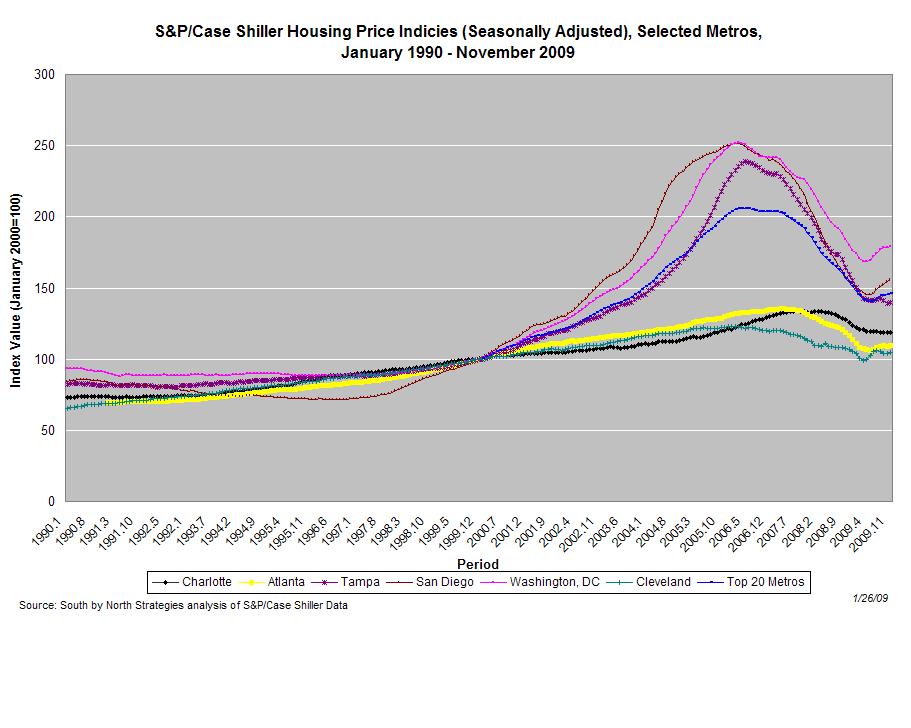
The graph (right) shows changes in price indices for selected metros. Data are shown for Charlotte, certain peer metros in the South Atlantic, and, for purposes of regional comparisons, San Diego and Cleveland. The composite measure for all 20 metros also is shown.
While Charlotte never experienced the same housing bubble seen in other metros, housing prices, as measured by the index, have fallen by 5.6 percent over the past year and by 10.8 percent since the start of the recession. And Charlotte was one of 19 metros tracked in the survey that recorded a month-to-month increase in prices. Although most of the price tracked by the S&P/Case-Shiller Indicies have risen over the past few months, those trends don’t necessarily mean that the housing bubble has fully deflated. Explains Calculated Risk:
The impact of the massive government effort to support house prices led to small increases in prices over the Summer, and the question is what happens to prices as these programs end over the next 6 months. I expect further price declines in many cities.

Around the Dial – Jan. 26
Economic policy reports, blog postings, and media stories of interest:
- Economix asks if family leave is a right or privilege.
- Paul Krugman explores the Bernanke Conundrum.
- Calculated Risk explains the December drop in existing home sales.
What Are the Economic Options?
At Grasping at Reality with Both Hands Brad DeLong asks what the Obama administration’s economic strategy is. Writes DeLong:
If the Senate won’t let us run bigger deficits, and if the Federal Reserve is not expanding but rather cutting back on its degree of monetary easing, then there are only three paths open to try to increase employment:
…
Shifting government spending from things that create the most in the way of useful goods and services (and that also boost employment) to things that create the most employment (and maybe also create some useful goods and services): i.e., large government employment programs.
…
Shifting private production from things that create the most in the way of useful goods and services (and that also boost employment) to things that create the most employment (and maybe also create some useful goods and services): i.e., large (but incremental and temporary) new employment tax credits.
…
Using the U.S. Treasury as the world’s biggest hedge fund to take huge amounts of private-sector risk onto the government’s books, and thus create an appetite on the part of investors to finance additional risky investment even given their limited and depressed risk tolerance.
December Producer Prices
The seasonally-adjusted prices received by producers of finished goods rose by 0.2 percent in December, according to data released recently by the U.S. Bureau of Labor Statistics. That same month, the prices received by sellers of intermediate goods rose by 0.5 percent, and the prices received by sellers of crude goods advanced by one percent.
Price increases for finished goods were driven primarily by rises in consumer food prices. At the earlier stages of production, various combinations of increases in food and energy prices accounted for most of the changes in prices. When energy and food prices are excluded, producer prices for finished goods were unchanged in December. Absent energy and food costs, producer prices rose slightly for intermediate goods and rose sharply slightly for crude ones.
Over the past year, producer prices have risen. Unadjusted prices for finished goods have grown by 4.4 percent, and producer prices for intermediate and crude goods have risen by 3 percent and 12.3 percent, respectively.
The new data offer two insights into the state of the American economy. First, the findings suggest that demand for good and services remains weak, though not quite as weak as in recent months. Second, the report indicates that inflation is not currently a threat to the larger economy.
Around the Dial – Jan. 25
Economic policy reports, blog postings, and media stories of interest:
- Calculated Risk gives a rundown on the residential housing market.
- The Atlanta Fed says to mind job creation, not discouraged workers.
- Economist’s View pulls together analyses of the bank reform plans.
 Email Sign-Up
 RSS Feed