Around the Dial – Jan. 28
Economic policy reports, blog postings, and media stories of interest:
- Economix looks at new BLS data on job juggling.
- The Economic Policy Institute previews the GDP numbers.
- Brad DeLong explores America’s employment dilemma.
- Martin Wolf asks if the bank reform plan misses the target.
- Calculated Risk runs down the December new home sales data.
Unemployment Claims in NC: Week of 1/9
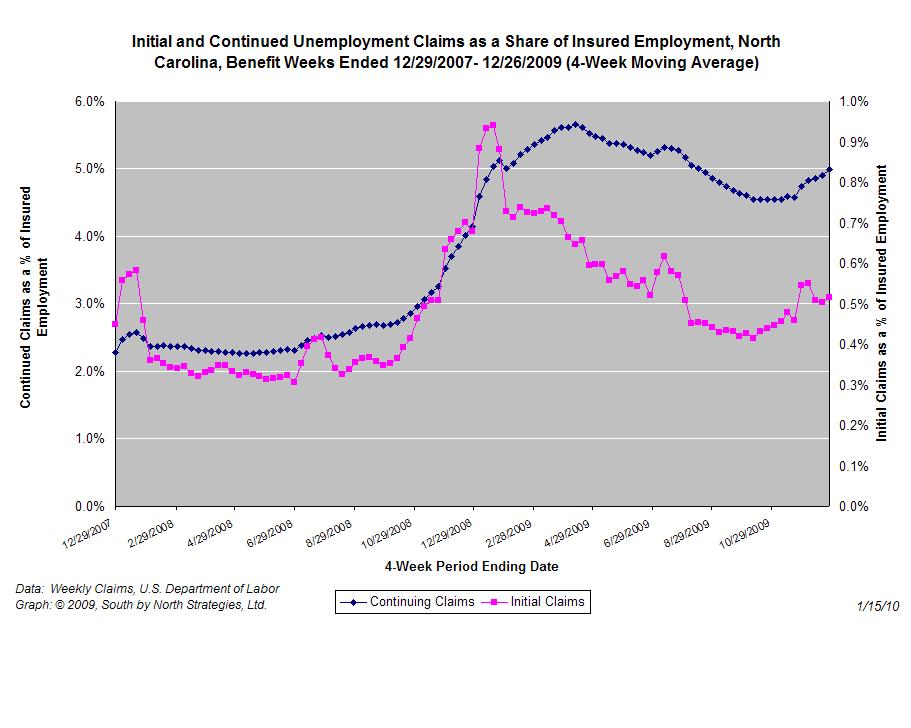
For the benefit week ending on January 9th, 26,063 North Carolinians filed initial claims for state unemployment insurance benefits, and 213,009 individuals applied for state-funded continuing benefits. Compared to the prior week, there were fewer initial and continuing claims. These figures come from data released today by the U.S. Department of Labor.
Averaging new and continuing claims over a four-week period — a process that helps adjust for seasonal fluctuations and better illustrates trends — shows that an average of 29,198 initial claims were filed over the last four weeks, along with an average of 213,188 claims. Compared to the previous four-week period, both initial and continuing claims were higher.
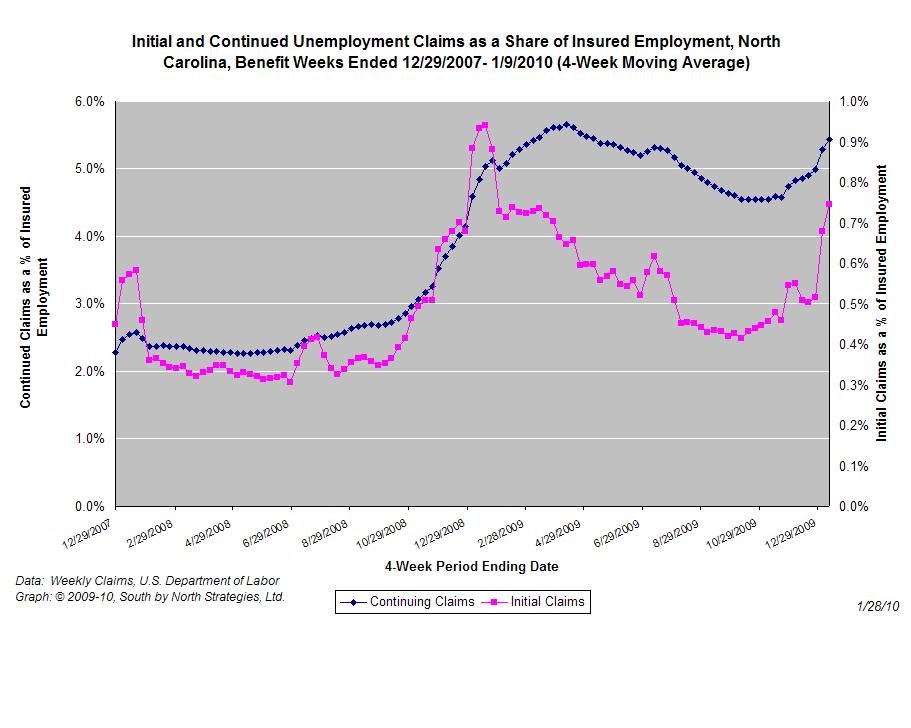
One year ago, the four-week average for initial claims stood at 37,512 and the four-week average of continuing claims equaled 195,039.
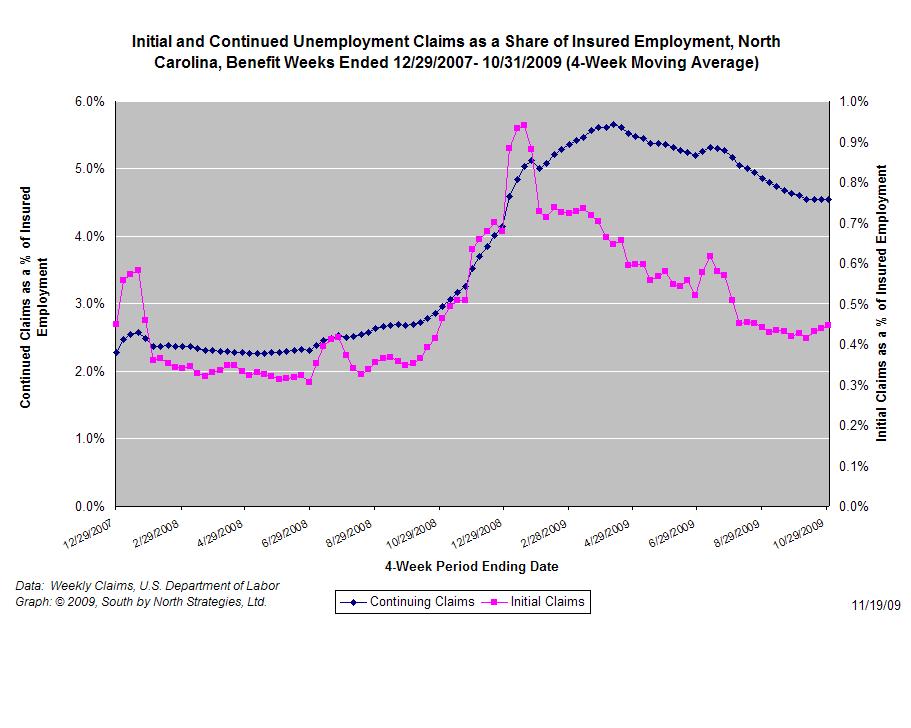
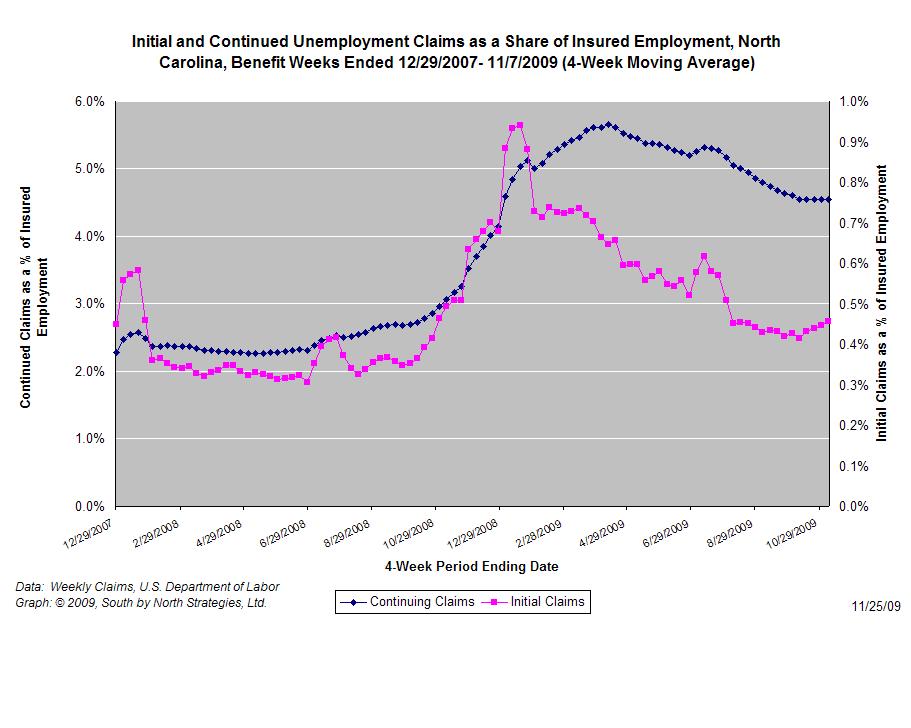
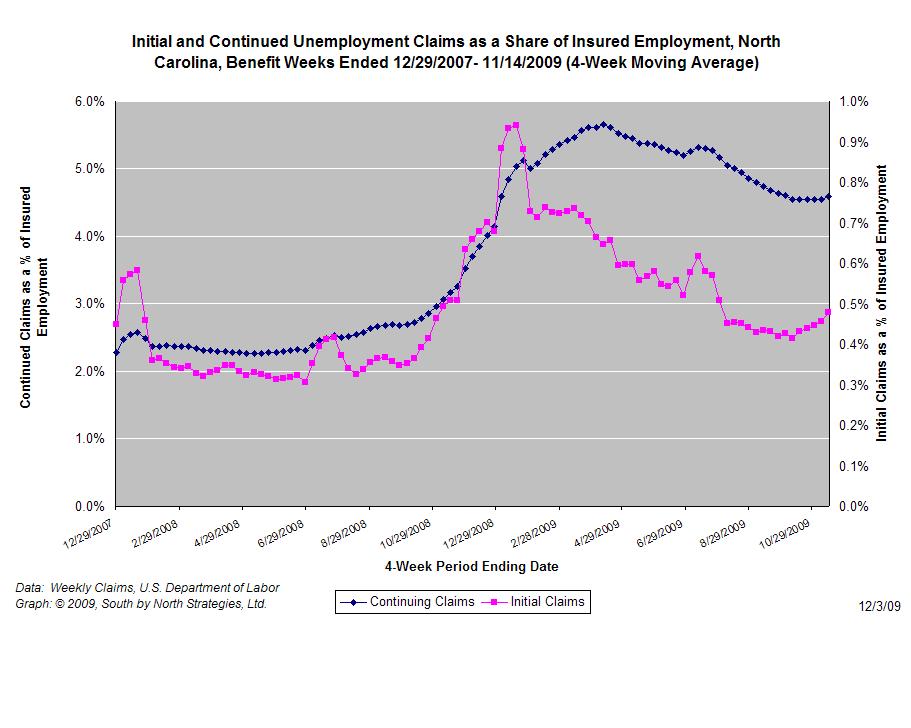
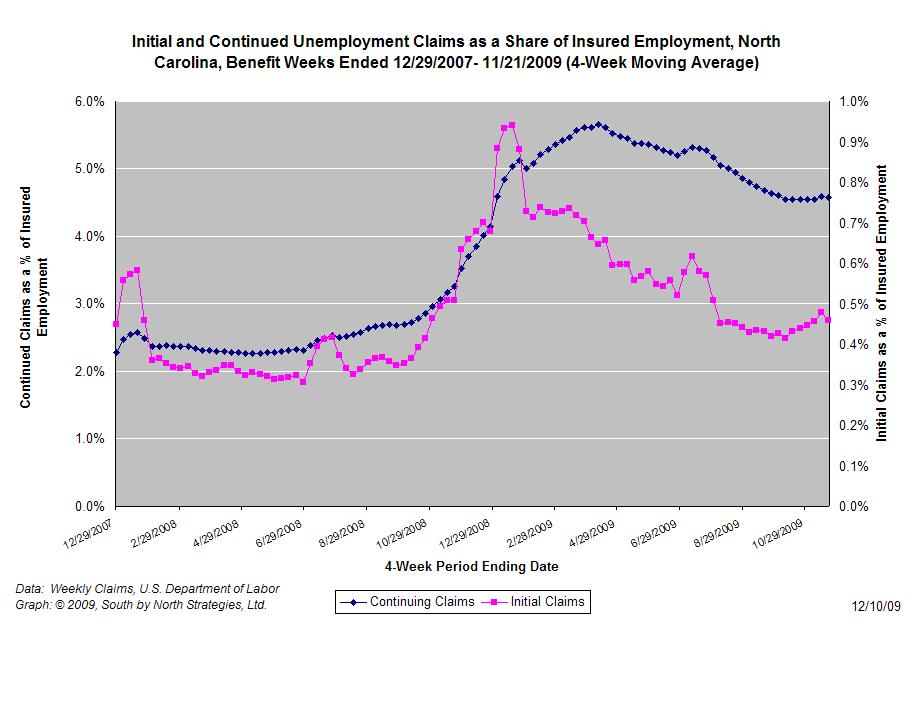
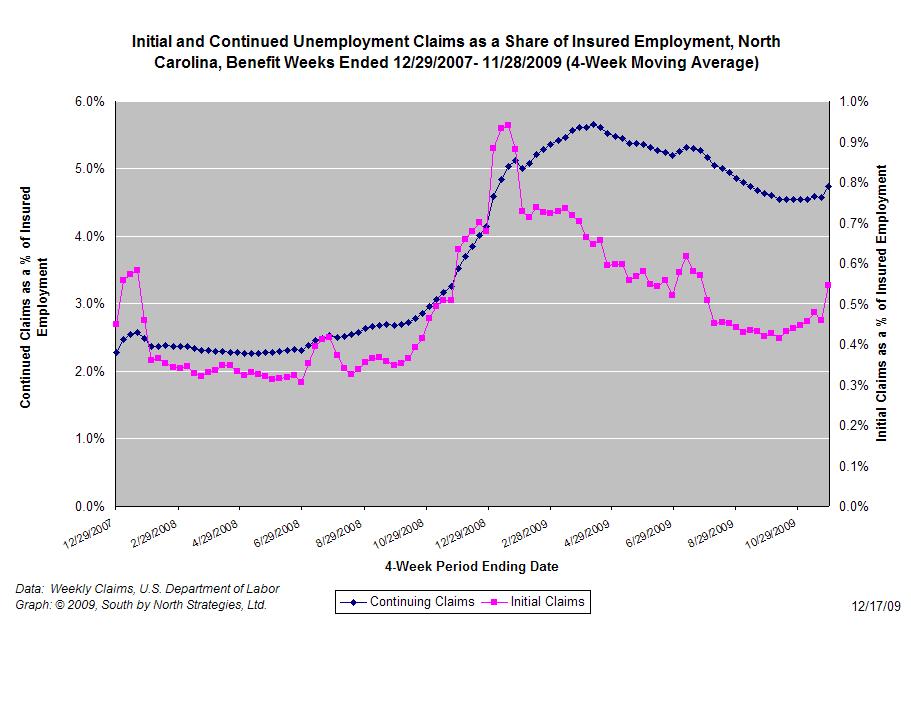
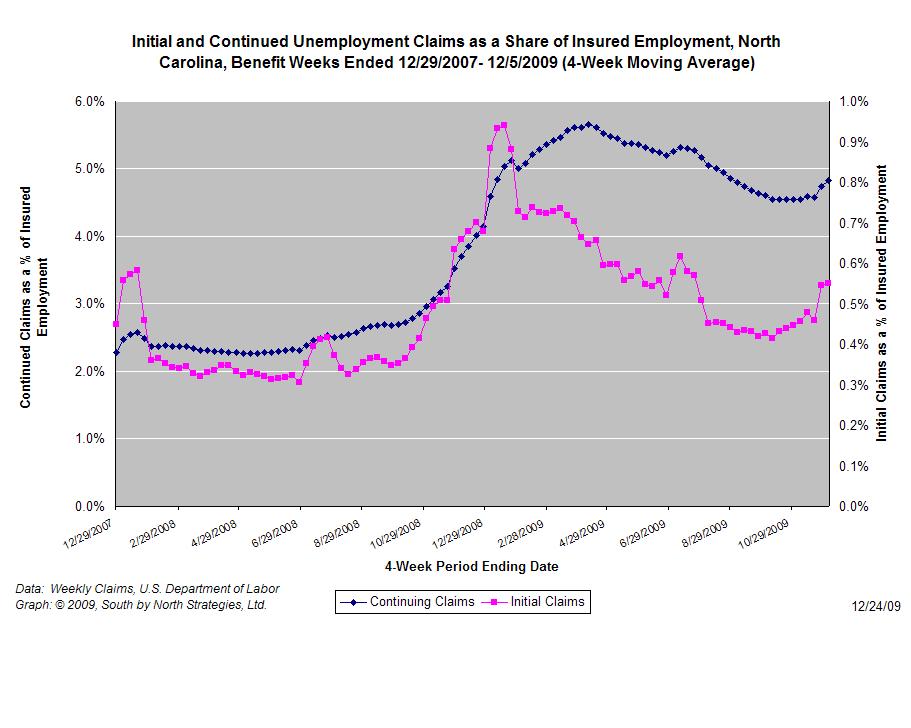
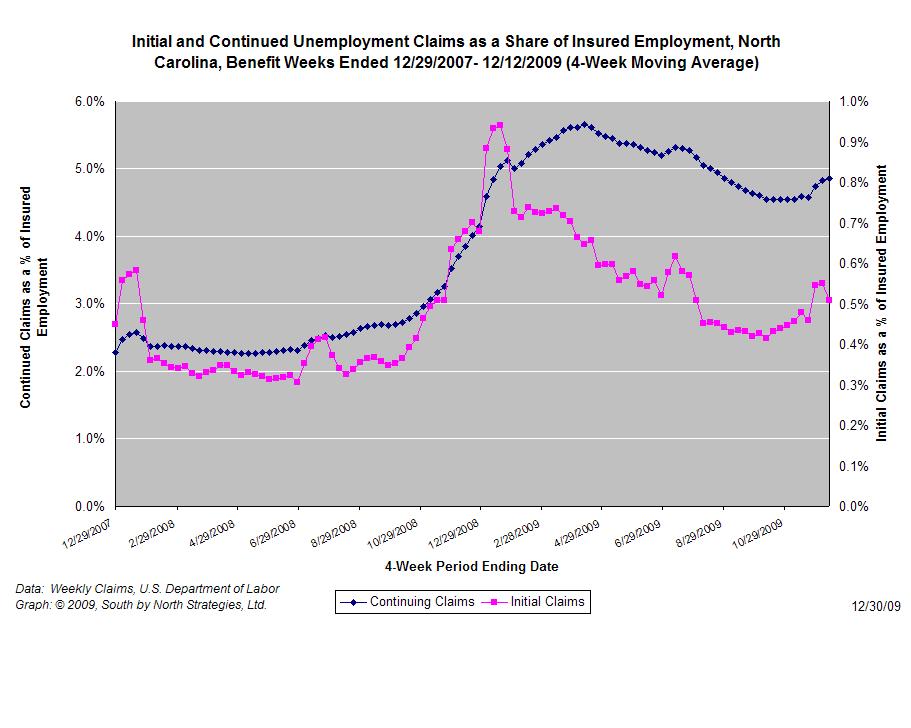
The graph (right) shows the changes in unemployment insurance claims (as a share of covered employment) in North Carolina since the recession’s start in December 2007.
Although new and continuing claims appear to have peaked for this business cycle, the claims levels remain elevated and point to a labor market that remains extremely weak. Especially troubling is the high level of continuing claims, which suggests that unemployed individuals are finding it extremely difficult to find new positions.
Service Activity in the South Atlantic: Jan.
From the Federal Reserve Bank of Richmond’s January survey of service-sector activity in the South Atlantic (District of Columbia, Maryland, North Carolina, South Carolina, Virginia and West Virginia):
The overall service sector weakened in January, damped by softness at services providers, according to the latest survey by the Federal Reserve Bank of Richmond. Retail sales were nearly flat for the month, although big-ticket sales remained in decline. For the first time since December 2007, shopper traffic rose. Merchants’ inventories also increased slightly in January. In contrast to the strengthening at retail establishments, however, revenues at services firms fell this month. Even so, survey respondents overall were upbeat about business prospects for the six months ahead.
…
The number of employees continued to shrink in the service sector, but the decline slowed at retail establishments. Average wages were virtually unchanged, and service sector price growth slowed. Expectations were for price increases during the coming six months to be somewhat slower than anticipated in last month’s outlook.
Around the Dial – Jan. 27
Economic policy reports, blog postings, and media stories of interest:
- Economist’s View is not pleased with the proposed federal spending freeze.
- Ezra Klein explains an economic failure to communicate.
- Dean Baker says it’s time to explain some recent economic history.
- The News & Observer reports on the Triangle’s 20% office vacancy rate.
Manufacturing in the South Atlantic: Jan.
From the Federal Reserve Bank of Richmond’s January survey of manufacturing activity in the South Atlantic (District of Columbia, Maryland, North Carolina, South Carolina, Virginia and West Virginia):
Manufacturing activity in the central Atlantic region contracted at a less pronounced rate in January, according to the Richmond Fed’s latest survey. The index of overall activity edged up a bit as growth in new orders turned slightly positive. Growth in shipments contracted at a somewhat slower pace, while employment contracted at a slightly quicker rate. Other indicators were also mixed. The pace of decreasing backlogs and capacity utilization were on par with December, while vendor delivery times increased. In addition, manufacturers reported slightly slower growth in inventories.
…
Looking forward, assessments of business prospects for the next six months were generally in line with last month. Firms anticipated that their shipments, new orders, backlogs, and capacity utilization would grow more rapidly in the months ahead.
 Email Sign-Up
 RSS Feed