Unemployment Insurance Solvency
The current issue of Triangle Business Journal contains an overview of the issues related to the Employment Security Commission of North Carolina’s borrowing from the federal government to pay unemployment insurance benefits. Once conditions stabilize, steps will need to be taken to rebuild system solvency, and tax matters will come into play. On that topic, the article featured the perspective of South by North Strategies:
“At some point, it’ll have to go up. We’ll have to rebuild the solvency of the system,” says John Quinterno, who writes on public policy issues for Chapel Hill-based South by North Strategies. “This is one of those things you don’t have to deal with yet since you are getting the money to pay the benefits. On this one, credit the feds; they have kept things running.”
Weekend Wonk Out
A round-up of policy reports from the week ending on 1/29:
- The National Skills Coalition documents the benefits of on-the-job-training.
- The Center for American Progress proposes changes to the Workforce Investment Act.
- Demos looks at trends in middle-class credit card debt.
- The Center on Budget and Policy Priorities explains the long-term budget forecast.
North Carolina Local Employment: Dec.
Labor markets across North Carolina performed poorly in December. Last month, 73 counties posted double-digit unemployment rates, and 45 counties recorded unemployment rates of at least 12 percent.
Every part of the state experienced weak labor markets in December. Unemployment rates exceeded 10 percent in 73 counties, and in 45 counties, at least 12 percent of the labor force was jobless and actively seeking work. County unemployment rates ranged from 6.2 percent in Orange County to 17.6 percent in Graham County.
Unemployment also rose last month in all 14 of the state’s metropolitan areas. Seven metros posted double-digit unemployment rates. The Hickory-Morganton-Lenoir area had the highest unemployment rate (14.8 percent) followed by Rocky Mount (13.9 percent). The lowest metro unemployment rate was 7.7 percent in Durham-Chapel Hill.
Click here to read South by North Strategies’ full analysis of the December employment report.
Two Lousy Years For Local Labor Markets
CHAPEL HILL (January 29, 2010) – Labor markets across North Carolina performed poorly in December, according topreliminary data released today by the Employment Security Commission. Last month, 73 counties posted double-digit unemployment rates, and 45 counties recorded unemployment rates of at least 12 percent. Local labor forces also contracted in 97 counties.
“Two years into the recession, job markets across North Carolina continue to deteriorate,” says John Quinterno, a principal at South by North Strategies, Ltd., a research firm specializing in economic and social policy. “Labor forces are shrinking, employment is falling, and unemployment is rising. There is little evidence that a turnaround is underway.”
Since the recession’s onset in December 2007, North Carolina has shed 5.9 six percent of its payroll employment base (-246,000 positions) and has seen its unadjusted unemployment rate climb from 4.7 percent to 10.9 percent. And in December, the statewide unemployment rate reached a modern high.
Every part of the state experienced weak labor markets in December. Unemployment rates exceeded 10 percent in 73 counties, and in 45 counties, at least 12 percent of the labor force was jobless and actively seeking work. County unemployment rates ranged from 6.2 percent in Orange County to 17.6 percent in Graham County.
“While the recession has battered communities across the state, non-metropolitan areas have been quite hard hit,” adds Quinterno. “Last month,12.2 percent of the non-metro labor force was unemployed, compared to 10.4 percent of the metro labor force. Non-metro unemployment has more than doubled over the last two years.”
Unemployment also rose last month in all 14 of the state’s metropolitan areas. Seven metros posted double-digit unemployment rates. The Hickory-Morganton-Lenoir area had the highest unemployment rate (14.8 percent) followed by Rocky Mount (13.9 percent). The lowest metro unemployment rate was 7.7 percent in Durham-Chapel Hill.
“Because of the lack of seasonal adjustments, monthly fluctuations in local unemployment rates must be interpreted cautiously, especially at this time of year,” warns Quinterno. “A better comparison is to contrast year-to-year data.”
Compared to December 2008, unemployment rates were the same or higher in every county and metro area. And compared to a year ago, 65 counties and 9 metro areas had smaller labor forces. Among metros, Jacksonville posted the largest decline in the size of its labor force (-1.7 percent), followed by Hickory-Morganton-Lenoir (-1.5 percent) and Goldsboro (-1.3 percent).
“Some analysts may say that the economy has turned a corner based on the seemingly strong fourth quarter growth figures reported in today’s advance estimate of the nation’s gross domestic product,” cautions Quinterno. “These numbers are unusually high due to a blip in inventory adjustments, and a dispassionate assessment offers little evidence of an imminent recovery in the job market. On the contrary, the report suggests that more difficulties are in store for 2010, especially as federal recovery spending fades out.”
In the long-term, any meaningful labor market recovery in North Carolina will be fueled by growth in the state’s three major metro regions: Charlotte, the Research Triangle, and Piedmont Triad. Yet little growth was evident in these communities during the last quarter of 2009. Collectively, employment in the state’s three major metro regions fell by 1.3 percent over that period, while the labor force contracted by 1.1 percent. The overall December unemployment rate in the major metros equaled 10.2 percent. Of the three areas, the Research Triangle had the lowest December unemployment rate (8.5 percent), followed by the Piedmont Triad (11.3 percent) and Charlotte (12.8 percent).
“One piece of good news contained in the December report is evidence of the powerful role that unemployment insurance played in blunting the recession in 2009,” observes Quinterno. “Last year, the Employment Security Commission paid out $4.8 billion in regular state payments, emergency federal benefits, and additional federal compensation. These payments not only helped households coping with a job loss, but they also generated an estimated $7.9 billion in statewide economic activity.”
State Coincident Indexes: Jan.
Economic conditions remained weak across much of the nation in December, according to the newest State Coincident Indexes Report prepared by the Federal Reserve Bank of Philadelphia.
In December coincident indexes moved in a negative direction in 40 states and in a positive direction in three states (NV, OK, and OR). No changes occurred in seven states (CA, ID, KY, MI, TX, UT, and VA).
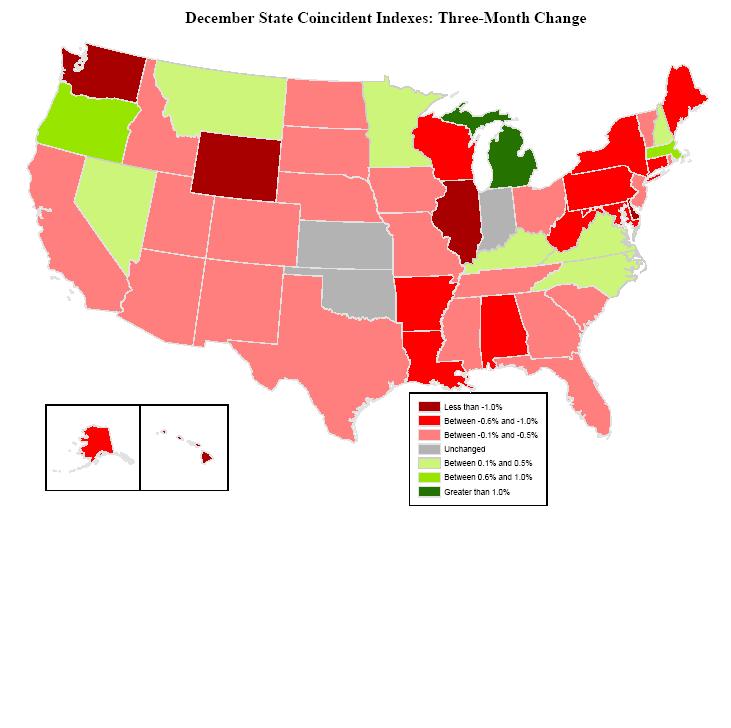 The map to the right, which is taken from the Reserve Bank’s survey, shows the three-month changes in coincident indicators by state. Positive numbers denote improvements in economic conditions, and negative numbers refer to declines.
Over the last three months, coincident indexes decreased in 37 states, rose in 10 states and held steady in three states.
During the same three-month period, North Carolina’s coincident index moved in a slightly positive direction, suggesting that economic conditions improved somewhat.
 Email Sign-Up
 RSS Feed