

The Financial Crisis: One Year Later
Last fall, the U.S. financial system was in imminent danger of collapse. To stave off that failure, Congress, federal agencies and the Federal Reserve engineered a bailout. One year later, where do things stand? What have the American taxpayers received in exchange for the aid given to the financial sector? What reforms have been undertaken?
To answer those questions, the PBS show Bill Moyers Journal devoted last weekend’s episode to exploring the state of reform and whether or not the U.S. missed a chance to better the financial system.
Click here to view a discussion among Moyers, MIT economist Simon Johnson, and U.S. Rep. Marcy Kaptur.
August Balance of Trade
The recession continued to affect America’s international trade in August. Once again, the U.S. imported more goods and services than it exported, according to the most recent report from the Bureau of Economic Analysis.
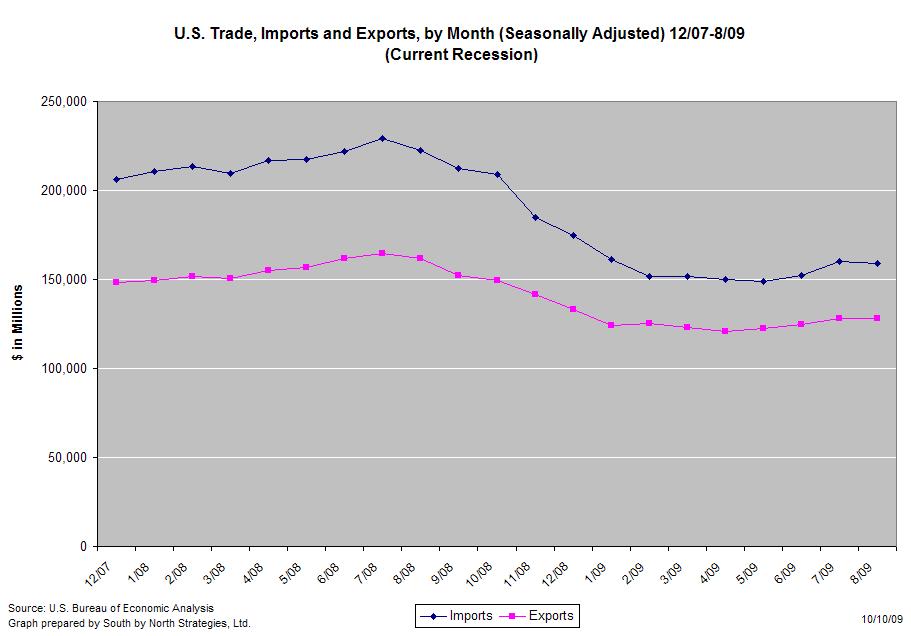 The graph (left) shows the changes in American imports and exports that have occurred since the start of the recession in December 2007.
The recession has reduced American demand for foreign goods and services and foreign demand for American goods and services (though the fall in the dollar’s value likely is boosting American exports).
Compared to a year ago (seasonally adjusted), U.S. imports were 29 percent lower while American exports were 21 percent lower.
The rapid decline in imports has helped to reduce the U.S. trade deficit (graph, below). In August, the U.S. imported $31 billion more than it exported. 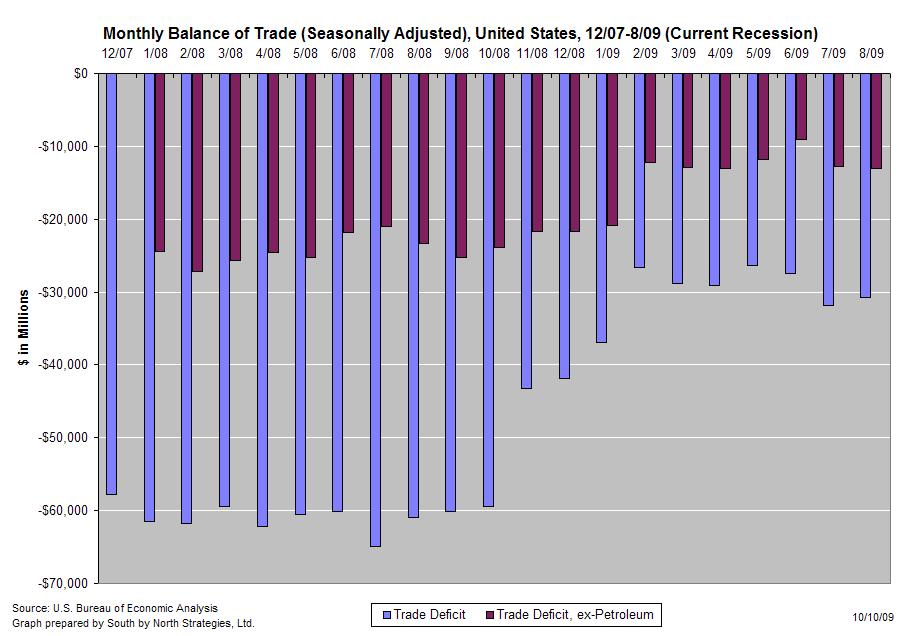 When imports of petroleum products are excluded, the trade gaps stood at a lower $13 billion.
Compared to one year ago (seasonally adjusted), the non-petroleum trade deficit is 44 percent lower and the overall trade deficit is 50 percent lower.
Weekend Wonk Out
A round-up of policy reports from the week ending on 10/9:
- The Center for Economic and Policy Research analyzes how foreign trade could be used to lower medical costs.
- The Economic Policy Institute details the long-term “scarring” likely to result from the recession.
- The NC Budget & Tax Center analyzes the policy “trifecta” used to balance the 2009-11 state budget.
Around the Dial – Oct. 9
Economic policy reports and media stories of interest:
- Paul Krugman of The New York Times opines about the “uneducated American.”
- At Vox EU, economist Alan Blinder estimates that 25% of all U.S. jobs are “offshorable.“
- The Winston-Salem Journal explores the role of blue-collar work in today’s economy.
- The Center on Budget and Policy Priorities looks at the recessionary role of the safety net.
 Email Sign-Up
 RSS Feed