

Number of Job Openings At Record Low
Findings from the newest version of the federal Jobs Opening and Labor Turnover Survey …
On the last business day of August, the number of job openings in the U.S. was little changed at a series low level of 2.4 million, the U.S. Bureau of Labor Statistics reported today. The hires rate was little changed and remained low at 3.1 percent in August. The total separations rate was little changed and remained low at 3.3 percent.
…
The job openings rate was unchanged in August at a rate of 1.8 percent. The number of job openings has fallen by 2.4 million, or 50 percent, since the most recent peak in June 2007. The job openings rate was little changed in August in all industries and regions.
…
The hires level was little changed at 4.0 million in August but has declined by 1.6 million, or 28 percent, since the most recent peak in July 2006. The hires rate was low in August at 3.1 percent and little changed from July. The hires rate was little changed in August in all industries.
Around the Dial – Oct. 8
Economic policy reports and media stories of interest:
- The Congressional Budget Office scores the Senate Finance Committee’s health bill.
- Writing for Project Syndicate, Brad DeLong points out the limits of macroeconomic modeling.
- David Leonhardt of The New York Times discusses the state of conservative economics.
- Simon Johnson of The Baseline Scenario on the problem of “bigness.”
Leaving on a Jet Plane
A new report from The Bookings Institution analyzes the state of air travel in the United States and flags the challenges that will need to be addressed when economic growth returns. Specifically, the report argues that that too much of the nation’s commercial air system is focused on heavily trafficked, inefficient short corridors connecting a handful of metro areas.
Key findings include the following:
- Some 99% of all airline passengers (annualized share) travel between or through one of the nation’s 100 largest metro areas. And 61% of all passengers are heading ultimately to one of the nation’s 25-largest metros.
- Half of all airline flights operate on routes of 500 miles or less with the busiest routes operating between a handful of metro areas (e.g. Los Angeles-San Francisco; New York-Washington, DC).
- The nation’s 26 largest metro areas (especially New York) are responsible of an increasing share of all airline delays.
Unemployment Claims in NC: Week of 9/19
For the benefit week ending on September 19th, 16,437 North Carolinians filed initial claims for unemployment insurance, and 184,051 individuals applied for continuing insurance benefits. Compared to the prior week, both initial and continuing claims were lower. These figures come from data released today by the U.S. Department of Labor.
Averaging new and continuing claims over a four-week period — a process that helps adjust for seasonal fluctuations and better illustrates trends — shows that an average of 17,241 initial claims were filed over the last four weeks, along with an average of 187,377 continuing claims. Both levels were down slightly compared to the previous four-week period.
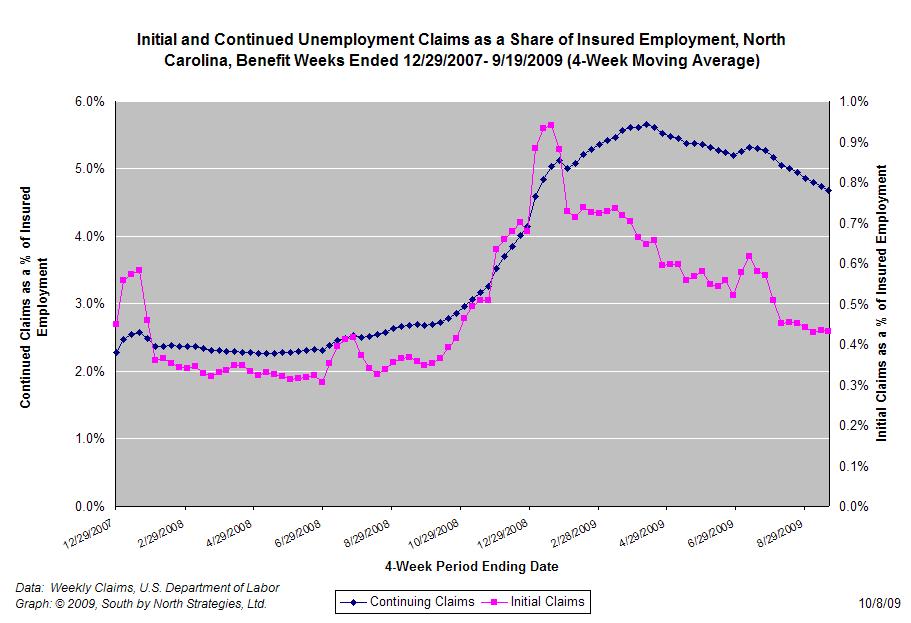 The graph shows the changes in unemployment insurance claims (as a share of covered employment) in North Carolina since the recession’s start (12/07).
Although new and continuing claims appear to have peaked for this cycle, the claims levels remain elevated and point to a labor market that remains extremely weak.
Around the Dial – Oct. 7
Economic policy and media reports of interest:
- In The Washington Post, Harold Meyerson argues for “augmenting” the recovery package.
- The Wall Street Journal documents rising vacancy rates in commercial office space.
- The Financial Times’ Martin Wolf warns against withdrawing fiscal stimulus too quickly.
- The Federal Reserve Bank of San Francisco explains why forecasts about inflation rates differ so greatly.
 Email Sign-Up
 RSS Feed