

Economic Policy in Action
The current issue of The New Yorker offers up an 11,000-word profile of Lawrence Summers, the director of the National Economic Council for the Obama administration.
Perhaps the most interesting section of the article authored by journalist Ryan Lizza is the discussion of how the size of the administration’s recovery package was determined:
On Tuesday, December 16, 2008, as five inches of snow fell on Chicago, Obama’s top advisers gathered in his transition headquarters to discuss the memo. Obama sat on one side of a large square table, and crowded around the three others were members of his incoming team: Biden; Summers; Rahm Emanuel, the chief of staff; David Axelrod, Obama’s senior adviser; Timothy Geithner, the Treasury Secretary; Christina Romer, the chair of the Council of Economic Advisers; Peter Orszag, the budget director; Jared Bernstein, Biden’s top economic adviser; and several more. Others, like Lee Sachs, a former Bear Stearns executive and Clinton Treasury official, who was an expert on the financial crisis and who later joined Geithner at Treasury, were brought in via teleconference. Summers led the meeting like an orchestra conductor, directing the other economic advisers, each of whom made a presentation.
(more…)
Public Opinion about the Economy
Recent media accounts of economic issues assume that the worst of the recession is over and that the American economy is growing again. This view, however, is not supported by a majority of registered voters.
A recent survey sponsored by the Economic Po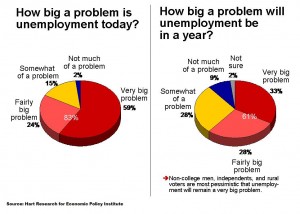 licy Institute found that 85 percent of American voters believe that the economy is still in a recession. Also, a majority of voters believes that unemployment is one of the two most important economic issues facing the country. Overall, 80 percent of voters see unemployment as a major problem, and 60 percent expect unemployment still will be a big story one year from now (graph).
Additionally, this recession is a very personal one: 57 percent of voters are personally close to someone who has been laid off and 61 percent are close to someone who has experienced a reduction in hours or pay.
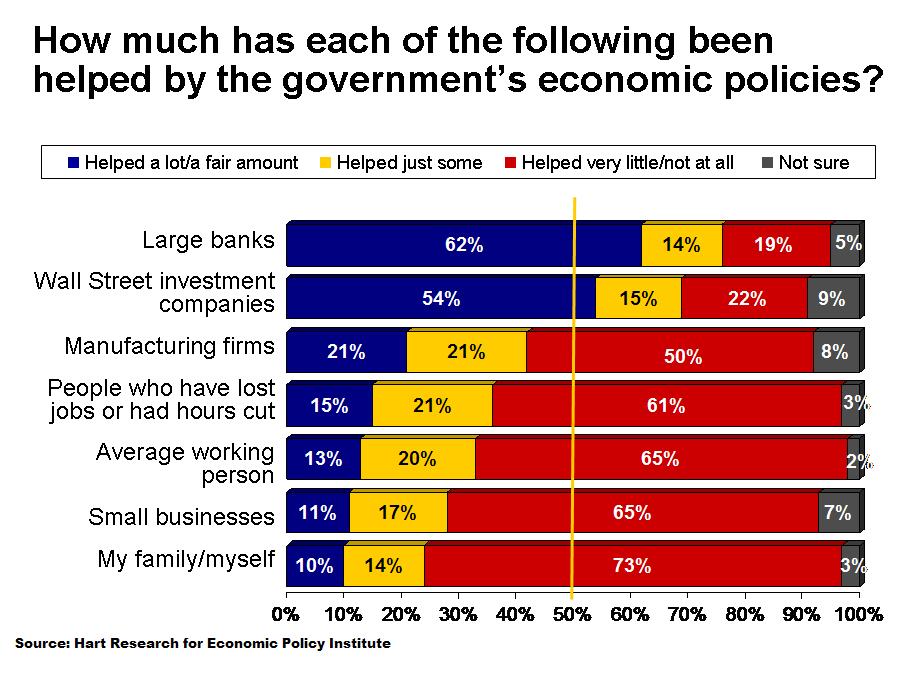 In terms of economic recovery, two-thirds of voters claim that that the federal recovery package has had a positive but minor impact. Instead, voters feel that the federal government’s actions have favored banks and Wall Street (graph).
Going forward, voters say that more must be done to create jobs and aid the unemployed. Such efforts should take precedence over other issues like reducing the federal budget deficit.
Reporting (Or Not) the Economy
According to a new study sponsored by the Pew Research Center’s Project for Excellence in Journalism, media coverage of the ongoing recession has paid scant attention to the economic issues of greatest day-to day concern to average Americans: issues like unemployment, housing and foreclosures, state and local spending on public services, and family economic hardships.
Instead, the Pew study found that media coverage of economic issues has been dominated by three topics: efforts to aid large banks, the passage of the economic recovery act, and assistance to the auto industry. Most of the coverage of these topics originated in actions taken by governmental and business leaders. The majority of stories originated from New York City and Washington, D.C., and most focused on the perspectives of government officials, business leaders, and academic experts.
Alarmingly, the new research found that coverage of economic issues has dropped sharply since the end of March, which is when the stock market began to recover. In fact, coverage of economic issues has moved in an inverse relationship to the direction of the stock market. When the market began to rally in late March, the idea that the economy was improving took firm hold in media accounts and has shaped much subsequent coverage, even though recent data do not necessarily support that view.
A Moving Benchmark
An analysis in today’s issue of The New York Times explains an important, albeit extremely technical aspect, of the latest national employment report: the benchmark revision.
To generate its monthly jobs estimates, the U.S. Bureau of Labor Statistics surveys non-farm employers subject to unemployment insurance taxation (virtually all) and then adjusts those numbers to reflect jobs created or destroyed by new and closing businesses. To verify the survey’s accuracy, the Bureau annually compares its survey data to actual unemployment insurance tax records for the month of March.
Normally, there is very little discrepancy between the two, but this year, a wide gap appears to exist due to less job creation at new firms and more job destruction at closing ones.
Specifically, the revision found that the economy shed 824,000 more jobs between March and 2008 and March 2009 than first reported. This means that jobs losses during the first half of 2008 were occurring at a rate three times greater than the reported one.
Moreover, the now eight million jobs that have been lost since December 2007 are equal to 5.8 percent of all the non-farm jobs that existed in the country prior to the recession. In percentage terms, this is the greatest contraction in employment than has occurred in all but one recession since 1939.
National Job Losses Mount in September
CHAPEL HILL (October 2, 2009) – National employment numbers released today show that September was the 21st-straight month in which the economy shed more jobs than it added. Another 263,0000 positions were lost, and the unemployment rate hit 9.8 percent.
“There is no good news in the September jobs report,” says John Quinterno, a principal at South by North Strategies, Ltd., a research firm specializing in economic and social policy. “Jobs are disappearing en masse, unemployment is rising, and the share of the population engaged in economically productive activities is dropping.”
Click to read South by North Strategies’ analysis of the latest employment report.
 Email Sign-Up
 RSS Feed