

Jobs-Centered Development in the American South
In 2009, South by North Strategies conducted a comprehensive review of the changes in state-level economic and workforce policies and practices that have occurred in the American South since the mid-1990s.
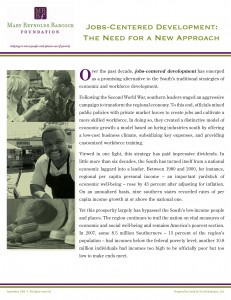 Commissioned by The Mary Reynolds Babcock Foundation in Winston-Salem, NC, the resulting study traced the evolution of “jobs-centered development.” This model strives to combine the traditional tools of economic and workforce development in ways that better cultivate the skilled workforces demanded by local businesses and expand the opportunities available to local residents, especially low-income ones.
The full study, entitled When Any Job Isn’t Enough: Jobs Centered Development in the American South, documented the need for a new development approach, traced the rise of current innovative practices, identified the building blocks of jobs-centered development, critiques popular strategies, and identified lessons applicable in recessionary times.
Click to view an executive summary of the report.
Connected by 25: At-Risk Youth in the Research Triangle
As part of the Connected by 25 initiative occurring in North Carolina’s Research Triangle, South by North Strategies analyzed the economic and social characteristics of young adults (ages 15-24) at risk of not making a successful transition to adulthood.
Using census and other public data sources, South by North Strategies built a framework of demographic, health, criminal and juvenile justice, employment, income, and educational indicators. The data provided the foundation for the 2008 report Disconnected Youth in the Research Triangle Region: An Ominous Problem Hidden in Plain Sight.
Data were assembled for the eight counties that constitute North Carolina’s Research Triangle. Indicators for Durham County received a second, more in-depth analysis, and for that county, the share of the youth population at high risk for disconnection was calculated.
The research was commissioned by MDC, Inc. in Chapel Hill, NC, as part of work supported by the North Carolina GlaxoSmithKline Foundation based in Research Triangle Park, NC.
Unemployment Claims in NC: Week of 9/19
For the filing week ending on September 19th, 18,046 North Carolinians filed initial claims for unemployment insurance, and 188,402 individuals applied for continuing insurance benefits. Compared to the prior week, both initial and continuing claims were higher. These figures come from data released today by the U.S. Department of Labor.
Averaging new and continuing claims over a four-week period — a process that helps adjust for seasonal fluctuations and better illustrates trends — shows that an average of 17,350 initial claims were filed over the last four weeks, along with an average of 189,656 continuing claims. Both levels were down slightly compared to the previous four-week period.
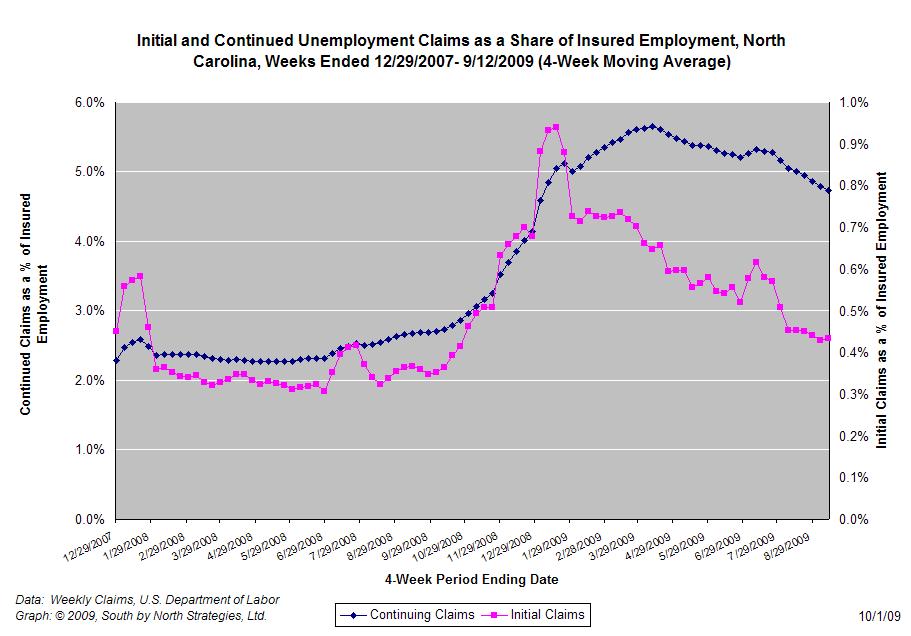 The graph shows the changes in unemployment insurance claims (as a share of covered employment) in North Carolina since the recession’s start (12/07).
Although new and continuing claims appear to have peaked for this cycle, the claims levels remain elevated and point to a labor market that is quite weak.
Quinterno Discusses Unemployment Rate on WCHL
On October 1, 2009, John Quinterno, a principal with South by North Strategies, was a guest on WCHL Radio in Chapel Hill, NC. Quinterno discussed the latest local unemployment rates, the shortcomings of the unemployment measure, and appropriate policy options.
Access to Higher Education in Western NC
In 2009, South by North Strategies released the results of a census of 1,200 working adults who had earned college degrees through the Appalachian State University Center at Hickory (formerly known as HMHEC).
 The center is an educational intermediary that connects working adults in Western North Carolina, an area with relatively few institutions of higher learning, to degree and certificate programs offered through a consortium of universities. Programs are offered via distance learning and at the center’s facility in Hickory, NC.
The study aimed to gauge the factors that led students to enroll in, persist with, and complete a degree program. The study also documented the impact that degree completion had on individuals’ labor market experiences. The findings were summarized in the 16-page booklet entitled Connecting People to Opportunity.
Click to view the executive summary or the full report. Click here to read a news story about the research.
 Email Sign-Up
 RSS Feed