

North Carolina’s Labor Market: 2010 Review
North Carolina’s labor market ended 2010 little changed from the start of the year. Between December 2009 and November 2010, the most recent month for which data are available, payroll employment in North Carolina rose by just 1,400 positions (+0.04 percent). While the number of unemployed Tar Heels and the the statewide unemployment rate fell during the year, much of the decline was due to a troubling contraction in the size of the state’s labor force. And, little evidence suggests that a robust jobs recovery will take hold in early 2011.
One Year, Two Job Markets
North Carolina’s labor market underwent two distinct phases in 2010 (figure, below). The first half of the year was a time of weak but positive growth. Between January and June, net job growth averaged 6,500 positions per month. 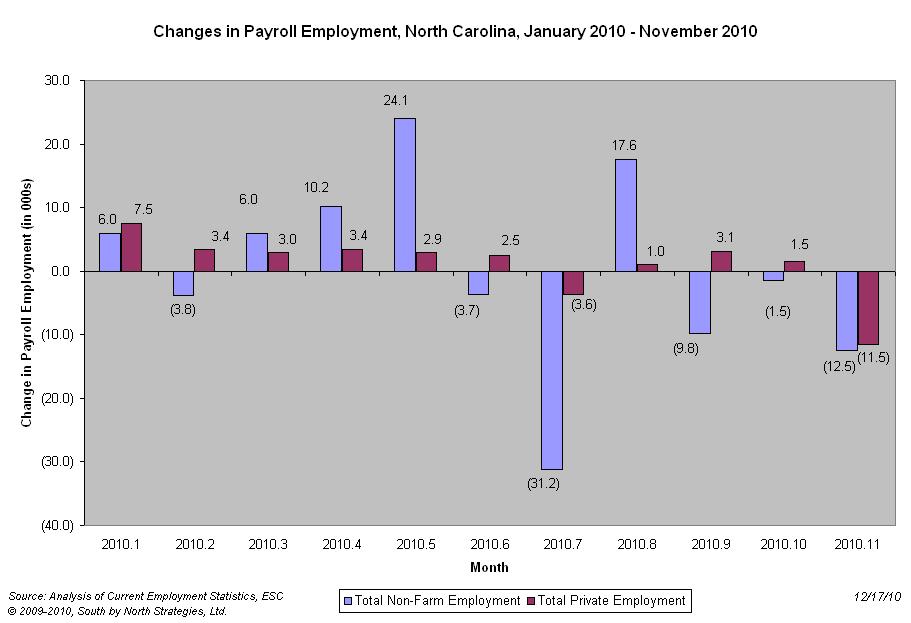 Total employment increased at a rate of 0.2 percent per month, while the number of unemployed individuals fell at a monthly rate of 1.5 percent. The labor force also grew at a monthly rate of 0.03 percent. The statewide unemployment rate, meanwhile, fell to 10 percent from 11.1 percent.
Much of that progress was the by-product of public policy supports provided by the federal government through the American Recovery and Reinvestment Act and related initiatives like the homebuyer tax credit and temporary hiring for the 2010 Census. As those supports faded away during the second half of 2010, North Carolina’s labor market sputtered.
Between July and November, net job loss in the state averaged 7,500 positions per month. Total employment fell at a rate of 0.2 percent per month, while the number of unemployed individuals fell at a monthly pace of 0.4 percent. Yet the labor force also contracted at a a monthly rate of 0.2 percent. The statewide unemployment rate, meanwhile, stagnated at a level fluctuating between 9.6 and 9.8 percent.
(more…)
SBN Releases 2010 Labor Market Review
CHAPEL HILL (December 30, 2010) – North Carolina’s job market ended 2010 little changed from the start of the year. Between December 2009 and November 2010, the most recent month for which data are available, payroll employment in the state rose by just 1,400 positions. While the statewide unemployment rate fell over the year, much of the decline was due to a contraction in the size of the state’s labor force. And, little evidence suggests that a recovery will take hold in early 2011.
These findings come from an end-of-year review of the North Carolina job market released today by South by North Strategies, Ltd., a research firm specializing in economic and social policy. Available on Policy Points, the firm’s blog, the review summarizes the year’s major developments in the labor market.
“Although North Carolina gained some jobs during 2010, the growth was insufficient to reverse the serious damage inflicted during the recession,” says John Quinterno, a principal with South by North Strategies, Ltd. “Much of the growth came during the first half of the year thanks to various public policy supports. When those supports dropped away, the economy not only proved unable to generate jobs on its own, but it also gave back many of the gains realized earlier in the year.”
The review notes that the early 2011 should be another difficult period for the state’s labor market. Many of the policy supports that helped during 2010 have ended and little appears to have taken their place in sustaining economic demand. And the employment and spending reductions that will result from probable public budget cuts only will exacerbate the downward pressures.
The review is particularly worried about the ongoing contraction in the size of the state’s labor force and the problem of long-term unemployment.
“Much of the recent decline in North Carolina’s unemployment rate is due to a decrease in the size of the labor force,” notes Quinterno.”The labor force shrank by 1.6 percent over 2010 as frustrated workers abandoned their job searches. This is not a sign of a healthy or recovering job market.”
Long-term unemployment also remains a serious concern in Quinterno’s judgment. “If the worsening pattern of long-term unemployment is not reversed soon, many individuals will become effectively unemployable due to skills deterioration, stiff competition, and negative stereotyping on the part of employers,” warns Quinterno. “At that point, a serious cyclical employment problem will become an intractable structural one.”
The full review is available at http://www.sbnstrategies.com/?p=5300
Around The Dial – Dec. 29
Economic policy reports, blog postings, and media stories of interest:
- The AP reports on the ‘un’retirement of the Baby Boomers.
- Economix wonders about the nation’s population shift.
- Naked Capitalism offers a “wall of worry for 2011.”
- Calculated Risk runs down the latest Case-Shiller housing data.
- The Wall St. Journal reports on changes to public university fees.
South Atlantic Manufacturing Activity: Dec.
From the Federal Reserve Bank of Richmond’s latest survey of manufacturing activity in the South Atlantic (District of Columbia, Maryland, North Carolina, South Carolina, Virginia and West Virginia):
Manufacturing activity in the central Atlantic region expanded at a quicker pace in December according to the Richmond Fed’s latest survey. All broad indicators — shipments, new orders and employment — posted solid gains. Other indicators also suggested stronger activity. District contacts reported that order backlogs returned to positive territory and capacity utilization grew at a faster pace. Manufacturers reported that delivery times grew at a somewhat higher rate, while inventories grew at a somewhat slower pace.
…
Looking ahead, manufacturers’ assessments of business prospects for the next six months were generally more optimistic in December. Survey contacts at more firms anticipated that shipments, new orders, backlog of orders, capacity utilization, and capital expenditures would grow more quickly during the next six months.
Not So Jolly & Bright
Bob Herbert of The New York Times points out the disconnect between recent economic data and the extent of joblessness in America this holiday season.
There is a fundamental disconnect between economic indicators pointing in a positive direction and the experience of millions of American families fighting desperately to fend off destitution. Some three out of every four Americans have been personally touched by the recession — either they’ve lost a job or a relative or close friend has. And the outlook, despite the spin being put on the latest data, is not promising.
…
No one is forecasting a substantial reduction in unemployment rates next year. And, as Motoko Rich reported in The Times this month, temporary workers accounted for 80 percent of the 50,000 jobs added by private sector employers in November.
…
Carl Van Horn, the director of the Heldrich Center and one of the two professors (the other is Cliff Zukin) conducting the survey, said he was struck by how pessimistic some of the respondents have become — not just about their own situation but about the nation’s future. The survey found that workers in general are increasingly accepting the notion that the effects of the recession will be permanent, that they are the result of fundamental changes in the national economy.
 Email Sign-Up
 RSS Feed