

A Flawed Fiscal Plan
Henry Aaron of The Brookings Institution looks at the proposal put forth by Erskine Bowles and Alan Simpson, the co-chairs of the National Commission on Fiscal Responsibility and Reform, and is not impressed. From the article …
Even more troubling than timing, is the program itself. Over the first nine years, 70 percent of the deficit reduction under the Bowles-Simpson “mark” would come from spending cuts, 30 percent from added taxes. The steady-state spending level, as a share of GDP, would be 20.5 percent of GDP. That is lower than spending averaged from 1980 to 2008 when none of the baby boomers had yet retired and claimed Social Security and Medicare and when spending on health care per person was a minor fraction of what it will be in 2020.
Declining Health Insurance Coverage
A new report from the Economic Policy Institute finds that the share of Americans under age 65 with employer-sponsored health insurance has fallen for nine straight years. In 2009, fewer than six out of every 10 such Americans received coverage through an employer plan provided to the individual, a spouse, or parent.
From the report …
While employer-sponsored health insurance (ESI)remains the predominant source of coverage for Americans under age 6, in 2009 ESI covered nearly 10% fewer under-65 Americans than in 2000. As many as 25 million more people under age 65 would have had ESI in 2009if the coverage rate had remained at the 2000 level. No demographic or socioeconomic group has been spared from the erosion of job-based insurance over the 2000s.Both genders and people of all ages, races, education,and income levels have suffered declines in coverage.Workers across the wage distribution, in small and large firms alike, and even those working full time and in white-collar jobs have experienced coverage losses.
Around The Dial – Nov. 16
Economic policy reports, blog postings, and media stories of interest:
- Marshall Auerback lays out the problems with China’s currency peg.
- The Progressive Pulse runs down the latest hunger data.
- Mark Schmitt asks if there are consequences for having no ideas.
- Ezra Klein lays out four different scenarios for the tax debate.
- The Wall St. Journal reports on the likely end of emergency unemployment benefits.
The Impact of State Legislative Elections
A recent segment on The PBS NewsHour considered what changes in partisan control of state legislatures might mean.
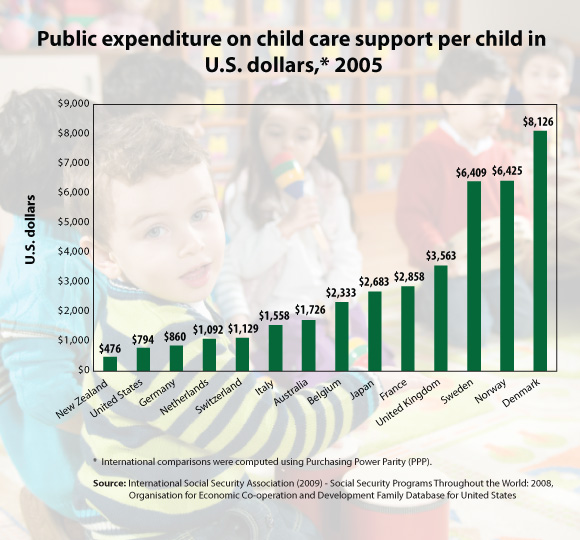
Child Care Funding Compared
A new figure from the Economic Policy Institute compares per-child public spending on child care among 14 advanced nations. The United States ranks second-to-last, trailing every country save New Zealand.
 Email Sign-Up
 RSS Feed