

Around The Dial – Nov. 15
Economic policy reports, blog postings, and media stories of interest:
- Naked Capitalism disagrees with Robert Shiller’s latest column.
- The New York Times looks at the mortgage interest deduction.
- The Charlotte Observer considers the future of middle-class jobs.
- Calculated Risk analyzes labor force participation trends.
- Felix Salmon explains the flaws with the Times’ budget calculator.
How Monetary Policy Happens
Sadly, this video (via Felix Salmon) offers one of the more informative (if somewhat problematic) explanations of how the Federal Reserve works and the rationale behind the latest round of quantitative easing.
Picturing The National Debt
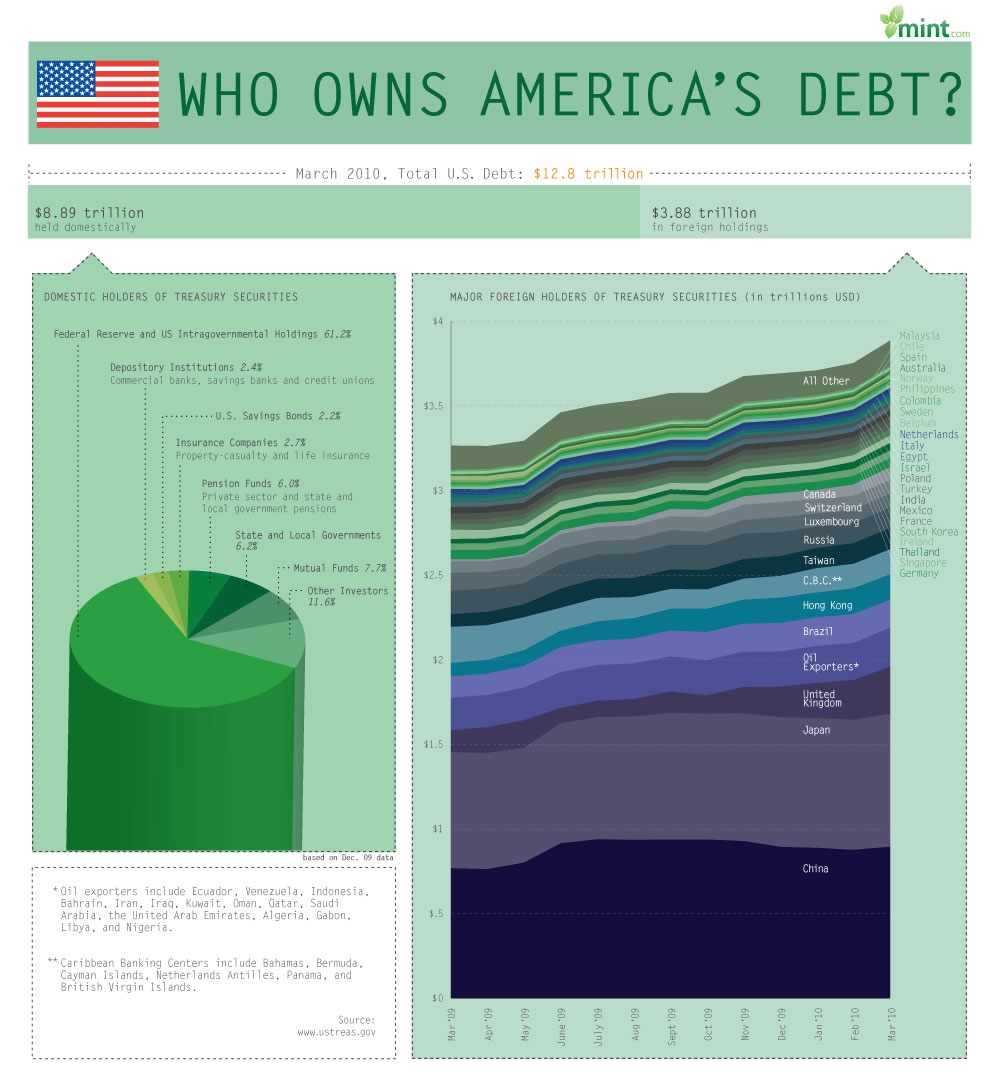
The Web site Mint.com has a nice graphic showing just who owns the United States’ $13 trillion in outstanding debt. As the graph shows, some two-thirds of the debt is owned by American sources, primarily the Federal Reserve. Among foreign creditors, Chinese and Japanese sources account for the two largest sources.
Around The Dial – Nov. 12
Economic policy reports, blog postings, and media stories of interest:
- Free Exchange graphs the deleveraging of household debt.
- Kevin Drum wonders if the deficit commission is serious.
- Felix Salmon wonders something similar.
- CBPP notes that the GOP budget plan will hit states hard.
The Benefits of Extending Unemployment Insurance
When Congress returns next week, it will consider whether or not to extend the recovery act provisions related to unemployment insurance set to expire at the end of the month. A new report from the Economic Policy Institute finds that extending those provisions would generate the equivalent of over 720,000 full-time jobs in a cost-effective manner. From the report …
Using a methodology described in Mishel and Shierholz (2010), we find that of the $104.7 billion increase in GDP related to continuing the unemployment extensions through 2011, some 37.4%, or $39.1 billion, will be recouped both in higher revenues, as more people and firms pay taxes, and in lower expenditures. Consequently, the effective cost to the budget of continuing the unemployment insurance extensions for a year is $25.9 billion instead of $65 billion. This means that the continuation of unemployment insurance extensions through 2011 will create 723,000 full-time-equivalent jobs at a cost of less than $36,000 per position. That alone is a good deal for all involved, but when we remember that these expenditures will at the same time be providing a lifeline to millions of families of the long-term unemployed during the worst downturn in seven decades, the case for continuing the extensions could not be clearer.
 Email Sign-Up
 RSS Feed