

A Midyear Review of NC’s Labor Market
During the first half of 2010, North Carolina’s job market essentially ran in place. Although jobs were not lost at the frantic pace of 2008-09, little progress was made. Conditions remained weak, and growth did not occur at the level needed to re-absorb displaced workers or accommodate new entrants to the labor force. And considerable evidence suggests that more difficulties are in store for the the second half of 2010.
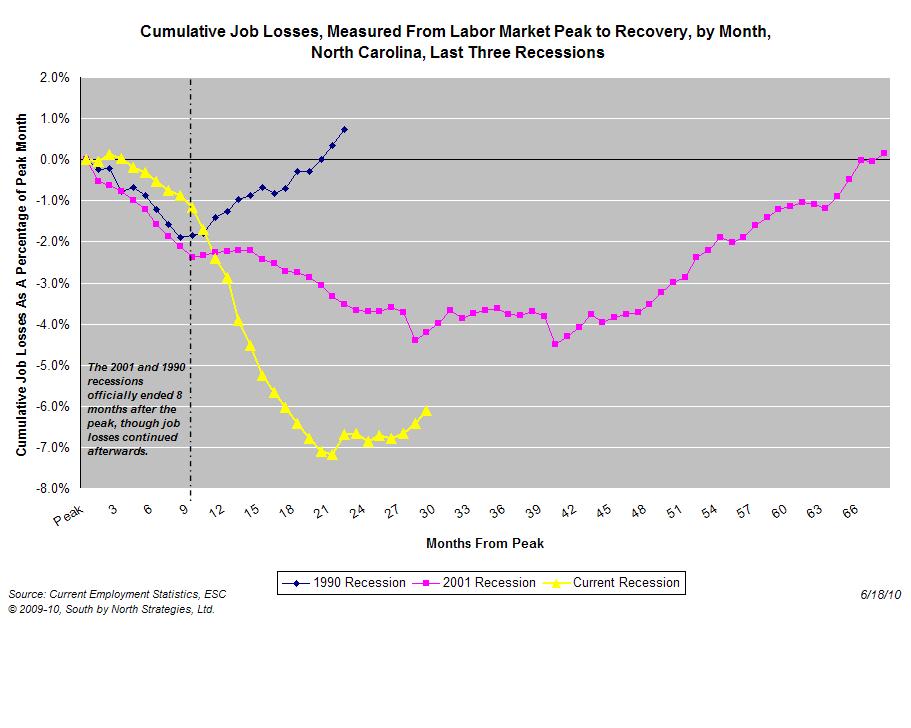 The figure (right) shows the job losses that occurred in North Carolina between December 2007 and May 2010, the most recent month with data. Over that period, North Carolina lost, on net, 254,000 positions or 6.1 percent of its payroll job base. Between September 2008 and April 2009, the state lost an average of 23,450 jobs per month. Losses slowed during the summer of 2009 before bottoming in September. Since then, the state has gained an average of 5,000 jobs per month.
Unfortunately, North Carolina needs to add some 5,500 positions per month to keep 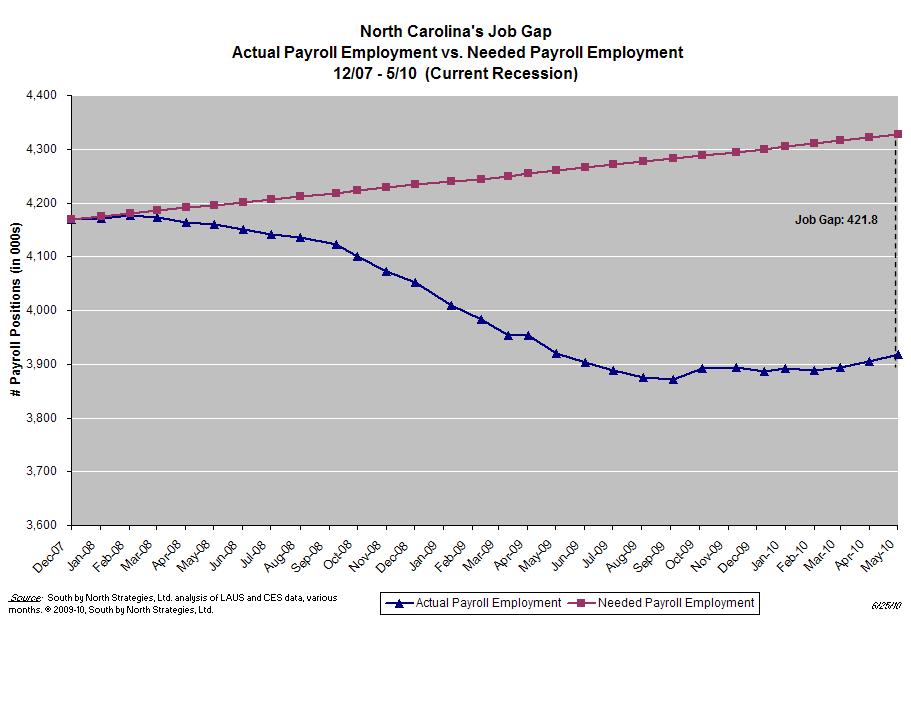 pace with workforce growth. If one considers the jobs that should have been created during the recession but were not, the actual gap facing the state is 422,000 positions (Figure, left).
While the job growth posted in 2010 is welcome, it is insufficient. The state has netted 31,300 jobs, but only 14,100 of those jobs are private-sector ones. As the figure (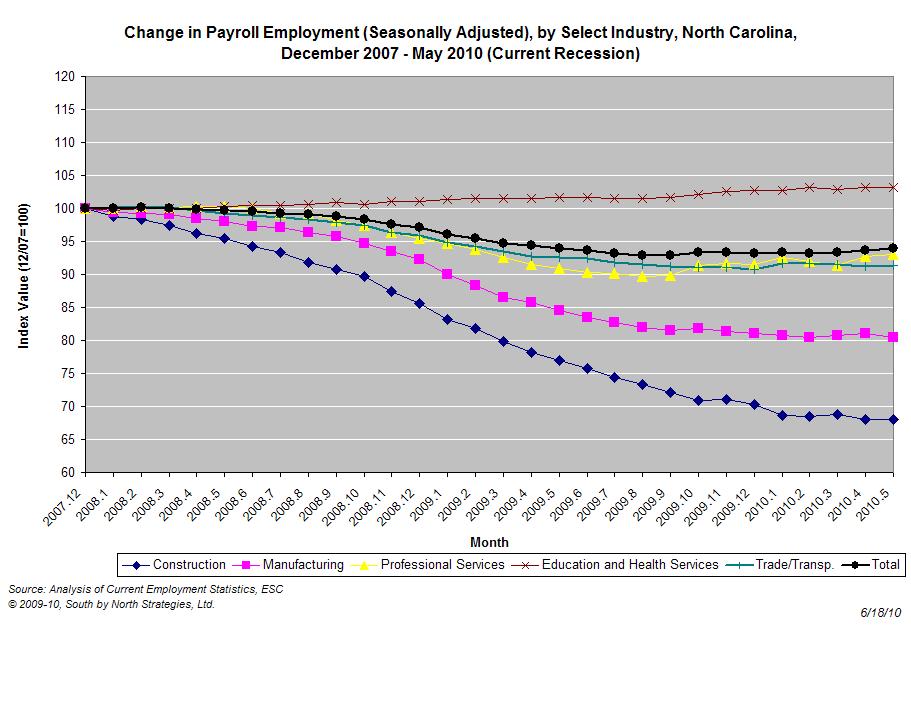 below) shows, selected private industries have posted little growth.
Meanwhile, many of the public-sector jobs that the state gained were temporary ones, primarily positions related to the 2010 Census. These jobs now are ending. In fact, the Census Bureau’s Charlotte region (NC, KY, TN, and VA) eliminated 27,748 jobs between the weeks of May 12th and June 12th.
Around The Dial – June 29
Economic policy reports, blog postings, and media stories of interest:
- Naked Capitalism debunks the idea of “twin deficits.”
- Paul Krugman worries about “the third depression.”
- Noah Feldman inquires into a liberal jurisprudence of economic justice.
- Research Desk closes the Social Security shortfall.
- Brad DeLong warns against “listening to arsonists.”
Unemployment Insurance & North Carolina
Congress’ inability to extend the various emergency unemployment insurance provisions contained in the recovery act is harmful to North Carolina’s unemployed workers and its overall economy. For, as the N.C. Budget & Tax Center has reported, unemployment insurance replaces part of the income lost by jobless workers and helps stabilize the larger economy.
In response to the current recession, the federal recovery act contained numerous provisions related to unemployment insurance. For individuals, the program created an Emergency Unemployment Compensation (EUC) program that allows individuals to receive up to 99 weeks of benefits. Additionally, the Federal Additional Compensation (FAC) program adds $25 to each weekly unemployment insurance check. And individuals may shield a portion of their benefits from federal income taxes.
State systems, meanwhile, received access to interest-free loans from the federal government, and the federal government also agreed to pay temporarily the states’ share of the Extended Benefits (EB) program. A series of incentive payments also provided states with supplemental funds provided they enacted certain reforms.
The expiration of certain recovery act provisions — primarily the EUC and FAC programs — will harm unemployed North Carolinians and slow the state’s recovery. Consider the following:
- The Employment Security Commission estimates that 21,000 people per week are losing EUC benefits.
- Without FAC benefits, the average weekly benefit will fall from $327 to $302, an eight-percent decline.
- In March, FAC alone supported an estimated $50 million in statewide economic activity.
- In May, EUC payments of $234 million supported some $383 million in statewide economic activity.
- Ending federal EB funding will impose more costs one the state’s insurance fund; in May, federal support saved the fund some $11 million.
Financial Reform: Summaries & Reactions
The financial reform bill agreed to by a congressional conference committee last week is a significant piece of legislation designed to address some of the issues that helped to bring about the current recession. However, the legislation contains many compromises, and it is unclear whether or not it will address core problems.
For a summary of key provisions, see this useful rundown from The Washington Post.
Reactions to the legislation have been mixed.
Writes Marshall Auerback:
The whole approach to financial reform has failed to deal with the core problems with gave rise to the crisis in the first place. Credit default swaps, collaterised debt obligations, etc., need to be understood as key components of an integrated system, the so-called “shadow banking system”, which was at the epicenter of the crisis. More broadly speaking, the shadow banking system needs to be understood as a key component of the larger capital market-based credit system that has, in the last three decades, risen to supply the majority of our credit, largely replacing the traditional bank-based credit system.
Argues Naked Capitalism:
The only two measures I see as genuine accomplishments, the Audit the Fed provisions, and the creation of a consumer financial product bureau, do not address systemic risks. And the consumer protection authority was substantially watered down. Recall a crucial provision, that banks be required to offer plain vanilla variants of products, was axed early on. In addition, the agency, initially envisioned as independent, will now be housed in the Fed, which has never taken any interest in consumers (witness its failure to enforce the Home Owners Equity Protection Act, a rule which would have limited subprime lending) and has a long standing hands-off posture towards its charges.
Concludes Dean Baker of the Center for Economic and Policy Research:
“The creation of resolution authority for large non-bank financial institutions is also a positive step, although the fact that no pre-funding mechanism was put in place is a serious problem. Also, the audit of the Federal Reserve’s special lending facilities, as well as the ongoing audits of its open market operations and discount window loans, is a big step towards increased Fed openness.
…
“On the negative side, there is little in this legislation that will fundamentally change the way that Wall Street does business. The rules on derivative trading will still allow the bulk of derivatives to be traded directly out of banks rather than separately capitalized divisions of the holding company. The Volcker rule was substantially weakened by a provision that will still allow banks to risk substantial sums in proprietary trading.
Around The Dial – June 28
Economic policy reports, blog postings, and media stories of interest:
- Naked Capitalism advises to be careful what you wish for.
- Calculated Risk previews the June national employment report.
- Free Exchange asks, how was your recession?
- The Charlotte Observer reports on long-term unemployment.
 Email Sign-Up
 RSS Feed