National Job Losses Moderate
CHAPEL HILL (December 4, 2009) – New national employment data show that November was the 22nd-straight month in which the economy shed more jobs than it added. Last month, 11,000 positions were lost, and 10 percent of the labor force was unemployed.
“The job market paused to catch its breath in November, and job losses were mild by the standards of this recession,” says John Quinterno, a principal at South by North Strategies, Ltd., a research firm specializing in economic and social policy. “Unfortunately, the overall employment situation remains bleak.”
In November, the nation’s employers eliminated 11,000 more payroll positions than they added. Also, revisions to the September and October data revealed that the economy lost fewer positions than first reported.
November job losses were concentrated in the manufacturing (-41,000); construction (-27,000); and information (-17,000) industries. These losses primarily were offset by gains in the professional and business services (+86,000) and health care (+21,000) fields. Much of the increase in professional services employment was driven by hiring in the temporary help services sub-industry (+52,000).
“Although the pace of jobs losses has moderated recently, the labor market remains incredibly weak,” notes Quinterno. “Since the recession started almost two years ago, the American economy has jettisoned 7.2 million jobs – an amount equal to 5.2 percent of all the positions that existed in December 2007.”
That decline is reflected in the household data released this morning. In November, 15.4 million Americans – 10 percent of the labor force – were jobless and actively seeking work. Proportionally more adult male workers were unemployed than female ones (10.5 percent versus 7.9 percent). Similarly, unemployment rates were higher among Black (15.6 percent) and Hispanic workers (12.7 percent) than among White ones (9.3 percent). Additionally, employment participation levels were the lowest ones recorded since the mid-1980s.
“Jobless workers are finding it incredibly difficult to find new positions,” adds Quinterno. “Last month, 38 percent of all unemployed workers had been out of work for at least six months, and the average spell of unemployment was 28.5 weeks. Because the number of job seekers far exceeds the number of job openings, many more individuals simply have given up on finding work. Counting those individuals would bring the underemployment rate to 17.2 percent.”
Today’s national data suggest that another weak employment report is in store for North Carolina. Since the recession’s start, North Carolina employers have eliminated, on net, 238,100 positions, and the statewide unemployment rate has climbed to 11 percent.
“In recent months, job losses and unemployment have abated and seem to have settled at extremely high levels,” observes Quinterno. “At the same time, little points to an imminent reversal. Consumer demand remains week, the housing market is dragging on growth, and the non-residential real estate bubble is deflating. Even more alarmingly, the federal recovery package probably has achieved its maximum effect, and elements of the package like extended unemployment insurance soon will start to phase out.”
“Based on current trends, it appears that high levels of joblessness will remain the norm into the future,” cautions Quinterno. “In fact, a growing number of studies suggest that unemployment rates will linger around the 10 percent mark through 2011, absent additional federal action.”
North Carolina’s Creative Economy
A recent analysis commissioned by the N.C. Department of Cultural Resources found that the state’s creative industries ( arts, information/ entertainment/new media, and design) contribute some $19.5 billion to state’s economy — an amount equal to five percent of North Carolina’s gross domestic product.
Additionally, the study, which was prepared by the policy research division of the N.C. Department of Commerce, discovered that some 100 creative industries accounted for some 293,000 jobs and was responsible for over $10 billion in compensation (4.9 percent of the state’s total).
Around the Dial – Dec. 3
Economic policy reports, blog postings, and media stories of interest:
- The Durham Herald Sun asks what the jobs summit means for NC.
- Reuters shares Goldman Sachs 2011 unemployment forecast: 10.75%.
- Econbrowser documents the anemic recovery.
- At CBS MoneyWatch, Mark Thoma asks what types of employment policies are needed.
- The American Prospect’s Harold Meyerson is “fed up with federalism.”
- The Baseline Scenario defends the Protestant work ethic.
Unemployment in NC: Week of 11/14
For the benefit week ending on November 14th, 22,741 North Carolinians filed initial claims for unemployment insurance, and 187,322 individuals applied for continuing insurance benefits. Compared to the prior week, there were many more initial and continuing claims. These figures come from data released today by the U.S. Department of Labor.
Averaging new and continuing claims over a four-week period — a process that helps adjust for seasonal fluctuations and better illustrates trends — shows that an average of 18,973 initial claims were filed over the last four weeks, along with an average of 181,445 continuing claims. Compared to the previous four-week period, both initial and continuing claims were much higher.
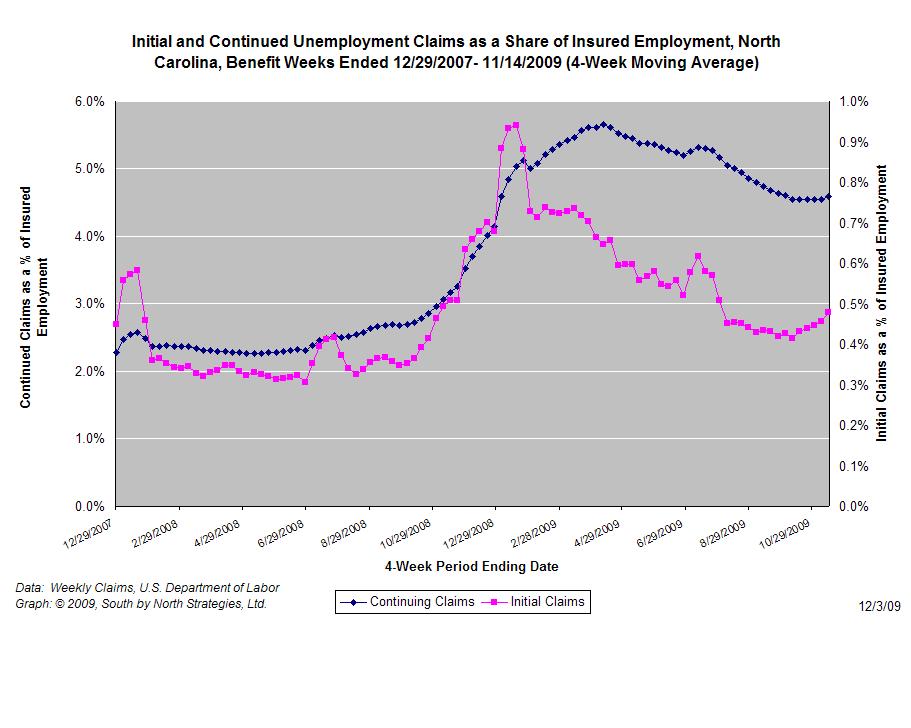
One year ago, the four-week average for initial claims stood at 20,448 and the four-week average of continuing claims equaled 127,062.
The graph shows the changes in unemployment insurance claims (as a share of covered employment) in North Carolina since the recession’s start in December 2007.
Although new and continuing claims appear to have peaked for this cycle, the claims levels remain elevated and point to a labor market that remains extremely weak.
Hopes for the Jobs Summit
An article in today’s issue of The Durham (N.C.) Herald-Sun featured the perspective of South by North Strategies’ John Quinterno the significance of the Obama administration’s “Forum on Jobs and Economic Growth.” Said Quinterno:
John Quinterno, a policy analyst in Chapel Hill, said he believes the federal government should reinforce economic safety nets by extending unemployment benefits passed in the $787 billion stimulus package and provide additional relief to states struggling with their own dwindling funds.
…
“The economy is a lot weaker than people envisioned and that’s one of the reasons unemployment remains at a high level. And the sources of demand in the economy, from what we’ve seen in the past in the third quarter, has been demand that’s come from government spending,” Quinterno said.
…
“When that starts to fade out, the question is — Do we have any other sources of demand to take its place?” he added.
 Email Sign-Up
 RSS Feed